For months, Dorothy Gale has been more ghost than girl in the world of Wicked: For Good. The film hides her in silhouettes, frames her from behind, and cuts away whenever audiences might finally get a clear look. Now, thanks to a quiet but emotional Instagram post from British actress Bethany Weaver, we finally have our first proper look at the woman who walked the yellow brick road in secret.
Weaver, a 30-year-old actress and pilates teacher with no blockbuster credits to her name, was revealed as the film’s Dorothy only shortly before release. 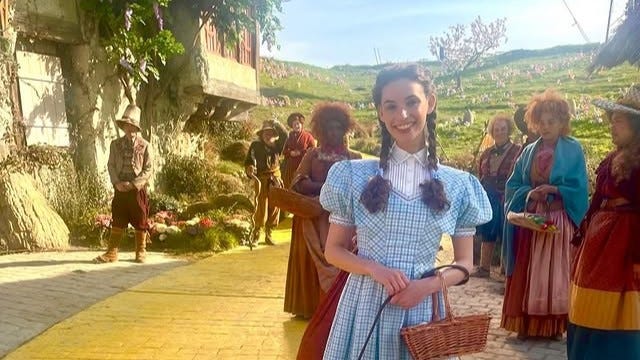
Yet even then, the production kept her firmly on the margins: no red carpets, no talk show rounds, no glossy magazine spreads. On screen, Dorothy’s big moment – the infamous dousing of Elphaba with a bucket of water – is again staged almost entirely in shadow, mirroring the original musical’s choice to make her more symbol than character.
In her new behind-the-scenes photos, Weaver finally steps into the light. The images show her in full gingham dress and braids, standing on intricately detailed sets that reimagine Oz with a mix of storybook color and moody, almost gothic scale. It is the first time many fans have seen her face in character, despite the film having already dominated discussion for weeks.
Living in the shadows of Judy Garland – on purpose
The decision to hide Dorothy was not a last-minute accident in the edit. Director Jon M. Chu has been open about treating Dorothy almost like a cameo from a legendary figure who belongs to another story. His focus in Wicked: For Good is firmly on Elphaba and Glinda; Dorothy is a disruptive presence whose arrival signals the end of their era. Giving her a big, traditionally framed hero entrance risked shifting attention away from the witches and toward a character whose emotional arc is being told in an entirely different film: The Wizard of Oz.
There is also the question of legacy. Judy Garland’s 1939 performance is one of the most iconic in cinema history, and any new Dorothy has to live with that shadow. Rather than inviting direct comparison, Chu chose to keep Dorothy’s face obscured, allowing Garland’s interpretation to remain the definitive screen version while still acknowledging the event that breaks the story of Wicked apart. In that context, Weaver’s job was never to outshine Garland, but to quietly carry forward the silhouette of a character everyone already knows.
A life-changing role you barely see
In her caption, Weaver describes the experience as life changing and humbling. She thanks co-stars like Jonathan Bailey and Ethan Slater, and even gives a shout-out to Oscar, the dog who plays Toto, calling them her fellow “Witch Hunters” as they marched along the yellow brick road together. She praises Chu as one of the great filmmakers of our time and talks about the responsibility of stepping into shoes worn by generations of performers before her.
What makes her words particularly striking is the contrast between the scale of the production and the size of her visible role. For most viewers, Weaver appears as a small figure in wide shots, a flash of blue and white racing down a corridor, or the silhouette lifting a bucket that changes Oz forever. No tearful close-up, no lingering reaction shot. Yet for Weaver, this is still a huge leap: being catapulted from teaching pilates to working on a massive studio musical with an A-list ensemble is the kind of surreal career twist many actors can only dream of.
One of the images she shares includes a video monitor seemingly showing a shot where her face is fully visible during a scene. That has sparked speculation among fans: was a more traditional Dorothy moment filmed and later cut, or was it always intended as coverage that would never make the final edit? The movie itself keeps that mystery intact, but the photos are a reminder that even minor characters are shot from every angle before the final version is carved down in the edit suite.
The price of keeping Dorothy anonymous
The secrecy around Weaver was not limited to the film. Reports have claimed that she was discouraged from attending major premieres and that other cast and crew were asked not to follow or interact with her on social media to avoid drawing attention to her identity. On one level, it is a fascinating example of how far a studio will go to preserve a specific creative choice. On another, it feels surprisingly harsh: a newcomer finally lands a huge role, only to be told that her best work will remain in the shadows while everyone else enjoys the spotlight.
Fans have been divided over that decision. Some respect the commitment to the bit, arguing that the anonymity makes Dorothy feel more like a myth breaking into Elphaba and Glinda’s world. Others see it as a needless overcorrection that denies an emerging actress the chance to enjoy the usual joys of a breakout role. When the marketing machine and spoiler-hungry coverage already made Dorothy’s inclusion a talking point before many had seen the film, the extreme secrecy around Weaver herself can feel, to some, less like artful mystery and more like a stunt that overshot the mark.
Age, likeness, and the endless Judy comparisons
Once the photos surfaced, the discourse did what it always does. Some viewers were quick to point out that Weaver looks older than the Kansas farm girl immortalized by Garland, while others simply said she looks charming and perfectly suited for a character mostly seen in long shots and from behind. A portion of the fandom is relieved that the film does not attempt a one-to-one Garland impersonation, whether through casting a lookalike or using digital trickery to paste a de-aged face onto a new performer.
There were even calls from some corners for an entirely different approach: casting a woman of color as Dorothy to push the Oz mythology in a more modern direction. Those arguments underline the tightrope Wicked: For Good walks between reverence for the classic and the desire to reshape the story for new generations. For now, Chu’s take leans heavily into continuity with the original Wizard of Oz, keeping Dorothy recognizably close to the archetype while refusing to put her front and center.
A divisive film with a powerful pull
Whatever audiences think about Dorothy’s treatment, it clearly has not hurt the film at the box office. The second half of Wicked’s two-part saga landed with the force of a Kansas house crashing into Munchkinland, pulling in more than 226 million dollars worldwide and securing one of the year’s biggest opening weekends. In a season where many big-budget releases have struggled just to break even, that kind of debut stands out.
Critically, though, reactions have been mixed. Reviews praise the opulent sets, sweeping musical numbers, and the chemistry between the leads, while also noting that the film carries over some of the first installment’s pacing issues and tonal unevenness. One prominent review settled on a middling score, describing Wicked: For Good as both dazzling and frustrating: a spectacularly mounted stage-to-screen translation that never fully escapes the limitations of its structure. Among moviegoers, opinions range from “terrible in every way” to “finally, a big musical that feels like an event again,” which is exactly the kind of noisy conversation studios quietly hope for.
Dorothy as a symbol, not a star
In the end, Bethany Weaver’s Dorothy may never be the definitive screen incarnation of the character, and that is precisely the point. This film was never meant to be her story. Instead, she is the catalyst, the shadow at the edge of the frame whose arrival collapses the fragile world Elphaba and Glinda have built. By hiding her face, Wicked: For Good asks audiences to feel the weight of Dorothy as an idea: the naive outsider whose very presence rewrites history.
Weaver’s behind-the-scenes reveal gives that idea a human face at last. It lets viewers connect the silhouette on screen to a real performer who trained, rehearsed, and stood under hot lights on elaborate sets, even if most of that work was destined to be glimpsed only in passing. For her, the role is already a milestone; for fans, the photos are a reminder that even in a world of witches and wizards, sometimes the most intriguing character is the one the camera refuses to fully show.
3 comments
I get why they focused on Elphaba and Glinda, but man, the whole secret Dorothy thing feels overcooked when every outlet was yelling about it day one anyway
She doesn’t look like Judy at all and I’m actually relieved. We really didn’t need a bargain-bin Garland cosplay or some weird CG face job
Still salty about the spoilers btw – some sites straight up blasted DOROTHY IS IN IT on the front page before I even bought my ticket 😒