NVIDIA’s boss Jensen Huang has practically become a regular in Taiwan’s airports this year. His fifth trip this year, timed around the US Thanksgiving holiday, isn’t about sightseeing or bubble tea; it’s a visible reminder of where the real power in the AI boom sits. 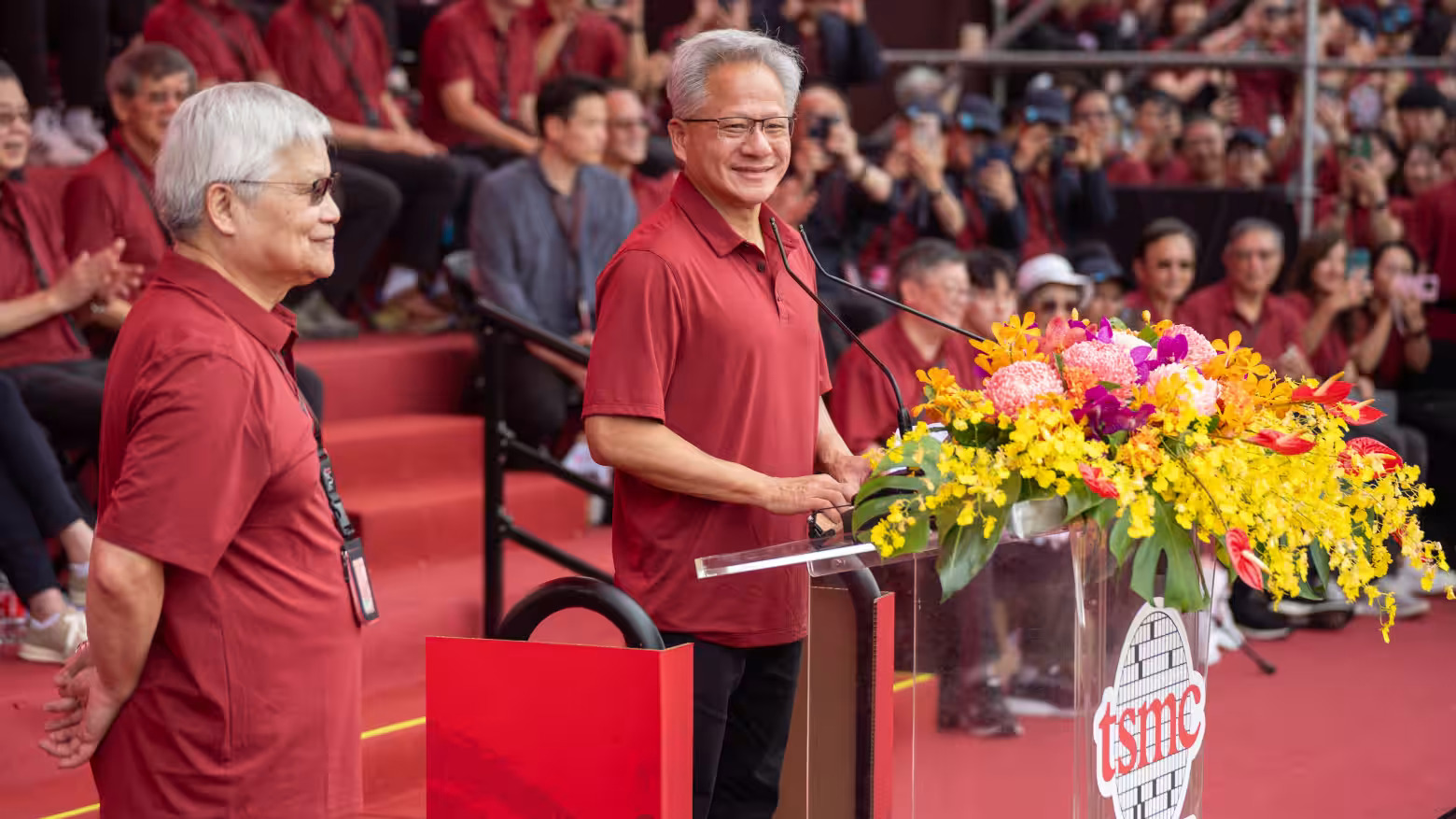
Taiwan is home not just to TSMC, the only foundry capable of producing NVIDIA’s most advanced GPUs at scale, but also to manufacturing giants such as Foxconn, Quanta and Wistron that assemble servers, networking gear and entire racks of AI infrastructure. When Huang flies in, he is essentially visiting the beating heart of his company’s supply chain and the front line of a global capacity squeeze.
Why Jensen Huang keeps flying to Taiwan
As local media reported, Huang’s latest visit combined hard-nosed negotiations with a softer diplomatic touch. Behind closed doors, he is believed to have discussed long-term allocation of TSMC’s leading-edge process nodes and advanced packaging lines, which are heavily overbooked by every major AI player on the planet. At the same time he made time to check in on the health of TSMC founder Morris Chang, a symbolic gesture that underlines how closely NVIDIA’s fortunes are tied to the Taiwanese semiconductor ecosystem. When production slots are worth billions in future data-center revenue, maintaining those personal relationships becomes part of core business strategy.
The new bottleneck: packaging, memory and power
Asked about the current state of AI demand, Huang has been blunt: the bottleneck is no longer just GPU silicon. High-bandwidth memory, advanced packaging technologies such as 2.5D and 3D stacking, server-grade power supplies, high-speed cabling and even basic components in AI racks are all in short supply. That scarcity is why NVIDIA is fighting so hard for a bigger slice of TSMC’s capacity. If it cannot secure enough of the most advanced nodes and packaging lines for generations like Vera Rubin and other upcoming AI GPUs, those orders will be snapped up by rivals or by hyperscalers building their own custom accelerators.
Fighting rivals for every wafer
Because there is no slack in the system, every wafer and CoWoS substrate that goes to NVIDIA is one that cannot go to AMD, Intel or to an in-house ASIC designed by a cloud giant. Some industry watchers already point out that Intel supply wins will quietly continue simply because Intel still controls its own fabs and can offer something when H100-class GPUs are sold out. For enterprise buyers, the choice often becomes brutally simple: wait months for top-tier NVIDIA hardware, or accept second-best silicon that actually ships. Either way, Huang knows that any failure to secure capacity in Taiwan risks leaving a door open for competitors.
ASICs, AI bubble fears and NVIDIA’s platform moat
The debate around whether AI-specific ASICs will eventually eat into NVIDIA’s dominance has grown louder alongside talk of an AI bubble that could burst if spending cools. Huang’s answer is that NVIDIA is not merely selling chips; it is selling a complete platform: GPUs, interconnects, networking, power and, crucially, a software stack that developers already know how to use. That combination, he argues, provides a moat that a single, narrowly targeted accelerator cannot easily cross. Even if some speculative AI projects fade, the underlying demand for accelerated computing in cloud, enterprise and scientific workloads looks more like a long-term structural shift than a passing fad.
Taiwan, Arizona and the fab question
In that context, Taiwan becomes the irreplaceable hub holding the whole strategy together. TSMC’s domestic ecosystem – from chip production to PCB makers and server integrators – is finely tuned to what Team Green needs and can react quickly when product roadmaps change. Some observers like to ask why NVIDIA does not simply fund an extra fab of its own, or rely on TSMC’s new site in Arizona to solve the shortage. The reality is that leading-edge fabs cost tens of billions of dollars and take many years to ramp, while the Arizona facility will be constrained and busy with other customers for a long time. For the foreseeable future, the most advanced, highest-volume AI production will still be negotiated in meeting rooms in Hsinchu, not in the American desert.
Rubin, Vera Rubin and the need to keep pushing
At the same time, NVIDIA cannot assume that capacity alone will defend its position. Its data-center roadmap, including Rubin-generation parts such as the Vera Rubin AI GPU family, is being built for a market where competition is fiercer than at any point in the last decade. Every cycle, customers expect huge jumps in performance-per-watt and in total system throughput. That is why Huang’s trips to Taiwan are paired with an internal continuous innovation drumbeat: new architectures, faster interconnects, better power delivery, denser memory and ever-more-efficient software that squeezes extra utilization out of each rack.
Future shock in the AI supply chain
For investors and engineers alike, it can feel like a kind of future shock. Stock prices swing violently on every rumor of a new GPU or a shift in AI spending, while factories run flat-out just to keep up with today’s backlog. Underneath the memes and trading screenshots of six-figure gains and losses, however, the signal is clear: AI infrastructure has become one of the most strategic assets in the global economy. Whoever commands the deepest partnerships with foundries like TSMC and the strongest grip on the supply chain stands to shape not just the next product cycle, but the direction of computing for years.
Seen through that lens, Huang’s frequent landings in Taipei are not unusual at all. They are the visible tip of an intense, behind-the-scenes battle over scarce, high-value manufacturing resources. As long as the world’s smartest algorithms depend on wafers etched in Taiwanese clean rooms, NVIDIA’s CEO will keep treating the island like a second headquarters – and every meeting with TSMC’s leadership as a decisive move in the high-stakes game for AI supremacy.