Where Winds Meet is one of those rare games that instantly tells you what it wants to be the moment you see it in motion. Swordsmen sprinting across water, drifting through bamboo forests on the wind, trading impossibly fast parries under a blood red sunset – it is a love letter to classic wuxia cinema wrapped in a modern open world action RPG. Developed by Everstone Studio, a team formed under NetEase specifically for this project and based in Hangzhou, the game has quietly evolved from a striking Gamescom 2022 reveal into a full scale cross platform release with global ambitions and a long term live service roadmap.
The title itself is a mission statement. 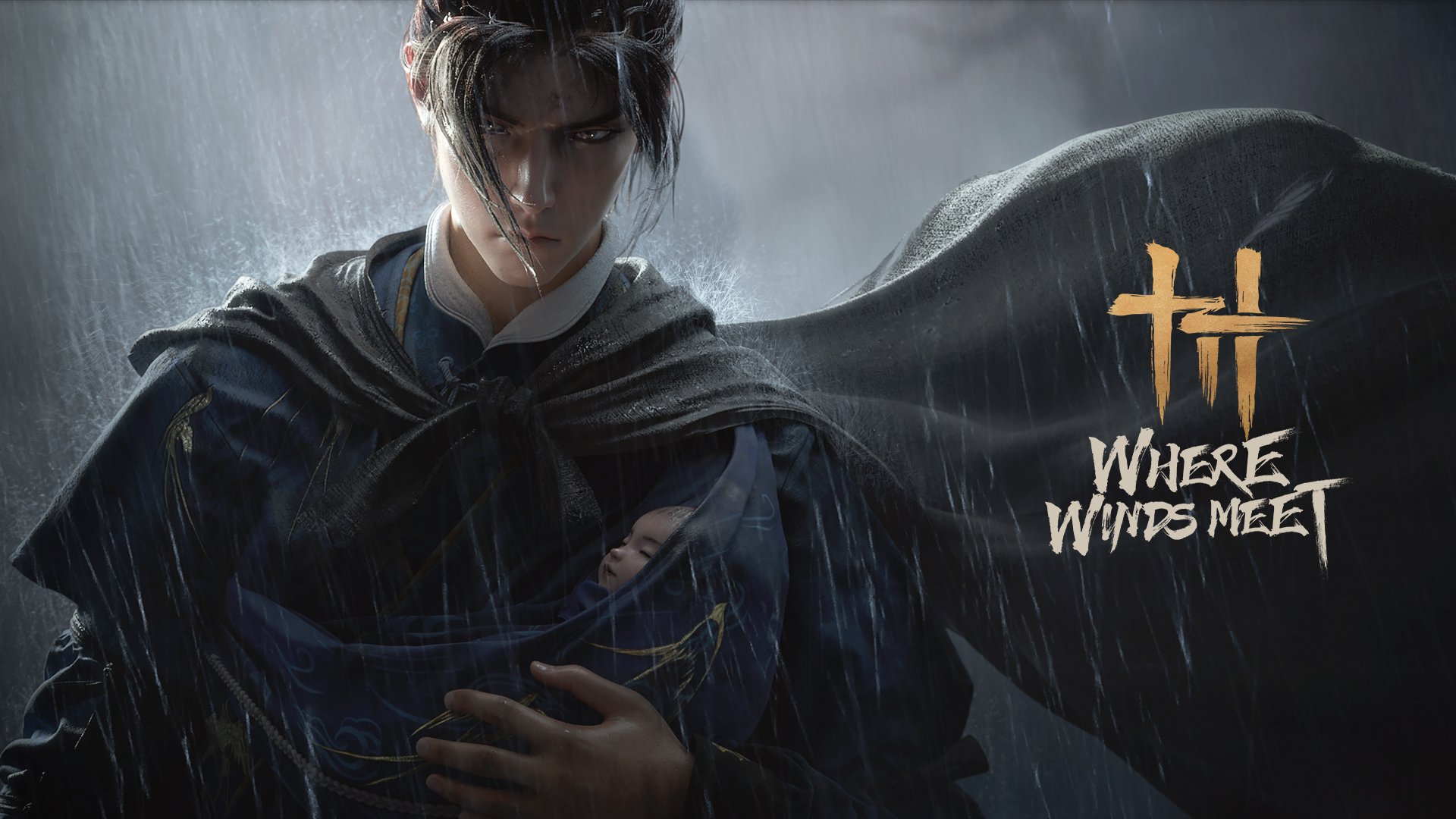
The developers explained that they chose the image of wind as a symbol of freedom, change, and wandering spirits. Where multiple winds converge, different paths and ideas collide. That concept feeds directly into the design of the game: it is about meetings and clashes between swordsmen, kingdoms, philosophies, and players. Exploration and freedom, civilization and harmony, and the messy in between space called Jianghu – the martial underworld of Chinese folklore – sit at the heart of the experience. Where Winds Meet is built to let you find your own path in that world rather than marching along a single prescribed story corridor.
Release timeline, platforms, and how you can play
Everstone Studio did not rush Where Winds Meet to market. After the Gamescom 2022 announcement, the team spent years iterating on core systems and testing them with players. The first closed beta test arrived in April 2024 on PC, giving early adopters a substantial slice of the world to explore and providing the developers with the data they needed to tune combat, progression, and online systems. Roughly a month later, NetEase confirmed that the project would no longer be PC only and that a PlayStation 5 version was in development alongside the already announced computer release.
The rollout since then has been deliberately staggered. The game first launched in China in December 2024, effectively acting as a large scale regional test bed before global servers went live. Two more testing rounds followed in May and July of 2025, this time focusing on international players and the infrastructure needed to support them. The full worldwide release landed on November 14, 2025, with the game available on PC via Steam and the Epic Games Store and on PlayStation 5 as a timed console exclusive. A mobile version is also on the way, scheduled to arrive on December 12, 2025, extending the Jianghu fantasy to phones and tablets.
Crucially, Where Winds Meet launches as a free to play title that supports cross progression between platforms. You can start your wandering swordsman on PC, continue the journey on PS5 in the living room, and later check in from mobile without losing progress. That flexibility reflects the central theme of wind and wandering – your character is no longer tied to a single device in the same way they are not tied to a single faction.
Free to play without pay to win
The decision to use a free to play business model often raises alarms for players who fear that the most powerful builds will be locked behind a credit card. Everstone and NetEase have repeatedly stressed that this is not the case here. Monetization in Where Winds Meet revolves around cosmetics, seasonal battle pass style tracks, and gacha like systems for visual items. That means outfits, weapon skins, emotes, mounts, housing decorations, and other ways to customize how your hero looks and how your personal space is dressed, rather than paid stat sticks that dominate competitive play.
The developers insist that there are no pay to win stat advantages attached to paid content. Progression in sect techniques, Inner Power cultivation, and overall character strength is designed to be earned through play, exploration, and mastery. For players wary of aggressive monetization, the promise is straightforward: spending money should change how your hero presents themselves to the world, not whether they have a chance to survive in it. How this model feels in the long term will depend on the cadence and generosity of events and rewards, but on paper it is a player friendly approach.
Between prestige action adventure and systemic wuxia sandbox
Genre labels rarely tell the full story, but they do help set expectations. Everstone describes Where Winds Meet as an open world wuxia ARPG that blends a strong narrative spine with social and multiplayer layers. Visually and tonally it sits in a space similar to Ghost of Tsushima with its cinematic duels and windswept landscapes, yet under the surface it leans harder into systemic design, player choice, and long term progression.
Wuxia is the binding glue here. The game embraces gravity defying martial arts, chivalric codes, righteous avengers, and tangled sect politics rather than aiming for strict historical simulation. Romanticized Jianghu folklore shapes not only combat animations but also quest design, faction systems, and the way the world responds to your actions. You are not just a hero in a static story; you are a drifting presence whose allegiances and reputation can reshape how that story unfolds.
A chaotic historical backdrop: Five Dynasties and Ten Kingdoms
The narrative unfolds during the Five Dynasties and Ten Kingdoms period, a turbulent slice of tenth century Chinese history wedged between the mighty Tang and Song dynasties. It is a time defined by short lived regimes, shifting borders, and near constant warfare. That chaos gives the writers plenty of room to weave fictional kingdoms and sect conflicts into a backdrop of genuine political instability.
Major cities like Kaifeng function as dense political and economic hubs in the game, full of officials, merchants, spies, and rival agents crammed into narrow streets and palace courtyards. Venture beyond the city walls and the tone changes. Borderlands bristle with fortresses and war camps. Misty bamboo forests hide bandits and reclusive masters. Harsh deserts and icy mountain passes mark the edges of imperial influence. Monasteries cling to cliffs, literally and figuratively standing apart from worldly struggles. Everywhere you go, the tension between imperial authority and the independent codes of the martial underworld is visible in the people you meet and the choices you make.
At the center of it all is your character, a nameless swordsman or swordswoman with a hidden past. Rather than locking you into a heavily scripted origin, the game draws you into conspiracies involving rival kingdoms, ancient martial sects, and relics that carry a hint of the supernatural without fully tipping into high fantasy. Themes of identity, loyalty, and the cost of freedom run throughout. Choosing who to protect, who to betray, and when to simply walk away can radically change who stands with you in later chapters.
Sects, philosophies, and the shape of your hero
Sects are the backbone of Jianghu in Where Winds Meet. Early on you are given a choice to align with one of eleven martial sects or remain unaffiliated and pick up skills through more flexible, morally grey methods. Each group comes with its own philosophy, internal rules, signature martial arts, and often a strong visual identity that influences costumes, weapon designs, and even the architecture of their headquarters.
- Well of Heaven is a lofty, almost ascetic order that pursues enlightenment through precise sword forms and strict discipline.
- Silver Needle specializes in subtlety, poisons, and pinpoint strikes that exploit enemy weaknesses rather than brute force.
- Midnight Blades thrives in the shadows, favoring dual weapons, ambush tactics, and hit and run skirmishes.
- Nine Mortal Ways studies harsh truths about mortality, turning pain and risk into explosive offensive power.
- Velvet Shade blends charm and deception, using fluid movements, fans, and veils to misdirect and control.
- Raging Tides channels raw momentum with heavy weapons and flowing, wave like combos that smash through lines.
- The Masked Troupe blurs the line between performance and violence, mixing theater, illusions, and unpredictable attacks.
- Lone Cloud prizes independence, framing its techniques around mobility, single target duels, and wind themed footwork.
- Hollow Vale leans into eerie, almost ghostly techniques and battlefield control abilities.
- Inkbound Order builds its strength on knowledge and written martial manuals, turning calligraphy and calculation into power.
- Mohist Hill draws inspiration from Mohist philosophy, emphasizing engineering, defensive tools, and utilitarian justice.
You can fully commit to one of these doctrines, gradually learning its core techniques and advanced forms, or you can remain sectless and essentially steal specific martial skills from different schools without formally joining. The latter route lets you assemble a highly customized move set at the cost of missing out on sect specific storylines, gear, and social advantages. Joining, infiltrating, and betraying sects is an important pillar of roleplaying, and it feeds directly into the game’s broader reputation systems.
Branching story, Lost Chapters, and Jianghu reputation
Where Winds Meet does not treat its plot as a straight corridor. Yes, there is a main story arc that pulls you through major kingdoms, sect headquarters, and key battles, but around it sits a web of branching dialogue, optional story detours, and faction questlines. The developers refer to some of these as Lost Chapter storylines, side tales that feel substantial rather than disposable filler.
These Lost Chapters can reframe key conflicts or give you information that completely changes how you view an NPC or faction. Completing them might introduce new allies during later climactic missions or open entirely alternate ways to resolve confrontations that would otherwise end in bloodshed. In parallel, sect and regional quest chains allow you to nudge the balance of power in specific areas, turning one town into a haven for a particular sect or provoking open turf wars.
Underpinning this is a Jianghu reputation system that quietly tracks how different groups and regions perceive you. Routinely side with a particular sect and its members may greet you warmly, offer rare manuals, or invite you into inner circle councils. Sabotage them repeatedly and you might be barred from their territory or hunted by elite assassins. Fame can unlock ornate outfits and unique story beats while infamy can close doors or open darker paths. The result is a world that reacts, even if not every reaction is immediately obvious.
Combat: wuxia spectacle with tactical teeth
The core combat loop in Where Winds Meet tries to balance commitment and spectacle. From the Soulslike side of the family it borrows ideas like locking on to specific targets, managing a stamina like resource, and relying on careful timing to survive. From character action games it inherits air combos, dramatic launchers, slow motion finishers, and an overall emphasis on looking and feeling stylish.
A universal guard and parry system sits at the heart of this. Most incoming strikes can be blocked or deflected if you time your inputs correctly. Success does not only keep you alive; it also builds stagger on your opponent and gradually opens windows to counter. Once that stagger meter breaks, the game encourages you to send enemies skyward with launch attacks, follow them with mid air dashes, and finish with cinematic blows that would not look out of place in a film. Different enemy types require different responses, so blindly spamming attack strings rarely works on higher difficulties.
To keep the wuxia fantasy accessible, Everstone includes several optional assists. Auto parry and auto dodge options can help newer or less dexterous players stay alive in crowded fights, while timing assistance slightly widens the window for perfect guards without fully removing the need to pay attention. Importantly, all of these aids can be disabled, allowing action veterans to keep the experience demanding and reaction based. The goal is not to flatten the skill curve but to give more players a legitimate way to live out the fantasies shown in the trailers.
Weapons, Inner Power, and flexible builds
Instead of rigid combat classes, Where Winds Meet uses weapon types to define broad playstyles. Straight swords focus on precise counters and ripostes, rewarding players who study enemy patterns and punish overextensions. Spears extend your reach, making them ideal for crowd control and battlefield spacing. Dual blades turn you into a whirling storm of short range damage, weaving in and out of danger with stance changes and high tempo strings.
Ranged pressure comes from bows and crossbows, which can soften up targets, interrupt certain enemy abilities, or pick off threats in vertical spaces before you commit to close quarters. Then there are more unusual tools: umbrellas that double as shields and melee weapons, ornate fans that manipulate distance and tempo, and Taichi inspired techniques that turn defense into flowing counterattacks. Each weapon category has its own martial manuals and skill branches, but the game actively encourages experimentation rather than asking you to lock into a single style for hundreds of hours.
That freedom is reinforced by the Inner Power system. As you progress, you slot manuals and passive meridian bonuses into your cultivation grid, effectively defining how your character channels their energy. One build might focus on parry based counters with a straight sword backed by meridians that amplify riposte damage and reward perfect guards. Another could pair a spear with crowd control techniques and passives that boost area attacks and stagger buildup. Because these systems are not hard locked at character creation, you can respec and reconfigure as you unlock more options, blending techniques from different sects and weapon families into a style that actually fits how you play.
Traversal, exploration, and life between battles
A wuxia hero is defined as much by how they move through the world as by how they fight, and Where Winds Meet takes that seriously. The traversal toolkit goes well beyond a basic sprint and jump. Your character can triple jump to clear wide gaps, sprint up vertical surfaces, dash across the surface of water for short distances, and glide using cloaks or even swords as improvised wings. The open world is designed around these abilities, with shrines perched on mountain ledges, hidden viewpoints tucked behind wall running routes, and legendary beasts prowling remote valleys that demand full use of your mobility skills to even reach.
For longer journeys, you can rely on mounts and boats to cross plains and rivers, and a network of fast travel points helps keep backtracking under control once areas are unlocked. Between major set pieces, a variety of low intensity activities let you breathe. Free interaction systems allow your character to sit and play instruments, practice calligraphy, feed animals, or simply watch village life unfold. These quieter moments are not just decorative; they help sell the idea that you are living in a world rather than moving between combat arenas.
Life skills broaden that idea further. You can take on roles like healer or scholar, delve into cooking and fishing, or lose yourself in mini games and spontaneous events. Being a healer could mean crafting medicines, running clinic like side activities, or supporting other players in cooperative content. Scholars might hunt for rare texts and inscriptions that unlock unique buffs or pieces of lore. Cooking and fishing provide both practical benefits and cozy diversions. The point is that Jianghu is not only about duels; it is also about the day to day lives of the people who inhabit it.
Solo adventure in a shared online world
Structurally, Where Winds Meet occupies a middle ground between a purely solo RPG and a full scale MMO. You can complete the main story and most side quests entirely on your own, treating the game as a traditional narrative driven open world adventure. However, the broader world is also populated with other players, and certain activities are explicitly designed for cooperation or competition.
Shared hubs and open zones host world events, massive boss hunts, sect wars, and competitive arenas. In these spaces, your sect alignment, build choices, and social reputation matter in ways that differ from solo questing. World bosses might require ad hoc alliances between rival sect players, while formal sect wars could escalate into sieges over control of strategic locations. Competitive arenas provide a more curated environment for testing your mastery of combat systems and build theory against other players.
Everstone frames the project as a living world with a long term live service plan. Seasonal updates are expected to add new regions to explore, additional sects to join or oppose, and fresh storylines that extend both the main narrative and the surrounding Jianghu politics. The developers repeatedly emphasize that this evolving layer should not come at the expense of solo players; the core story is meant to stand on its own for those who simply want a meaty wuxia ARPG to sink into. For everyone else, the evolving social and political landscape provides reasons to return regularly.
Visuals, engine, and performance on PC
Under the hood, Where Winds Meet runs on NetEase’s in house Messiah engine, and the game uses that technology to push a very modern visual presentation. Densely layered vegetation, reflective bodies of water, and richly detailed cityscapes help sell each region as a distinct place. Dynamic lighting and weather combine with time of day changes to transform familiar locations, and polished martial arts animations give duels and large scale battles a smooth, choreographed feel.
On PC, the game supports a generous suite of cutting edge technologies for those with compatible hardware. NVIDIA users can enable DLSS 4 or DLAA alongside Reflex, with Super Resolution, Frame Generation, and Multi Frame Generation available on GeForce RTX graphics cards. According to the developers, performance can be boosted by up to three point nine times at 4K, with top tier configurations such as a GeForce RTX 5090 capable of reaching extremely high frame rates that can push toward five hundred frames per second in ideal conditions. AMD FSR 3.1 and Intel XeSS 2 are also supported, giving players on non NVIDIA hardware access to spatial and temporal upscaling options.
FSR Frame Generation is present as well, though it cannot be combined with XeSS upscaling or used simultaneously with HDR displays. High dynamic range support is otherwise available for those with compatible monitors or televisions, bringing extra punch to sunsets, torchlit caves, and neon lit city nights. If your local hardware falls below the recommended requirements or you simply prefer the convenience, Where Winds Meet can also be streamed through the cloud via NVIDIA GeForce NOW, which offloads the rendering load to remote servers and lets lower spec machines experience higher settings than they could natively handle.
Console performance and DualSense features
On PlayStation 5, Where Winds Meet targets sixty frames per second, aiming to keep combat snappy and responsive even in large scale fights. However, heavy scenes packed with enemies, spell effects, or dense city crowds can cause the frame rate to dip into the forties or even thirties. Resolution is rendered internally below full 4K and then reconstructed to provide a sharper final image while balancing performance demands, a common approach for visually ambitious open world titles on current generation consoles.
Owners of the more powerful PS5 Pro are offered two main graphics options. A higher resolution standard mode focuses on image clarity and detail, while a ray traced mode introduces ray traced reflections that enhance water, polished surfaces, and certain environmental materials. In both cases the frame rate remains variable rather than perfectly locked, so players will need to decide whether they prioritize visual fidelity or smoother performance. Importantly, both the PS5 and PC versions support the DualSense controller’s adaptive triggers feature, adding extra physical feedback when drawing bows, firing crossbows, or clashing blades. Combined with the rich audio design of martial clashes and environmental ambience, it helps deepen immersion without changing the underlying mechanics.
Who Where Winds Meet is for
Put all of this together and a clear picture emerges. Where Winds Meet is not trying to be the most punishing Soulslike on the market, nor is it a purely story driven, strictly linear adventure. Instead it aims to be a broad, flexible wuxia sandbox where you can choose to focus on razor sharp duels, sprawling exploration, social roleplay, or some blend of all three. Fans of Ghost of Tsushima may be drawn to its windswept landscapes and samurai adjacent duels, while players who enjoy systemic open worlds and build crafting will likely appreciate the depth in its sect systems, weapon variety, and Inner Power cultivation.
The free to play and cross progression framework lowers the barrier to entry and makes it easier to dip in and out as new regions and seasonal events arrive, though long term satisfaction will depend on how respectfully the live service elements are handled. For now, the core pitch is compelling: a lavishly produced wuxia open world that takes Jianghu myths seriously, invites you to define your own role within them, and then lets you pursue that role across PC, PlayStation 5, and eventually mobile devices. Where winds meet, paths cross, and for Everstone Studio this game is where years of ambition and experimentation come together.
1 comment
Your article helped me a lot, is there any more related content? Thanks!