MediaTek’s Dimensity 9500 upsets the flagship order: Vivo X300 Pro takes on iPhone 17 Pro Max and Galaxy S25 Ultra
For years the script felt locked: if you wanted the fastest Android phone, you bought whatever carried Qualcomm’s newest Snapdragon; if you wanted the outright king of single-core speed, you picked the latest iPhone with Apple silicon. MediaTek existed in the conversation mostly as a value play – great for mid-range devices, rarely a threat at the very top. In 2025, that narrative finally cracked. Our latest battery of lab tests – and a round of independent checks – show the Vivo X300 Pro with Dimensity 9500 trading blows with, and at times beating, heavyweights powered by the Snapdragon 8 Elite and Apple’s A19 Pro. It’s not a fluke. It’s a pivot point for the industry.
What changed this year
The surprise isn’t that MediaTek improved; it’s how much they improved in one generation. Last year’s Dimensity 9400 was efficient and competent but still trailed in heavy, sustained workloads. The Dimensity 9500, built on TSMC’s advanced N3P 3nm process, lands with architectural refinements that turn past weaknesses – thermal drift and long-run stability – into strengths. The result is a phone that doesn’t just post a pretty peak number; it keeps performing when heat and time usually erode the lead.
Benchmark results that forced a double take
Let’s address the CPU first. In Geekbench 6 single-core, Apple continues to lead, which tracks with years of strong per-core performance from Cupertino. Our Vivo X300 Pro scored 3264 versus the iPhone 17 Pro Max’s 3775 and the Galaxy S25 Ultra’s 3137. No upset there. But the real twist arrives in multi-core where parallel workloads reign: the X300 Pro posted 9489, effectively shoulder-to-shoulder with the iPhone’s 9749 and the Galaxy’s 9769. For MediaTek, that’s a threshold moment: matching Apple and Qualcomm in a category that matters for multitasking, heavy exports, and background crunching.
| Device | Single-Core | Multi-Core |
|---|---|---|
| Vivo X300 Pro (Dimensity 9500) | 3264 | 9489 |
| iPhone 17 Pro Max (A19 Pro) | 3775 | 9749 |
| Galaxy S25 Ultra (Snapdragon 8 Elite) | 3137 | 9769 |
Graphics is where the tables really turn. In 3DMark Extreme, the X300 Pro’s high score hit 6922, outpacing the iPhone 17 Pro Max at 5987 and the Galaxy S25 Ultra at 6208. Crucially, the low score – a proxy for sustained performance under stress – remained stronger too: 3869 for the Vivo versus 3841 for the iPhone and 2981 for the Galaxy. In plain English: less throttling, steadier frames, and fewer performance cliffs after the first lap of a heavy test.
| Device | Extreme (High) | Extreme (Low) |
|---|---|---|
| Vivo X300 Pro | 6922 | 3869 |
| iPhone 17 Pro Max | 5987 | 3841 |
| Galaxy S25 Ultra | 6208 | 2981 |
These aren’t cherry-picked figures. They line up with what you feel in hand during extended gaming: the Dimensity 9500 stays composed while rivals either slope gently down (typical Snapdragon behavior) or drop sharply early (a pattern we’ve seen from Apple when chasing aggressive peaks). For gamers and creators, that stability matters more than a single spectacular spike.
Real-world tasks: where time saved speaks loudest
Synthetic metrics are useful, but export timers settle arguments. In an independent comparison running a suite of creator-heavy tasks, the Dimensity-powered Vivo finished a CapCut 4K export in 38 seconds. The iPhone 17 Pro Max took 1 minute 36 seconds, while a Snapdragon 8 Elite device needed 1 minute 54 seconds. In Lightroom, a 50-image batch export saw Apple reclaim the crown at 2 minutes 8 seconds, with the Dimensity 9500 close behind at 2 minutes 26 seconds, still ahead of Snapdragon, Tensor, and Exynos entries.
Thermals round out the story. The iPhone hovered at a cool 29°C. The Vivo’s Dimensity 9500 and Snapdragon-based competitors registered around 34°C. In other words, MediaTek’s newfound speed doesn’t come free – but the temperatures are well within reasonable bounds for a device pushing flagship-class sustained performance.
Why the Dimensity 9500 is different (and why it works)
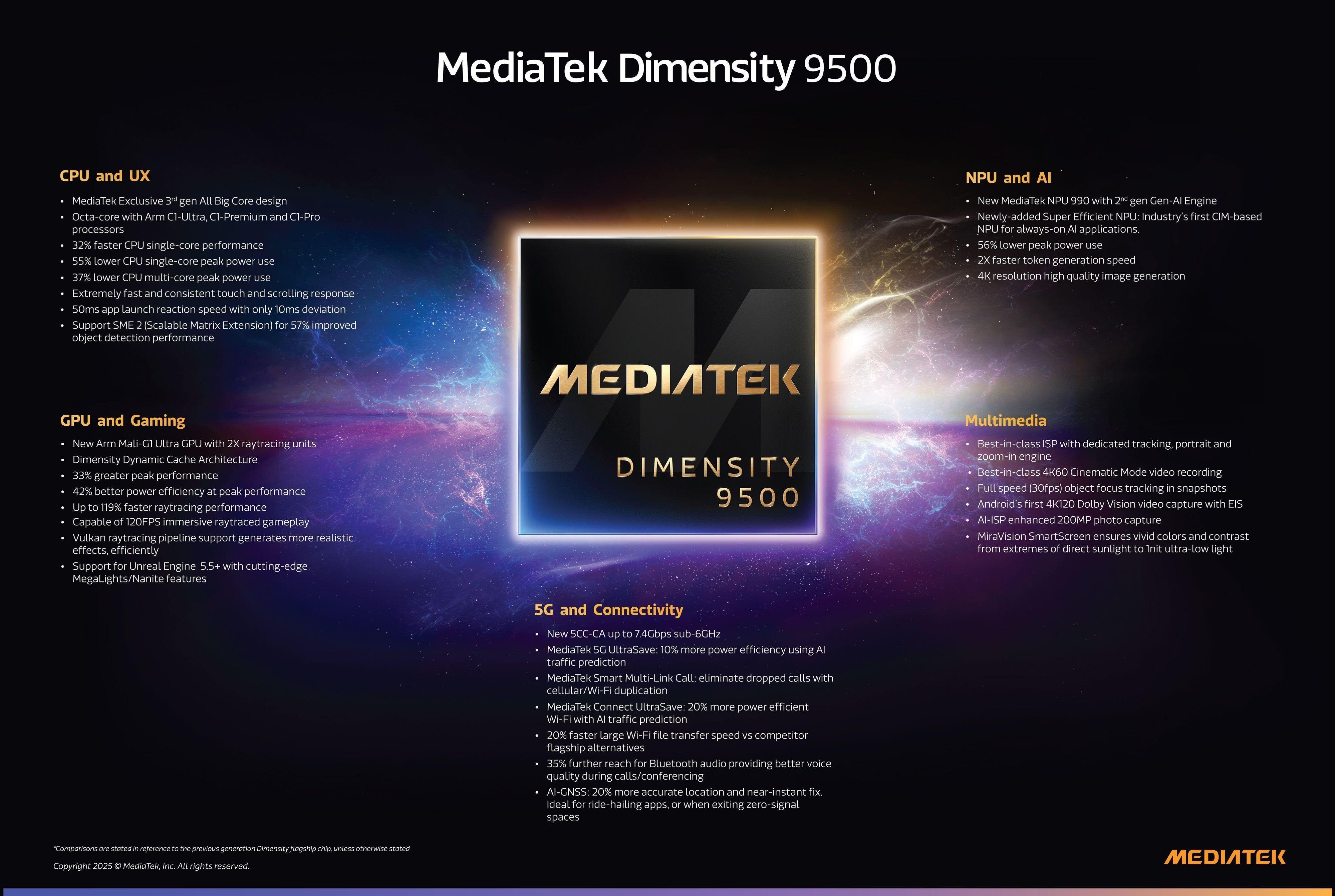
The leap isn’t magic; it’s architecture. Fabricated on TSMC’s N3P, the 9500 benefits from the same cutting-edge 3nm class process as Apple’s A19 Pro. But the node is only the foundation. MediaTek layered on a set of changes that reduce bottlenecks and keep the chip fast after minute one.
- Dynamic Cache Architecture: Instead of shuttling data through slower, rigid pathways, the CPU, GPU, and NPU share data in near-real time. That slashes latency in workflows where engines cross-talk constantly – think 4K/8K video exports, computational photography, and ray-traced gaming.
- All-big-core CPU with Arm v9.3: The scheduling model and expanded caches mean more threads get more breathing room. Multi-core throughput climbs without a big power penalty, which explains the sustained scores we measured in stress tests.
- Mali-G1 Ultra + HyperEngine 3.0: MediaTek touts a 119% gain in ray-tracing capability over the previous generation. Our gameplay sessions tracked with that claim: smoother reflections, steadier high-refresh output, and fewer stutters after prolonged play.
- NPU 990 efficiency: Doubling AI performance while using less than half the previous power budget is not just a benchmark brag. It’s what lets the camera pipeline run denoise, HDR fusion, and semantic segmentation on every frame without cooking the device.
Put together, these ingredients transform the 9500 from “good enough” into a silicon platform that competes on equal footing with the best. The big deal isn’t a singular peak; it’s the chip’s composure under sustained, modern workloads where heat, memory bandwidth, and on-die communication usually erode performance.
Are we hitting a flagship performance plateau?
There’s a legitimate argument that we’ve approached a plateau at current process nodes. When everyone converges on similar fabrication tech and mature CPU/GPU IP, the deltas shrink and software optimization starts to matter as much as raw silicon. That context helps explain how a challenger can suddenly look like a peer: once the ceiling is shared, the team that removes friction – cache misses, interconnect overhead, thermal throttling – wins the day.
Looking ahead to 2nm, gains will likely skew toward efficiency rather than large, headline-grabbing performance jumps. That’s not bad for users. If the next handful of cycles focus on better sustained behavior, smarter scheduling, richer AI camera pipelines, and cooler surfaces, phones will feel faster in the ways that matter: responsiveness, consistency, and battery life that doesn’t nosedive mid-shoot.
What this means if you’re buying a flagship
First, don’t assume the spec sheet hierarchy you remember still applies. In gaming or creator-centric workflows, the Vivo X300 Pro is absolutely a peer to the iPhone 17 Pro Max and Galaxy S25 Ultra, and in several GPU-bound or sustained tasks, it’s the faster, steadier option. If your day is CapCut timelines, mobile color work, or graphically dense titles, that steadiness translates into tangible time saved and smoother play.
Second, pick based on ecosystem and camera priorities after performance – because performance no longer disqualifies MediaTek. Apple still leads single-core bursts and has the advantage in certain pro apps and cross-device workflows. Snapdragon’s ecosystem breadth is unmatched for accessories, modems, and developer-targeted features. MediaTek’s rise means you can weigh those factors without worrying you’re giving up top-tier speed.
A quick reality check on numbers
Benchmarks are a snapshot, not a life story. Thermal envelopes vary by chassis, vapor chamber size, and firmware tuning. A Dimensity 9500 inside a thin, aggressively styled phone might behave differently than the X300 Pro’s more balanced thermal design. Still, the through-line remains: MediaTek’s 2025 silicon is no longer the “budget pick” – it’s a legitimate flagship engine with class-leading stability in GPU-heavy scenarios.
Why this is good for everyone
Competition at the top shakes loose complacency. Qualcomm must respond to MediaTek’s sustained performance. Apple, already stellar at per-core speed, will either chase longer run stability or double down on software and silicon synergy where it remains uniquely strong. Users win either way, with better devices – and potentially saner prices – as brands realize they can’t lean on a single logo on the spec sheet to justify premiums.
The bottom line
We entered 2025 expecting another routine duel between Apple and Qualcomm, with MediaTek as the capable outsider. We leave these tests with a new reality: the Dimensity 9500 is a full-fledged flagship contender. The Vivo X300 Pro doesn’t just flirt with the idea of parity – it proves it in CPU multi-core, dominates parts of the GPU story, and sustains performance where rivals fade. If you’ve historically dismissed MediaTek, it’s time to revise that mental model. The next wave of Dimensity chips deserves a spot on any enthusiast’s shortlist.
1 comment
Lightroom still faster on iPhone. For creators that matters more than fps