Every few years, the tech world is gifted a myth. Sometimes it’s a miracle battery, sometimes it’s a foldable that will change everything, and sometimes it’s a mid-range Android dipped in rhetorical gold. The saga of the so-called Trump Phone – marketed as the T1 Phone 8002 (Gold Version) – is the rare story that manages to be all three at once: an object, a symbol, and ultimately a mirage. 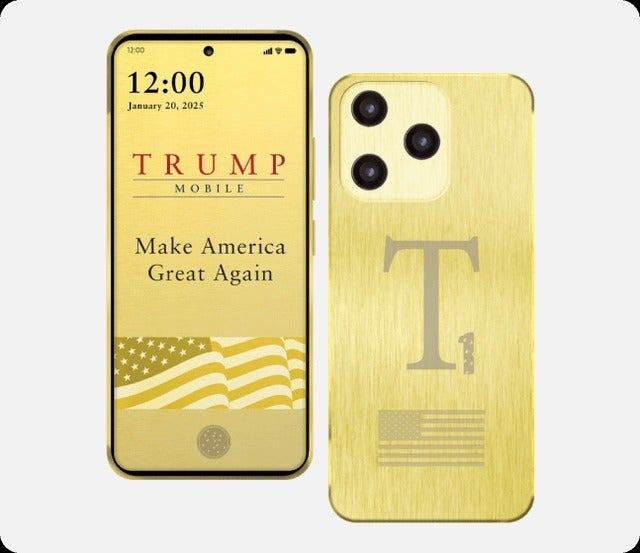
What began as a promise to “revolutionize mobile calling” morphed into 2025’s strangest episode of vaporware theater, complete with changing specs, disappearing slogans, and a chorus of unanswered emails.
How the legend began
In June, the curtain rose with brassy fanfare. Eric and Donald Trump Jr. unveiled Trump Mobile, its flagship rate bundle – the on-the-nose “47 Plan” priced at $47.45 per month – and the glittering hero device: the T1 Phone 8002, draped in gold and drummed up as a product “designed and built in the United States.” On paper, the handset sounded like a familiar upper-mid device: a 120Hz 6.78-inch OLED; 12GB of RAM; a hefty 5000mAh battery (billed as a “long life camera,” because why not); and a triple-camera island that looked like an iPhone sketched from memory on a cocktail napkin. The pitch wrapped the silicon in patriotic language, as if assembly lines and eagles were natural coworkers.
Then the copy shifted. The site’s triumphant “Made in the USA” line quietly dissolved and was replaced by a more elastic phrase: “Designed with American values in mind.” Readers fluent in industry euphemism heard the translation immediately: ideated here, manufactured… elsewhere. Anyone who has ever toured a handset supply chain knows how hard true domestic production is. Chips, memory, radios, antenna tunings, factory calibrations – these aren’t conjured by marketing, they’re forged in logistics.
From deposits to déjà vu
By July, Trump Mobile opened preorders with a $100 deposit, pointing to an August ship date. Then September. Then “later this year,” depending on which screenshot your browser cache captured. Along the way the spec sheet went on a diet: the 6.78-inch display slimmed to 6.25 inches; RAM figures vanished; and the product photos began to look suspiciously familiar. In one widely shared image, Internet sleuths noticed a gold overlay perched atop what looked like a Samsung Galaxy press photo, with a third-party case brand watermark still peeking through like a magician’s hidden string.
That was the first big tell. Real phones start as engineering validation test units, pre-production shells, and factory jigs – there are always authentic stubs, CADs, or in-hand prototypes. When the best you can muster are Photoshop composites and retroactive edits, you’re not building a phone; you’re pitching a vibe.
October’s echo chamber
October arrived with promises that the T1 was just about to land. It didn’t. The social accounts fell quiet after late August. Press inboxes gathered dust. The website clung to its “later this year” banner like a motivational poster in a startup hallway. Meanwhile, attention drifted from the MVNO service itself – “unlimited talk, text, and data,” the usual bundle – to the only question that mattered: Where is the phone?
Silence is a product too, just not the one people pre-ordered.
Premium performance, selectively defined
As autumn edged toward winter, the pitch evolved again: phrases like “American hands behind every device” and “Premium Performance. Proudly American.” cropped up. Those sentiments land differently when customers can’t point to a single fulfilled order. Instead of shipping its golden promise, the storefront started listing refurbished iPhones and Samsungs – the retail equivalent of a magician distracting you with a different deck.
None of this made the T1 tangible. What it made was a narrative. And that narrative sits at the intersection of politics, branding, and the evergreen allure of a bargain flagship.
The anatomy of vaporware in three acts
Act I: The halo. You launch with a story bigger than the silicon. The T1’s halo was patriotism gilded with scarcity. It’s a powerful emotional cocktail: values plus exclusivity. If you can get people to picture themselves owning the meaning, they’ll ignore the missing manual.
Act II: The shifting baseline. The copy, dates, and numbers begin to drift. The display shrinks. The RAM disappears. The shipping window slides. People squint – and when they squint, they justify. “Manufacturing is hard,” they’ll say (true), “and supply chains are chaos” (also true). This buys time, which is the scarce commodity of Act II.
Act III: The vanishing. The final act is a soft fade, not a crash. Posts stop. Replies stop. The product page becomes a museum exhibit to optimism. The last line – “later this year” – turns from date to décor.
Why the red flags mattered
Building a phone is a high-wire routine. You need modem certifications, RF testing, thermal budgets, camera pipelines, and an update strategy. You need carriers to sign off on network behavior and emergency services compliance. You need IMEIs and factory tooling. When a company talks first about slogans and paint, and only later about drivers and updates, you’re hearing the back half before the front half exists.
Equally telling: the deposit structure. A $100 placeholder for a brand-new, unproven handset with no independent hands-on? That’s a fundraiser, not a launch. Established OEMs take preorders once reviewers have touched the device, or at least after carrier partners have demo units behind glass. Absent that, you’re not preordering a product – you’re financing a possibility.
What the T1 symbolized
Strip away the gold and you’re left with a $499 metaphor: a device built from loyalty first and components second. The Trump Phone was pitched as Made in America, then reframed as made with American values, then effectively made of American patience. In the end, it functioned like a cultural Rorschach test. Fans saw a statement piece, skeptics saw a brass-tinted rebrand of commodity Android hardware, and journalists saw a case study in how hype metastasizes in an attention economy.
There’s a reason people wanted it to be real. We love artifacts that let us hold an idea in our hand. A gold T1 would have been an Instagram caption you could dial, a talking point with a SIM tray. Even critics admit there’s a perverse charm in imagining that first smudged selfie from a camera marketed as a battery.
The timeline, clarified
- June: Announcement blitz. Big claims about American design and build, a 120Hz 6.78-inch OLED, 12GB RAM, 5000mAh battery, triple cameras, and the 47 Plan. Patriotism in caps lock.
- July–September: $100 deposits open. Dates slide from August to September to “later.” Specs are tweaked downward; press imagery triggers déjà vu with case-brand relics hiding in pixels.
- October: A promise that the launch is imminent, followed by the quietest month in marketing. Social feeds stall. Press lobs questions into a void.
- November and beyond: New patriotic copy; zero confirmed shipments. Refurbished mainstream phones appear on the store, which is awkwardly practical for a company that hasn’t shipped its own flagship.
How to spot the next T1
Vaporware isn’t illegal; it’s a confidence game that feeds on our impatience. Here are the tells:
- Photo-first, prototype-later: If renders do the heavy lifting and no engineer is allowed to boot a unit on camera, pause.
- Patriotism over paperwork: Claims of origin should be backed by certification breadcrumbs – FCC filings, factory audits, or at least consistent supplier identifiers.
- Moving targets: Shrinking screens, mutable RAM, and hazy ship windows signal a product searching for itself.
- Deposit pressure: A cash barrier to “reserve your place” without independent validation is a tax on hope.
- Support silence: If the inbox goes dark before the phone exists, imagine the warranty queue after it ships.
The MVNO backdrop no one talked about
Lost in the glitz was the carrier story. Most boutique phone brands don’t build towers; they rent them via MVNO deals and bundle data with a themed wrapper. That can be perfectly fine – many MVNOs are great. But when the handset itself is the headliner, the service must be boringly reliable. You can’t bolt a flashy phone to an untested help desk and call it an ecosystem.
Vibes, values, and buyer protection
The Trump Phone ends up as a cautionary tale at the intersection of identity and commerce. Tech is already tribal – blue bubble versus green bubble, Apple versus everyone. Layer politics on top and you don’t just buy features; you buy membership. That’s powerful, and it’s precisely why deposits should be treated like investments: never risk what you can’t afford to watch disappear behind “coming soon.” If you did put money down, document everything: dates, emails, screenshots. If refund requests go unanswered, check your payment network’s dispute windows. Hype isn’t a warranty.
The epilogue, for now
Where is the Trump Phone? Nowhere you can unbox. Everywhere you can argue about. It’s a $499 lesson in how easily ambition can outrun execution, and how a handful of glossy images can raise real cash. The device promised to be a golden shortcut to meaning; it turned into a $100 speed bump for believers waiting on a delivery truck that never turned down their street.
Maybe there’s a crate of prototypes sitting next to other famous delays in the great warehouse of tech lore. Maybe there never was. Either way, the T1 Phone 8002 has already fulfilled its final role: not as hardware, but as homework. The test asks only one question – next time we see this pattern, will we recognize it sooner?
3 comments
My uncle put $100 down and now won’t talk about it. Awkwarddd
Great read. More of this consumer-protection vibe pls
Imagine the warranty process if it HAD shipped. Yikes