Tim Cook, Apple’s Next Chapter, and the Rise of John Ternus
In Cupertino, the countdown to Apple’s next big transition may already have started. According to multiple reports based on the Financial Times’ investigation, the company’s board has stepped up its long-running succession planning for CEO Tim Cook, opening the door for a leadership change as early as the beginning of 2026. At the center of these conversations is John Ternus, the low-profile but influential senior vice president who currently oversees Apple’s hardware engineering division.
Unlike the occasional market rumors that surface whenever an Apple executive trends on social media, this wave of speculation is rooted in tangible signals. Insiders say Apple’s directors and senior leadership have been holding more frequent and more focused discussions about succession, with a working assumption that any announcement would arrive only after the company reports its all-important holiday-quarter earnings in late January. That window is not accidental: it would give Apple a clean runway ahead of its usual calendar of high-stakes moments, from the Worldwide Developers Conference in June to the expected iPhone 18 unveiling in September.
Why 2026 Is Shaping Up as a Turning Point
If that timing holds, 2026 could become the year Apple introduces a new public face while trying to convince investors, developers, regulators, and customers that its long-term strategy will remain steady. Tim Cook, who took over from Steve Jobs in 2011, has now spent more than 14 years in the top job and recently turned 65 – older than the average Fortune 500 CEO both in age and tenure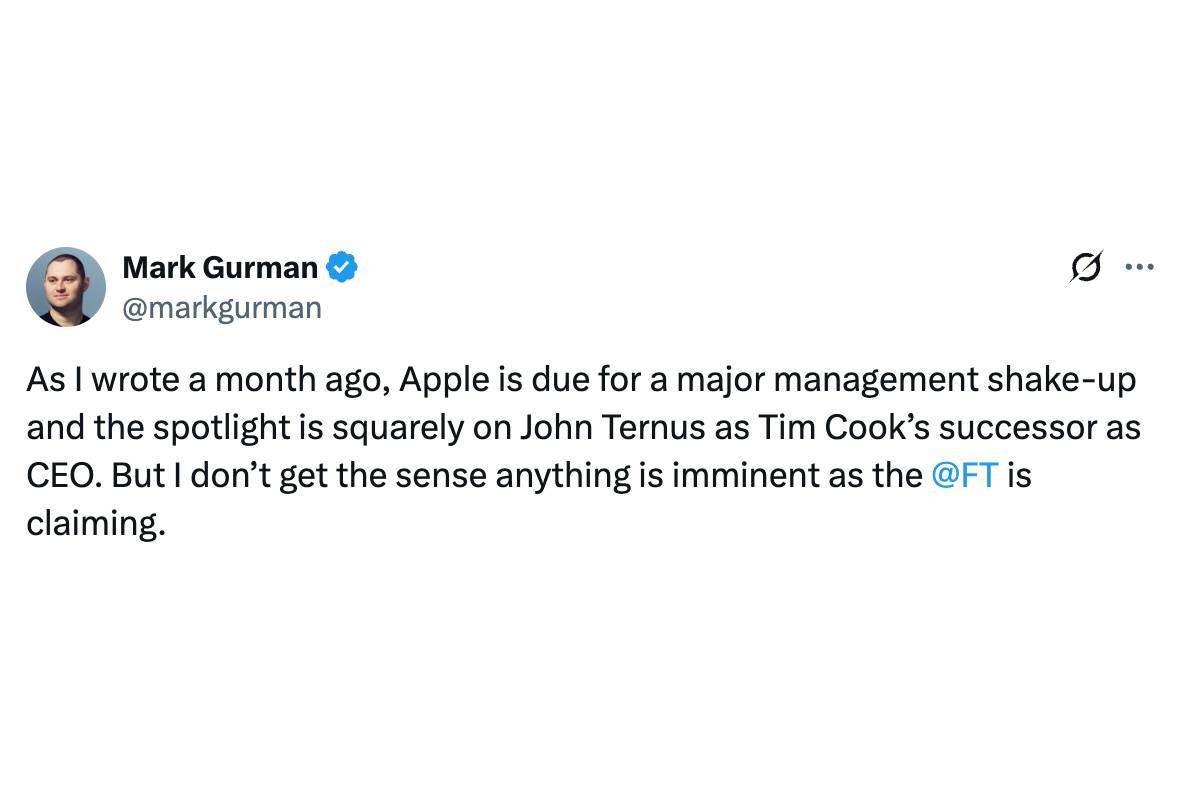
. During his era, Apple’s market capitalization exploded from around $350 billion to roughly $4 trillion, turning the company into a financial juggernaut and one of the most scrutinised businesses on the planet.
Crucially, people familiar with the planning insist this potential transition is not a reaction to any crisis. Apple’s fundamentals remain solid, and the company is still capable of record quarters. Instead, the board appears to be dealing with something far more ordinary but strategically sensitive: the reality that even highly successful CEOs eventually retire, and that a company of Apple’s scale cannot afford to improvise when that moment arrives.
Who Is John Ternus, the Frontrunner to Replace Cook?
In that context, John Ternus stands out as a carefully cultivated internal candidate. Now in his early fifties, he would mark a return to a hardware-first leader at a moment when Apple is under pressure to prove that its best days of product innovation are not behind it. Ternus joined Apple back in 2001 as part of the product design organization and spent years working on headline devices before rising through the ranks. Over time he took on responsibility for hardware engineering across major lines including iPhone, iPad, Mac, AirPods, and Apple Watch, and he has become a familiar figure at Apple’s launch videos and WWDC segments.
Where Cook built his reputation on ruthless supply-chain efficiency and operational discipline, Ternus offers something different: deep technical credibility with the teams that actually build Apple’s devices. Inside the company he is widely described as respected and trusted, someone who understands the trade-offs between battery life, performance, design, and cost at a granular level. His close involvement in the rollout of Apple’s in-house silicon across Mac and iPad has only reinforced that image.
Why a Hardware CEO Matters for Apple Right Now
If Apple’s board ultimately chooses Ternus, it would send a clear signal about how the company views its future. After several years in which the narrative shifted toward services revenue, subscriptions, and ecosystem lock-in, Apple now faces harder questions: can it still create another product as culturally dominant as the iPhone, or is it destined to live off refinements and financial engineering?
A CEO whose entire career has been spent shipping hardware would be a statement that Apple still sees breakthrough devices at the core of its identity. That matters in a landscape where rivals are racing ahead on visible AI features, and where experimental categories like spatial computing and mixed reality have yet to prove they can move hundreds of millions of units. A technologist in the corner office could bolster morale among engineers and reassure the market that Apple is not done taking engineering risks.
The Case Against: A Careful Operator, Not a Wild Innovator
However, Ternus is not universally seen as a radical visionary who will rip up Apple’s playbook. People who have worked alongside him describe a cautious, consensus-driven decision maker who prefers polished execution to headline-grabbing gambles. Supporters can point to clear wins, such as the ongoing transition of the iPad lineup to cutting-edge OLED displays and the tightly integrated hardware-software approach around Apple silicon. These moves have helped differentiate Apple’s devices from their rivals in performance and efficiency.
Critics, on the other hand, note that his track record is not spotless. The controversial MacBook Pro Touch Bar, widely criticised by professionals and eventually removed from newer models, emerged on his watch. He also had a hand in the ambitious but niche Apple Vision Pro headset, which so far has struggled to escape early-adopter status, and was involved in the company’s ultimately abandoned self-driving car initiative. These projects underline a difficult truth: even for Apple, big swings do not always connect – and Ternus’s instincts may lean more toward incremental refinement than radical reinvention.
Narrowing Field of Internal Candidates
The broader executive picture at Apple only sharpens the focus on Ternus. For years, Chief Operating Officer Jeff Williams was viewed as the most obvious successor, an operations-focused leader in the mold of Cook himself. With Williams preparing to exit, that path appears to be closing. Other heavyweights such as software chief Craig Federighi or services boss Eddy Cue are critical to the current structure but are seen, at least for now, as less likely choices for the CEO job, whether due to their specialized domains or simple lack of appetite for the role.
Apple’s long-standing preference is to promote from within, which significantly narrows the credible list at a time when several senior figures are approaching retirement age. Bringing in an outsider to run a company so defined by its culture and secrecy would be a dramatic departure, and nothing in the current reporting suggests the board is leaning that way. That leaves Ternus as the most plausible “continuity candidate” who is also young enough to lead Apple for a decade or more.
What Happens to Tim Cook?
One scenario that observers see as highly likely is a staged transition in which Cook steps back from day-to-day management while remaining as chair of the board for a period of time. That arrangement would let him continue to steer high-level strategy, manage key political and regulatory relationships, and offer cover to a less familiar successor who suddenly has to handle earnings calls, scrutiny from lawmakers, and intense media attention.
Such a move would mirror transitions at other Silicon Valley giants, where founding or long-serving CEOs have shifted into executive chairman or non-executive chairman roles. For Apple, it would combine stability at the top with room for a fresh leadership style to emerge, without sending shockwaves through the market.
No Guaranteed Timeline, but a Clear Direction
Despite all the chatter, there is still no fixed public timeline. The board could decide to delay an announcement, especially if macroeconomic conditions worsen or if major products slated for 2026 slip on the roadmap. Apple is acutely aware that any misstep during a handover would be seized on by competitors and amplified by the market, particularly at a time when AI and new computing paradigms are redrawing the tech landscape.
For now, the message drifting out of Cupertino is one of managed evolution rather than sudden revolution. Tim Cook’s eventual exit was always a matter of when, not if; the latest reporting simply suggests that “when” has moved from abstract future talk to a specific window after the next holiday earnings season. Whether John Ternus ultimately takes the crown or the board surprises everyone with a different choice, the decisions made over the coming months will shape who leads Apple into its next decade – and whether that era is remembered for another category-defining product or for impeccably managed, carefully engineered continuity.
1 comment
ngl I can’t picture Apple without Tim Cook on stage… feels like end of an era tbh