Valve is stepping back into the living room with a clear message: the new Steam Machine is meant to feel less like a niche PC project and more like a console you can actually justify buying. After unveiling its trio of hardware – Steam Machine, Steam Frame, and Steam Controller – the biggest unknown was always price. Now Valve is finally talking, and the promise is bold: the company insists its box will be priced to compete not only with traditional gaming consoles, but also with the cost of building a comparable gaming PC yourself.
Hardware engineer Yazan Aldehayyat explains that price wasn’t an afterthought stapled on at the end of development. 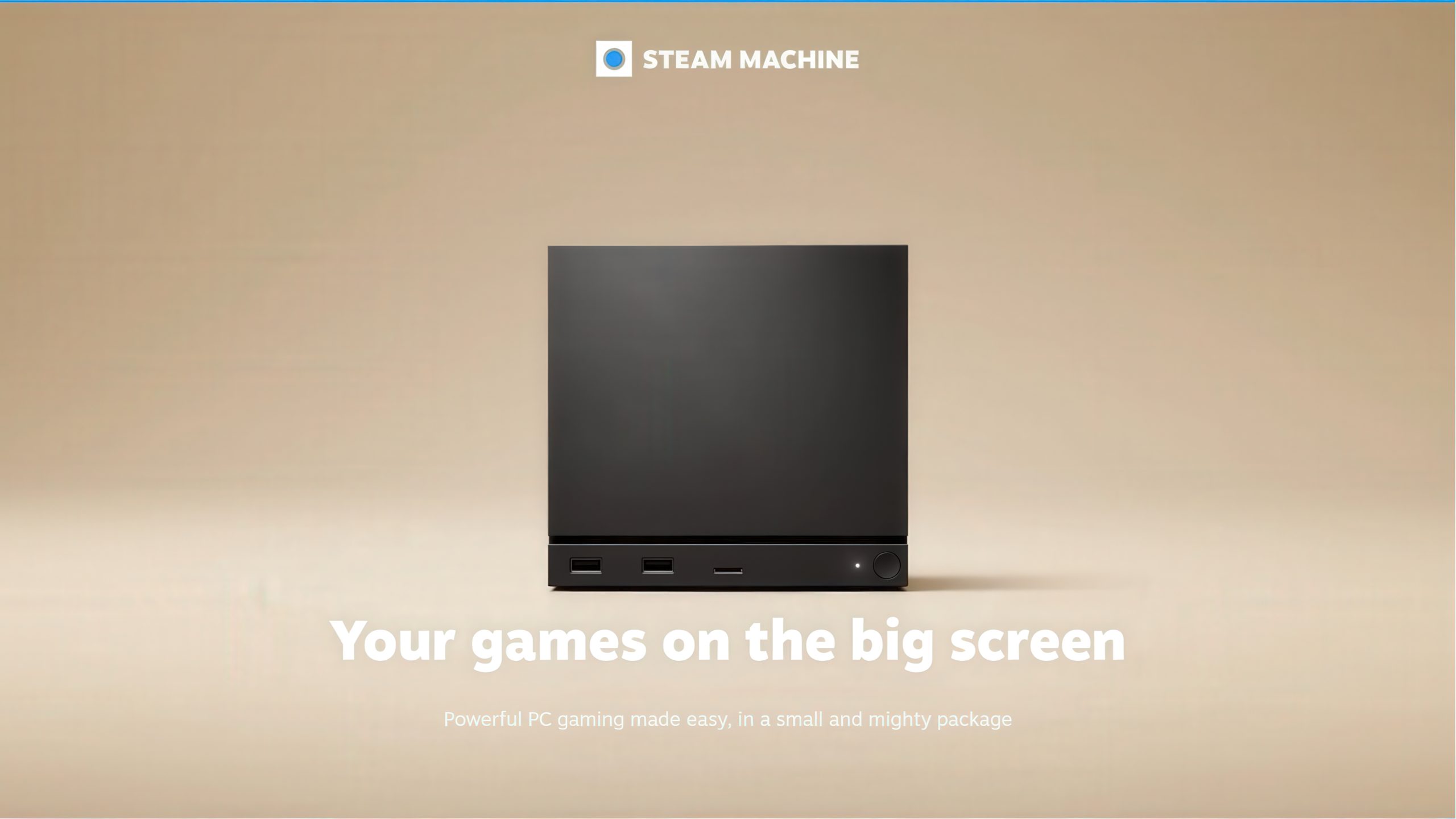
According to him, every feature and component choice was filtered through the same question: does this keep the machine approachable and affordable? Rather than chasing exotic components that look impressive on spec sheets, Valve says it tuned the configuration around real-world Steam users, mining the hardware survey to understand what most people actually have in their rigs and what they realistically expect in terms of performance.
That analysis led to a target: 4K output at 60Hz in all Steam games via upscaling. In practice, that means running titles at a lower internal resolution and using upscaling techniques to fill a 4K television. Early hands-on testing backs up Valve’s positioning. In one internal demo, Cyberpunk 2077 reportedly ran at 1440p and 60 frames per second, then upscaled to 4K – a respectable result for a compact box. However, the moment ray traced reflections and sun shadows were enabled, performance plunged toward 30 FPS, a reminder that ray tracing is still one of the most demanding features in modern games.
That kind of performance places the Steam Machine in an interesting bracket. Digital Foundry and other analysts expect it to sit somewhere between an Xbox Series S and a standard PlayStation 5, likely leaning closer to Sony’s console in raw rendering power when ray tracing is disabled. That’s an important detail for buyers comparing their options in 2025, because living room boxes live or die by how well they can run big multiplatform titles at stable frame rates.
The competition it has to worry about is crystal clear. The Xbox Series S 512GB model is now sitting around $379.99, while the PlayStation 5 Digital Edition has climbed to roughly $499.99 after recent price hikes driven in part by tariffs and shifting component costs. Above them both is the PlayStation 5 Pro at about $749.99, a significantly more powerful machine on paper. If Valve wants to be taken seriously in the living room this time, it can’t just say it’s competitive with PC builds, which are notoriously more expensive when you factor in cases, power supplies, cooling, and a Windows license. It has to look compelling next to these consoles on a store shelf or product page.
That’s why many observers believe there’s an unwritten rule here: the Steam Machine absolutely needs to undercut the PlayStation 5 Pro and ideally land closer to the Series S and standard PS5 in perceived value. A mid-range price paired with performance that hovers near the PS5 would make Valve’s story much stronger: you get console-style simplicity plus instant access to an enormous existing Steam library, frequent PC sales, and mod support where games allow it.
Not everyone is impressed by Valve’s conservative approach, though. In enthusiast circles you already see comments complaining that the box is underpowered and should have shipped with some mythical high-end GPU – the sort of jokingly exaggerated “AMD AI Max 395” people throw around when they really mean they wanted something absurdly overbuilt. There’s a real tension here: hardcore PC builders naturally compare everything to the bleeding edge, while Valve is clearly targeting a broader audience that wants plug-and-play convenience on the TV rather than chasing benchmark charts.
From a strategic standpoint, Valve seems to be betting that smart compromises will matter more than raw specs. By choosing hardware that sits in a sweet spot between cost and performance, the company can keep the box smaller, cooler, and quieter than a typical DIY gaming tower. That makes it easier to place in a media cabinet, and more acceptable to people who don’t want a roaring GPU fan in the middle of their living room. At the same time, aiming for solid 1440p performance with 4K upscaling aligns with how most console games already operate behind the scenes.
In the end, the Steam Machine’s success will likely come down to how aggressive Valve is willing to be on pricing. If the company really delivers a box that feels close to a PlayStation 5 in everyday use, yet costs nearer to an Xbox Series S build-equivalent PC, it could finally crack the living room after earlier experiments fizzled. If, however, the final sticker price drifts too close to the PS5 Pro while offering less raw power, the machine risks being seen as neither the best console nor the best PC – and that is the one position a new platform cannot afford to occupy.
1 comment
if it runs cyberpunk at 60fps without sounding like a jet engine i’m already impressed ngl