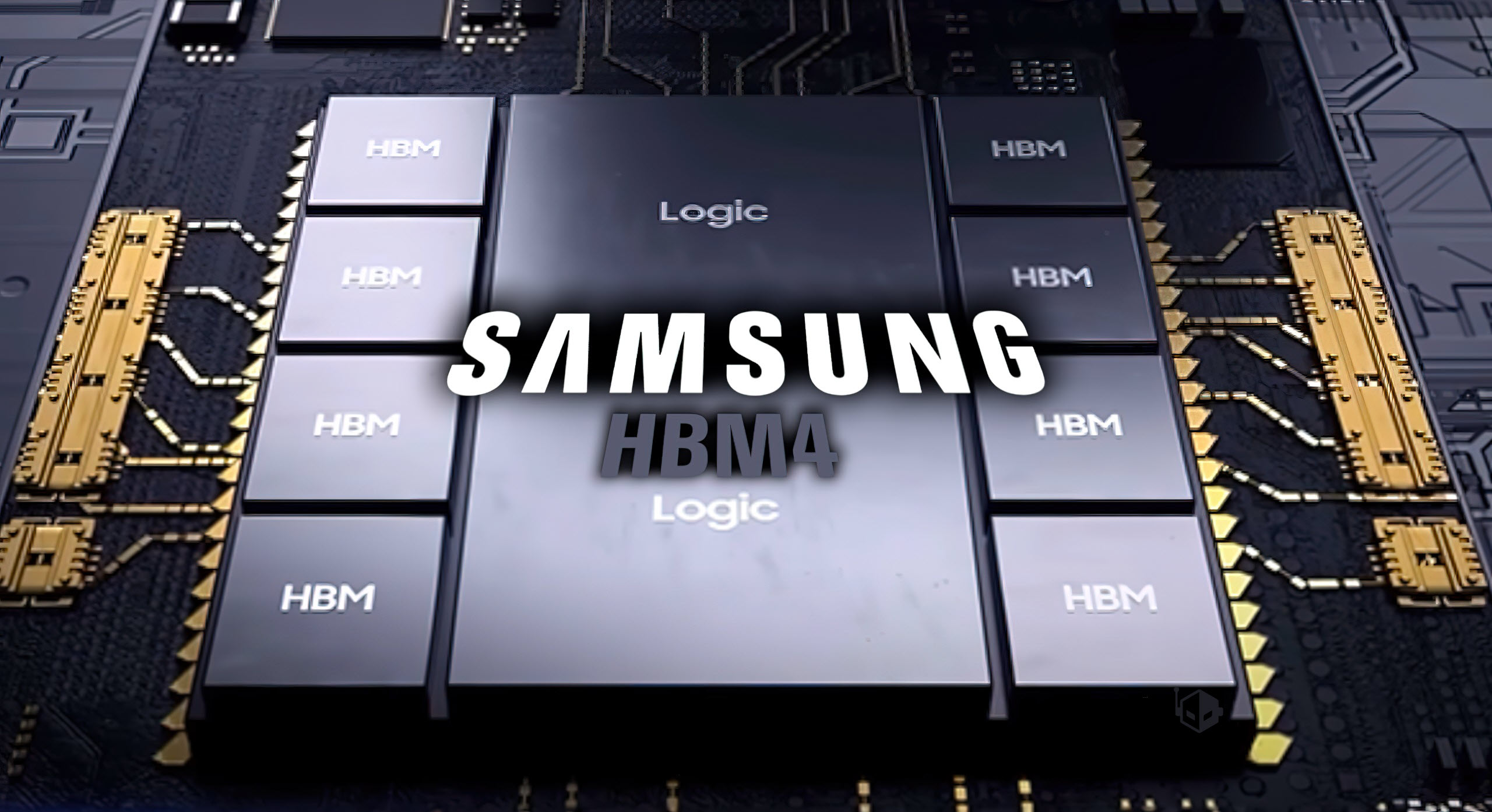
Samsung has landed a headline HBM4 supply agreement with NVIDIA, a pairing that underscores how central ultra-fast stacked memory has become to the next wave of AI accelerators. The win does more than move product; it validates Samsung’s latest DRAM process as production-worthy at the front edge. According to the companies, the HBM4 generation that Samsung is preparing for NVIDIA hits a blistering 11 Gbps per pin, comfortably outpacing the current JEDEC baseline of 8 Gbps. For hyperscalers chasing transformer throughput and lower training times, that delta is not trivia – it’s capacity, tokens, and time to convergence.
HBM – High Bandwidth Memory – stacks multiple DRAM dies on a logic base die connected to the GPU via a wide interface. Samsung’s HBM4 uses its 6th-gen 10 nm-class DRAM nodes married to a 4 nm logic base die, aiming to combine raw pin speed with better energy efficiency per bit. More speed alone is pointless without power and thermals in check, so Samsung is pitching this part as a balanced upgrade: higher bandwidth within a similar or lower pJ/bit envelope. If that claim holds in shipping systems, it meaningfully widens the GPU memory pipe and reduces the chance that memory becomes the bottleneck when models scale.
NVIDIA’s next major architecture – often referred to as Rubin in industry chatter – will arrive into a landscape where AI clusters are increasingly limited by memory bandwidth, not just compute. Locking in a supplier that can run HBM4 at 11 Gbps gives NVIDIA options: fatter stacks, more stacks per GPU, or both, which translates into higher tokens/sec and better utilization in training and inference. The deal also signals that Samsung has cleared critical readiness gates – yield, reliability, and controller compatibility – early enough to matter for Rubin’s ramp.
Context matters here. Samsung’s HBM3 journey was rocky, and rivals seized share. This agreement suggests a reset. With HBM4, Samsung is not just catching up; it’s trying to set the pace. That will force SK hynix and Micron to tighten their own HBM4 roadmaps or risk ceding sockets. Meanwhile, AMD’s Instinct MI450 series looms as a competitive foil to NVIDIA’s Rubin, and memory choices will be pivotal on both sides. If bandwidth per accelerator jumps materially, we should see gains in attention-heavy layers and improved scaling efficiency across multi-GPU nodes.
Speed figures are only one piece of the deployment puzzle. Sustained 11 Gbps operation across tall stacks stresses everything: TSV integrity, thermals, signal integrity on the interposer, controller firmware, and package power delivery. Data center operators will care as much about availability and power per token as about peak benchmarks. In practice, the most valuable HBM4 is the one you can buy in volume that stays inside the cooling budget while delivering predictable latency and bandwidth under real workloads – not just idealized bursts.
The vibes in the enthusiast and enterprise communities mirror this duality of excitement and caution. On the one hand, long-time memory watchers remember Samsung’s storied DDR4 B-Die era and see the HBM4 milestone as a return to form. On the other, skeptics argue it’s premature to celebrate until we see shipping servers, validated firmware, and multi-vendor interoperability under pressure tests. Both sentiments can be true: the paper specs look stellar, but datacenters run on reproducible performance and stable lead times.
For NVIDIA, the calculus is straightforward. With training runs measured in millions of GPU-hours, shaving even single-digit percentages off time-to-train compounds into huge cost savings. If Rubin pairs higher compute density with HBM4 at 11 Gbps, operators may be able to hit the same quality targets with fewer nodes or shorter schedules. For research teams, wider memory pipes also enable larger context windows and more aggressive parallelism strategies – benefits that spill into inference when serving mixture-of-experts and long-sequence models.
What to watch next: (1) confirmation of stack heights, capacities, and thermal design power across Samsung’s HBM4 lineup; (2) early platform benchmarks showing sustained bandwidth and latency under mixed workloads; (3) evidence that yield and supply can meet hyperscaler demand; and (4) counter-moves from SK hynix and Micron, which will determine pricing power into 2026. If Samsung’s execution holds, this deal is more than a socket win – it’s a narrative turn, positioning the company back at the center of the AI memory story.
1 comment
If Rubin gets this bandwidth, long context inference might actually feel less like a science project