Samsung has finally shown the world the Galaxy Z TriFold, a device that looks like someone took a regular foldable, added another hinge, and pushed the idea of a phone tablet hybrid to the extreme. The company is positioning it as a halo product that should arrive in stores around the first quarter of 2026, and crucially, this time the United States is on the launch roadmap as well. 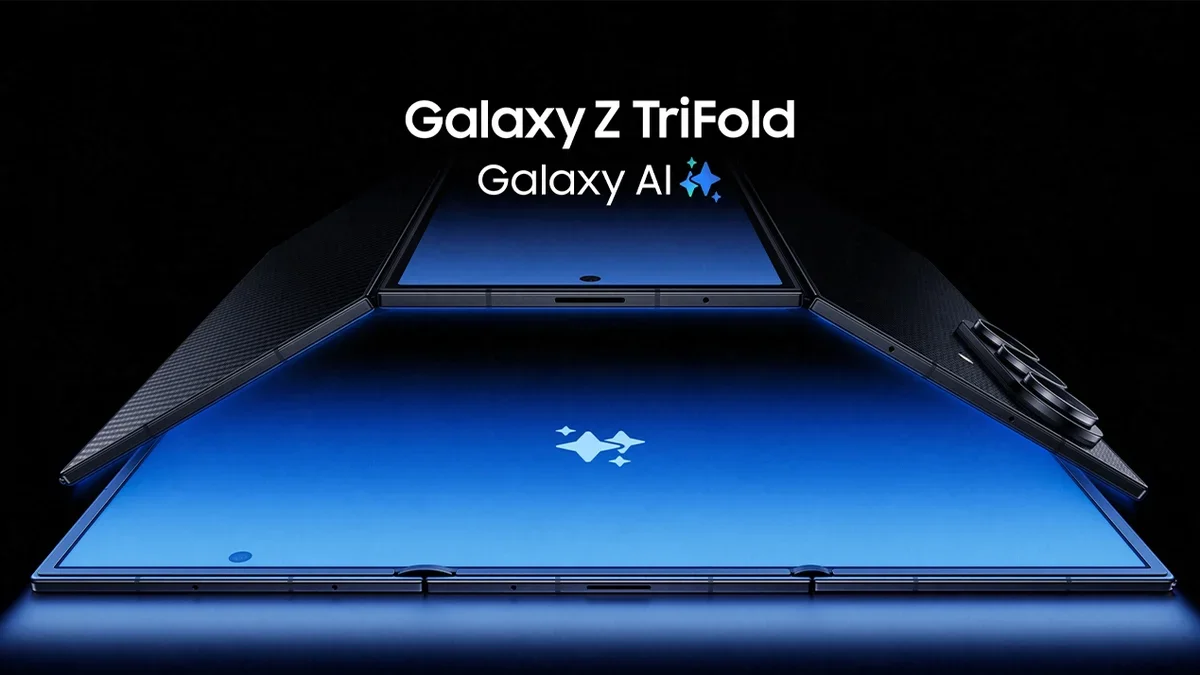
That alone makes the project more than a lab curiosity. Yet even in the hands on clips and carefully staged demos, it is obvious that this is not a product designed to replace your everyday phone the way a Galaxy S flagship might. It is a showcase of what Samsung can do with flexible displays, rather than a blueprint for what everyone will carry in their pockets in a few years.
Triple foldable phones are not entirely new. Huawei stepped into this territory earlier with the Mate XT, a device that demonstrated how a slab of glass and metal could bend in multiple places to become a surprisingly large canvas. Huawei chose a folding pattern that alternates inward and outward bends, creating a motion that looks almost like a zigzag when you open it. Samsung has taken a different approach. The Galaxy Z TriFold folds inward in a way that makes the display loop around itself in a tighter curve, closer to a spiral than a simple accordion fold. The company claims that this geometry helps protect the flexible panel and allows a cleaner outer silhouette when the device is shut, and in practice it gives the phone a distinct personality compared with its rival.
That personality comes with physical consequences. When the Galaxy Z TriFold is folded down into phone mode, it measures 159.2 by 75 by 12.9 millimetres. Unfolded fully, it turns into a tablet like sheet that is 159.2 by 214.1 by 3.9 millimetres, with an uninterrupted main display that approaches ten inches on the diagonal. The numbers matter because they translate into a very real 309 gram weight, which puts the TriFold in small tablet territory. For comparison, an iPad mini tips the scales at less, despite offering a similarly large screen. Slip the TriFold into a jeans pocket and you will never forget it is there. This is not the type of phone you casually toss into a pocket before a quick run to the store; it is a piece of kit you carry with deliberate intent.
I have always gravitated toward compact phones, the kind of devices that disappear in the hand and never make your bag feel heavier than it should. The TriFold is the philosophical opposite of that ideal. It is unapologetically thick, unapologetically dense, and wants you to treat it almost like a miniature ultrabook that happens to make calls. Some people will love that idea, especially early adopters who already juggle multiple devices and want to streamline their setup. However, for the majority of users who mainly scroll social feeds, reply to messages, take photos, and stream video, the form factor looks like overkill. A standard flagship plus a lightweight tablet continues to cover those needs with fewer compromises, often for less money and with better battery life.
Price is a huge part of the story. Samsung has not released final retail figures yet, but company representatives hint that the Galaxy Z TriFold will land comfortably above the two thousand dollar line once taxes and carrier markups are included. At that level you are hovering around the combined cost of a high end smartphone and a premium small tablet, or even a capable laptop. The tri foldable promises the fantasy of carrying one device that can shrink for quick tasks and expand into a workstation for serious work. In reality you are paying a heavy premium for that integration, along with the risk that comes with an intricate hinge mechanism and a flexible display that is still more fragile than glass. For most buyers, that equation simply does not add up.
There is, of course, a subset of users who can genuinely exploit what the TriFold offers. Imagine a freelance photographer or designer who needs to mark up images on the go, jump between cloud storage, messaging apps, and editing tools, and still answer calls from clients. For that person, a ten inch canvas that lives in a coat pocket is attractive. The same goes for mobile gamers who treat their phone as a handheld console, or road warriors who spend more time answering email from trains and airports than from a desk. The operating system already supports multiple window layouts, split screen app pairs, and desktop style taskbars, and on hardware like this those features finally have space to breathe. Yet even within these groups, many will still prefer a thin laptop plus a normal phone once they weigh reliability, repair costs, and simple convenience.
In a sense, the Galaxy Z TriFold is the logical continuation of a long running Samsung obsession. The company has been bending and stretching screens in the lab for more than a decade. We have seen single hinge phones evolve from fragile prototypes to mainstream Galaxy Z Flip and Fold lines that you can buy in a mall store. Behind the scenes there have been concept panels that roll outward like scrolls, displays that stretch and snap back into shape, and experimental rigs where a single sheet of OLED folds in three or four precise places. To outsiders these projects can look like stunts, but they serve a purpose. By pushing materials, adhesives, and hinge designs to their limits, Samsung learns how far it can safely go in products that do ship in large volumes.
That is also why the TriFold feels as much like a statement as a gadget. Huawei earned bragging rights when it put the first commercial triple foldable into the world, even if it remained rare outside its home market. Samsung, as the largest display maker in the phone industry, was never going to let that narrative stand for long. The TriFold is a loud way of saying that the company can match and arguably surpass that achievement, with a more refined folding path and the promise of a broader global rollout. Once a heavyweight brand plants its flag in a new category, others almost inevitably follow. We are already seeing concepts from Tecno, Honor, and smaller players that sketch out their own takes on the triple hinge idea. Even if none of these models ever become best sellers, they shape perception. They tell investors, carriers, and consumers that the brand at least has the technical chops to compete.
Despite all of this, it would be a mistake to look at the Galaxy Z TriFold and declare that this is where phones are headed as a whole. Regular foldables, the kind that simply open into tablet mode once, are still fighting for mainstream acceptance. They remain more expensive than slab phones, are more susceptible to damage, and still rely on software developers to properly adapt their apps to odd aspect ratios. A device that folds twice inherits all of those challenges and adds new ones. There are extra creases to engineer around, more moving parts that have to survive tens of thousands of cycles, and even trickier compromises around battery capacity and heat dissipation. For shoppers who simply want a reliable phone that lasts several years and does not demand extra care, triple foldables solve problems they never had while introducing new worries they did not ask for.
And yet, that does not mean projects like the TriFold are pointless. Far from it. Experimental devices create pressure that eventually pays off for the rest of the lineup. A hinge strong enough to support three display segments can teach engineers how to make thinner, more durable hinges for regular foldables. Multitasking interfaces tuned for a massive unfolded panel can later be simplified for tablets or laptops. Even small advances in scratch resistance, anti reflection coatings, or power efficiency discovered in these halo products can end up inside far more affordable phones within a few years. There is also an emotional angle. Big, slightly impractical ideas remind people that the tech world has not settled into a boring cycle of annual camera bumps and new colors.
So when I look at the Galaxy Z TriFold, I see something that I would probably never buy with my own money and still feel oddly glad exists. It is a proof of concept you can eventually walk into a store and touch, a glimpse of an alternate path where our pockets are filled with expanding slabs instead of simple rectangles. It will almost certainly remain a niche purchase for enthusiasts with deep wallets, people who enjoy explaining what their strange three part phone can do every time they place it on a cafe table. For everyone else, it is a conversation starter that lives on review sites, launch events, and social feeds, a reminder that the market has room for devices that are more ambitious than practical.
In the long run the story of mobile devices is likely to be written by ideas that are far less spectacular but far more boringly useful: lighter batteries, sturdier frames, smarter software that anticipates what we need. Triple foldables are more like vivid side branches on that evolutionary tree. The Galaxy Z TriFold in particular captures the tension between spectacle and utility better than almost any recent phone. It shows how far flexible displays have come, how much ambition still exists inside a mature industry, and how companies like Samsung are willing to chase wild concepts simply because they can. The future belongs to sensible devices, but it is shaped by daring experiments like this one.
2 comments
ngl this thing looks sick but my wallet started crying at the specs alone 😂
cool concept but i can see myself babying it every day, one drop and instant panic