Is Samsung really easing off the gas pedal with the Galaxy S26 so it can land a knockout punch with the Galaxy S27 just as Apple celebrates the iPhone 20? With the S26 family expected in early 2026 and the S27 lining up for 2027, the timing alone is enough to spark conspiracy-level speculation among smartphone fans. 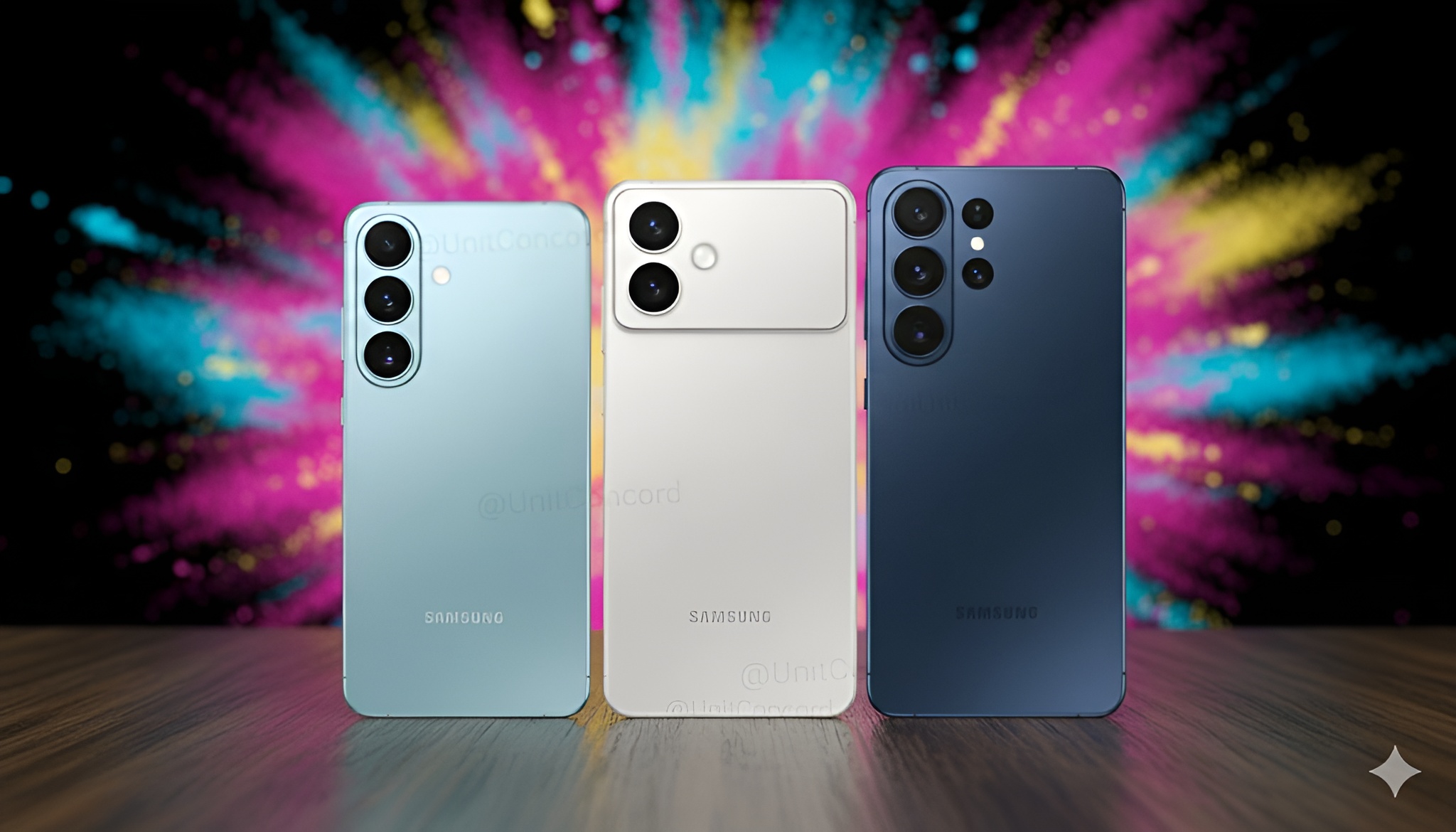
On one side you have a relatively conservative Samsung flagship refresh; on the other, rumors of Apple preparing its most radical iPhone redesign in a decade. That split is turning the S26 into what many see as a deliberate warm-up act before the real show begins.
Galaxy S26: a quiet refinement year
Samsung’s recent Galaxy S launches have often alternated between bolder redesigns and quieter polish years, and everything we know so far points to the Galaxy S26 series landing squarely in the latter category. Leaks suggest the standard Galaxy S26 will gain a slightly larger display, while the Galaxy S26 Ultra trims down a bit in thickness and swaps its sharper corners for more rounded, hand-friendly edges. The Ultra’s punch-hole selfie camera is also expected to grow by roughly 4 mm, widening the field of view for group shots and making ultra-wide selfies less dependent on software tricks and AI stretching.
The rest of the hardware story, however, feels more like tidying up details than redefining what a modern flagship should be. Wireless charging is finally catching up to what iPhone users have enjoyed for years, closing an odd gap for such a premium Android line. Around the back, Samsung is said to be returning to more pronounced rear camera islands instead of the cleaner, minimalist look of some recent models. None of that is ugly or wrongheaded, but it is incremental. It is the sort of update you buy because your older phone is due for retirement, not because you are blown away by something genuinely new.
That sense of caution is clearest in the camera setup of the Galaxy S26 Ultra. On paper, it is barely distinguishable from what is expected on the Galaxy S25 Ultra. Samsung is likely to reuse a mix of very high-resolution sensors and long-range zoom lenses that already work well today, with only modest tweaks to apertures and image processing. At a high level, the rumored configuration looks like this:
- A 200 MP ISOCELL HP2 main camera that may gain a slightly wider aperture to improve low-light performance and reduce motion blur
- A 50 MP ultrawide shooter, likely based on an ISOCELL JN3 or Sony IMX564, for landscapes, cramped interiors and creative close-up perspectives
- A 5x periscope telephoto around 50 MP, handling long-range zoom while keeping noise and smearing in check
- A 3x telephoto module around 12 MP for portraits and mid-range framing that bridges the gap between the main lens and periscope zoom
- A 12 MP selfie camera that pairs with the larger punch-hole cutout to deliver a noticeably wider field of view up front
It is a robust, versatile camera array that will almost certainly deliver strong results, but it closely mirrors the S25 Ultra’s expected layout rather than breaking new ground. In other words, the S26 Ultra looks like a refinement of a proven formula, not the start of a new era in Samsung mobile photography.
If there is one component generating real excitement on the S26 spec sheet, it is the Exynos 2600 system-on-chip. Early benchmark chatter paints it as a big leap for Samsung’s in-house silicon, with promising gains in both raw performance and energy efficiency. For years, Exynos chips have lived in the shadow of Qualcomm’s Snapdragon flagship line, especially in gaming, camera pipelines and sustained heavy workloads. A genuinely competitive Exynos 2600 could reset that narrative and give Samsung more control over its hardware roadmap.
The catch is that Samsung is reportedly limiting the Exynos 2600 to the base and Plus models of the S26 in certain regions, while the Ultra – the halo product most enthusiasts care about – may stick with a Snapdragon variant in many markets. That strategy makes it harder for Samsung to turn its silicon breakthrough into a simple hero message. Instead of one unified story about a next-generation chip powering the entire family, buyers get a patchwork of configurations that depends on model and country.
iPhone 20: Apple lines up its big anniversary swing
Now place that cautious Samsung roadmap against what is rumored for Apple’s 2027 anniversary phone. The iPhone 20 is widely expected to be Apple’s first truly all-screen handset, finally hiding the selfie camera underneath the display. Instead of a notch or a Dynamic Island cutout, the entire front would be uninterrupted glass, with the camera only revealing itself when needed. The display itself is rumored to flow over the sides in a waterfall-style curve that visually merges into the metal frame, giving the device a seamless, almost liquid appearance in the hand.
This sort of design has real technical consequences, not just marketing impact. When the screen wraps and curves that aggressively, conventional mechanical buttons become harder to integrate cleanly without breaking the illusion of a single continuous surface. That is why leaks point to Apple moving heavily toward solid-state controls on the iPhone 20: capacitive strips or pressure-sensing areas for volume, power and even camera triggers, all backed by finely tuned haptic feedback. Instead of a clicky button, you feel a precise vibration that convincingly simulates one. Apple has already experimented with this idea on older iPhones and Mac trackpads, but extending it across most of the hardware controls would mark a decisive break from traditional smartphone ergonomics.
On the camera side, Apple is also said to be readying a major sensor upgrade built around LOFIC – Lateral Overflow Integration Capacitor – technology. In simple terms, this is an advanced flavor of CMOS sensor design that helps capture both tiny amounts of light and extremely bright highlights in the same scene without blowing out details or drowning them in noise. Traditional smartphone sensors constantly juggle a trade-off between sensitivity and saturation: push too far toward sensitivity and bright areas clip; push too far toward handling bright light and shadows turn muddy and noisy.
LOFIC structures add extra capacity for managing charge inside each pixel. When a bright part of the image would normally overflow and clip, the excess charge can be redirected and stored more intelligently instead of simply being lost. That gives the sensor more headroom, so it can preserve detail in both shadows and highlights at the same time. For everyday users, the technology translates into night photos with richer contrast, less grain and more color nuance, and bright daylight shots with fewer blown-out skies, white shirts and faces. If Apple delivers on that promise in the iPhone 20, it could be one of the biggest practical jumps in iPhone image quality in years.
Why Samsung might be holding back for the Galaxy S27
Taken together, those rumored changes make the iPhone 20 sound like the sort of once-in-a-generation redesign that defines an era – the kind of phone that gets its own museum exhibit in 20 years. And that is exactly why some industry watchers believe Samsung is intentionally holding back with the Galaxy S26. The company’s MX division, which handles smartphones, is already treated internally as a dependable profit engine rather than an experimental playground. The real moonshot bets – AI compute, high-bandwidth memory, bleeding-edge 2 nm and 1.4 nm chip fabrication, advanced X-Cube and I-Cube packaging and novel sensor and memory technologies – are happening elsewhere inside Samsung’s empire, funded in large part by the steady cash flow from Galaxy phones.
From that perspective, you can read the S26 as a strategic pause rather than a creative slump. Why spend huge R&D money launching a dramatically new Galaxy in 2026 if Apple is going to soak up most of the oxygen with the iPhone 20 the very next year? A safer Galaxy S26, followed by a genuinely bold Galaxy S27 in 2027, would let Samsung meet Apple’s big anniversary phone head-on instead of arriving already exhausted from the year before. In this generous interpretation, the company is not running out of ideas; it is simply pacing itself for a delayed clash of titans.
Of course, strategy cuts both ways. If Samsung underwhelms too obviously with the S26, it risks handing over mindshare – and maybe market share – to Apple and aggressive Chinese rivals in the meantime. Many buyers do not think in long-term chess moves; they upgrade when their contract ends or when their current phone feels slow, and they buy whatever looks most exciting in that moment. A year that feels like a holding pattern on the Galaxy side could be all some users need to jump ecosystems, especially as services, messaging platforms and wearables become increasingly sticky.
For Samsung, the challenge is to make the S26 solid enough that nobody feels punished for buying it, while still keeping enough wow-factor innovations in reserve for the Galaxy S27 to stand shoulder-to-shoulder with the iPhone 20. That might mean saving a complete design overhaul, more aggressive under-display camera tech, a new generation of on-device AI features or a sweeping camera software reboot for 2027. Whatever shape it takes, the Galaxy S27 will have to do more than match Apple spec-for-spec; it will need a clear identity and story of its own, not just the role of Android answer to a historic iPhone.
The 2027 flagship showdown
For now, 2026 is shaping up to be the calm before a far bigger storm. The Galaxy S26 looks like a careful refinement of a proven formula, powered by a potentially resurgent Exynos 2600 but wrapped in a familiar shell, with cameras and design that feel evolutionary rather than revolutionary. The real fireworks – an all-screen iPhone with LOFIC-powered imaging, solid-state controls and, hopefully, a Samsung flagship willing to be truly daring again – are reserved for 2027. Whether Samsung’s apparent restraint turns out to be a masterstroke or a missed opportunity will only become clear when the Galaxy S27 finally steps onto the stage alongside the iPhone 20 and the two tech giants fight not just for benchmarks, but for the narrative of what the next decade of smartphones should look like.