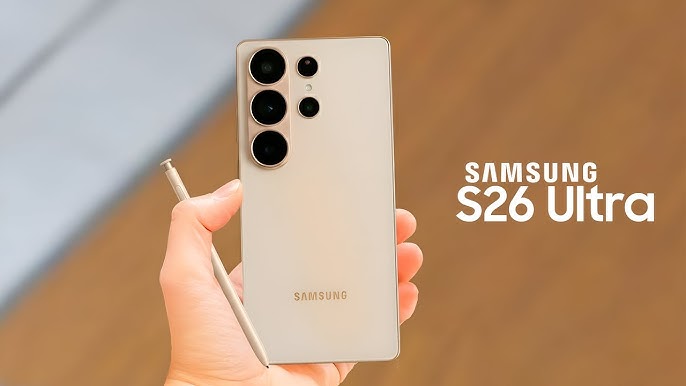
Samsung Galaxy S26 Ultra: faster wireless charging, familiar formula
Samsung’s next ultra-flagship is beginning to take shape, and charging appears to be a central storyline. The Galaxy S25 Ultra shipped with 45W wired charging and 15W wireless charging. Multiple reports now point to a bigger headline for the successor: the Galaxy S26 Ultra is rumored to move to 60W wired and, crucially, a bump to 25W wireless. That’s a meaningful step up on paper and, if the thermal design cooperates, should translate into shorter top-ups on a stand or pad.
The wireless jump matters because it’s the part you feel daily. Cable bursts are great for emergencies, but many people live on desks and nightstands where the phone rests and sips power constantly. Moving from 15W to 25W doesn’t sound dramatic, yet it can shave notable minutes off the 0–50% window and make quick top-ups during a coffee break more realistic – again, assuming the charging coil and heat management are tuned to hold peak power instead of throttling early.
There’s also chatter about the rest of the family. The vanilla Galaxy S26 and S26+ are tipped to step up from 15W to 20W wireless. That aligns the range around faster untethered charging without pushing every model to Ultra levels. As for reverse wireless charging, the S25 Ultra supported 4.5W. It’s currently unclear whether the S26 Ultra will stick with that or nudge higher.
Dimensions are another intriguing piece. A well-known tipster has circulated what they call “official and accurate data,” listing the S26 Ultra at 163.6 × 78.1 × 7.9 mm and the standard S26 at 149.4 × 71.5 × 6.9 mm. Other reports have floated slightly different numbers for the smaller model (149.5 × 71.6 × 7.24 mm and earlier 149.3 × 71.4 × 6.96 mm). In short: the Ultra still reads as a tall slab with squared shoulders; the regular S26 continues to chase a compact-ish footprint. As always with pre-launch dimensions, file under “likely but not final” until Samsung publishes the spec sheet.
These leaks arrive alongside renders credited to familiar CAD leakers, suggesting a design language that doesn’t rip up the playbook. That’s sparking a familiar debate among fans: should an Ultra be the place where Samsung goes wild with batteries, charging, and cameras, or is the deliberate, reliability-first cadence part of the appeal? Some enthusiasts argue that Chinese rivals already deliver 40–80W wireless and triple-digit wired speeds, making 25W/60W feel conservative. Others counter that sustained performance, battery health, and global certification (plus wide accessory compatibility) matter more than one-shot peaks on a chart.
Context helps. Wireless charging speeds are only half the experience; sustained power, surface temperature, pad alignment tolerance, and software smarts (like learning your routine to slow-charge overnight) decide whether the feature feels premium or gimmicky. If Samsung’s 25W target is paired with tighter thermal envelopes and smarter ramps, it could feel like a bigger upgrade than the wattage alone implies. Conversely, if it spikes briefly before settling near 15–18W, the improvement will look modest in real life.
Here’s the snapshot of what’s being whispered right now:
- Galaxy S26 Ultra (rumored): 60W wired; 25W wireless; reverse wireless TBD; 163.6 × 78.1 × 7.9 mm.
- Galaxy S26 / S26+ (rumored): 20W wireless (up from 15W previously).
- Galaxy S25 Ultra (reference): 45W wired; 15W wireless; 4.5W reverse wireless.
Beyond the numbers, the branding question lingers. “Ultra” sets expectations: a sense that every spec is turned up. If the S26 Ultra arrives with faster wireless and higher wired speeds but otherwise hews closely to an established hardware recipe, some power users will inevitably label the upgrade incremental. Yet the mainstream audience that actually buys millions of Galaxies may appreciate a steadier evolution: better charging, familiar ergonomics, accessories that still fit, and a platform tuned for longevity.
Bottom line: if the leaks hold, 25W wireless broadens convenience in daily use, 60W wired shortens those last-minute top-ups, and the chassis remains comfortably familiar. The last word, as always, awaits Samsung’s official unveiling, which will settle the dimension discrepancies and confirm whether reverse wireless charging gets love this cycle.
1 comment
Y’all saying nobody cares about Galaxy… meanwhile Samsung selling trucks of them. Echo chamber much 😂