Samsung Galaxy Book6 Pro Leak Points to Intel Core Ultra Series 3 “Panther Lake” – What the Early Benchmarks Do (and Don’t) Tell Us
Samsung’s next premium ultrabook, the Galaxy Book6 Pro, has surfaced in a public benchmark listing carrying Intel’s Core Ultra Series 3 “Panther Lake” silicon. It’s our clearest signal yet that laptop makers are lining up designs for Intel’s post-Arrow/Lunar generation, promising faster performance, smarter AI acceleration, and better efficiency. But as with any pre-launch sighting, you need to separate what’s genuinely indicative from what’s just noise.
The sample spotted is configured with a Core Ultra 5 338H, a mainstream 45W-class part aimed at thin-and-light performance laptops. The database entry notes a 1.90 GHz base clock with an expected boost in the sub–5.0 GHz range (around 4.7 GHz for this SKU). Core topology continues the hybrid pattern: 4 Performance cores, 4 Efficiency cores, and 4 Low-Power E-cores (often used for background and bursty tasks). On paper, that mix should improve sustained responsiveness in a slim chassis while keeping thermals in check.
Graphics are where the leak triggered the loudest debate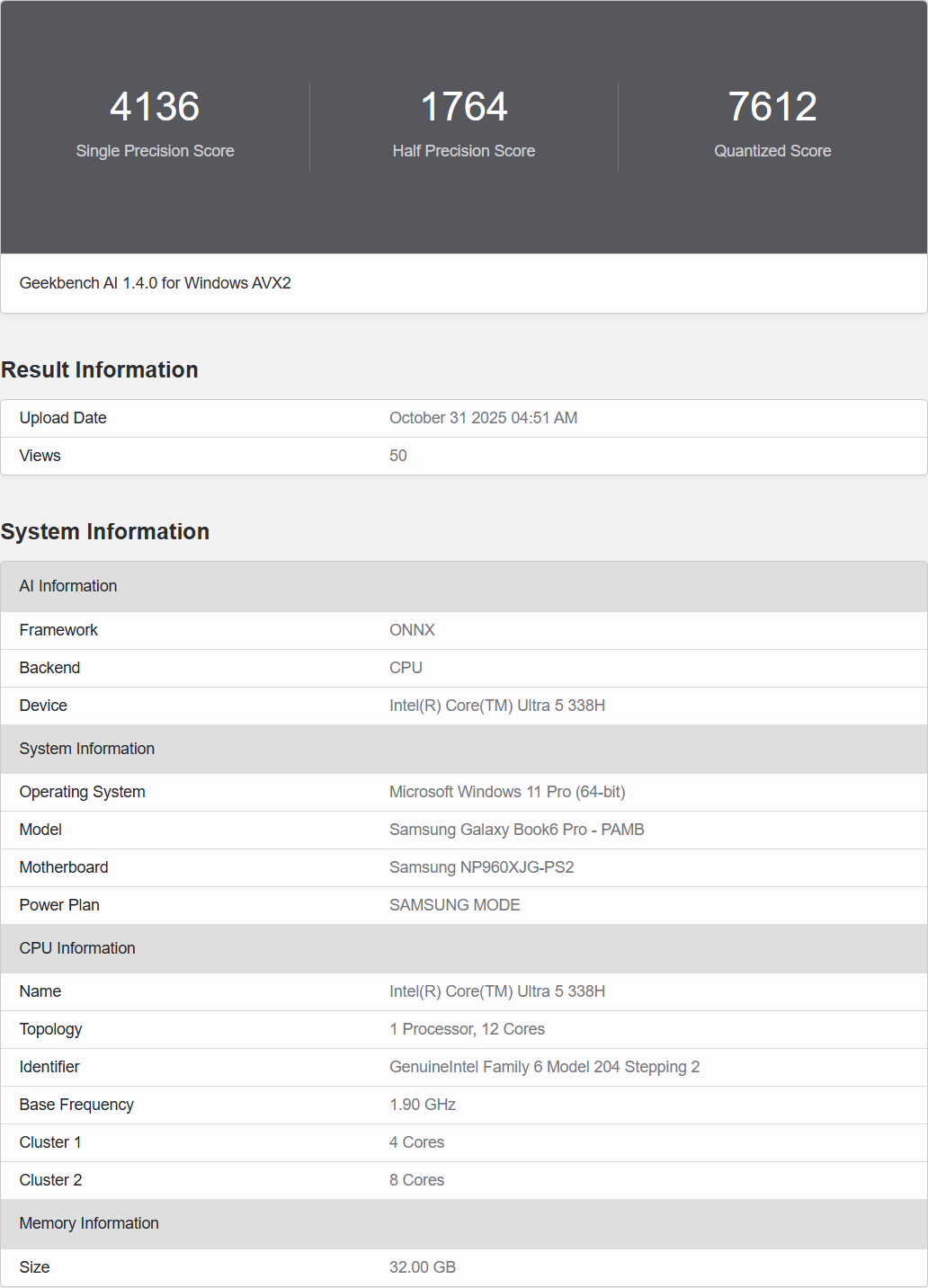
. The listing references an Arc B370 iGPU on the new Xe3 architecture. One early readout said four Xe3 cores; community analysis quickly pushed back, pointing to prior guidance that B370 targets around 10 Xe3 cores, with a potential B390 tier stepping to 12 cores. That discrepancy is a classic example of why pre-release database fields can misreport or omit capabilities. Expect final silicon – and Samsung’s tuning – to land closer to the higher-core interpretation. Either way, Xe3 should bring a generational bump in media blocks and modern APIs, and paired with faster LPDDR, could be a meaningful leap for light gaming and creator workloads.
Another point of confusion came from AI “benchmarks” attached to the leak. They were apparently executed via the ONNX runtime on the CPU, not on the iGPU or the on-die NPU. That’s not representative of what Panther Lake will do once laptop makers wire models to the right accelerator. The real story for 2025–2026 laptops is where your workload lands: CPU for control and scalar logic, iGPU for highly parallel graphics/tensors, NPU for power-efficient on-device inference. Until we see numbers from the NPU and Xe3 paths, treat any early AI scores as a placeholder rather than a verdict.
Zooming out, Samsung’s Galaxy Book line typically pairs sleek magnesium chassis with high-resolution OLEDs, quiet fans, and solid battery life. Slotting Panther Lake into that template hints at a practical upgrade path: longer unplugged time at the same performance – or more performance at the same acoustics. Expect refinements like Wi-Fi 7, faster storage, and smarter background AI features (summarization, transcription, camera effects) running mostly on the NPU to keep drain low.
For those tracking the stack, here’s a spec snapshot of rumoured H- and U-series placements (subject to change as final SKUs firm up):
| Model | P/E/LP-E | Base / Boost | iGPU (Xe3) | Power |
|---|---|---|---|---|
| Core Ultra 5 338H | 4 / 4 / 4 | 1.9 / ~4.7 GHz | B370 (~10 cores expected) | 45W |
| Core Ultra 7 358H | 4 / 8 / 4 | ~1.9 / ~4.8 GHz | B370/B390 (tbd) | 45W |
| Core Ultra X7 368H | 4 / 8 / 4 | tbd | Up to 12 cores (rumored) | 45W |
| Core Ultra X9 388H | 4 / 8 / 4 | tbd | Top Xe3 config (tbd) | 45W |
| Core Ultra 7/5 U-series | 4 / 0–4 / 4 | tbd | B3xx | 15–28W |
As for timing, indications are that initial Panther Lake SKUs arrive this quarter with a broader reveal and OEM wave around January at CES 2026. That lines up with Samsung’s usual cadence of showing its premium notebooks alongside major silicon milestones.
So what’s the verdict so far? This leak says the Galaxy Book6 Pro will lean on Intel’s next architecture for a balanced blend of CPU snap, stronger integrated graphics, and practical, platform-level AI. It does not tell us final iGPU core counts, NPU TOPS, or Samsung’s exact chassis/cooling choices – each of which can swing real-world results. If you’re shopping in this bracket, watch for: (1) confirmed NPU throughput and which apps use it; (2) memory bandwidth (LPDDR speed and channels); (3) display (OLED refresh, brightness, color); and (4) acoustics under load. Those will matter more than any stray early benchmark field.
Bottom line: Panther Lake in a Galaxy Book chassis looks promising for mobility, but the smart read is to wait for fully accelerated AI tests and final iGPU specs. Treat every pre-launch number with the usual grain of salt – and keep an eye on how Samsung tunes the Book6 Pro to make those watts really count.
1 comment
Pretty sure B370 is ~10 cores. That 4-core line is a placeholder, chill