Imagine paying ten thousand dollars for a flagship workstation graphics card and watching it become literal e waste because a small PCIe connector board snapped and cannot be replaced. 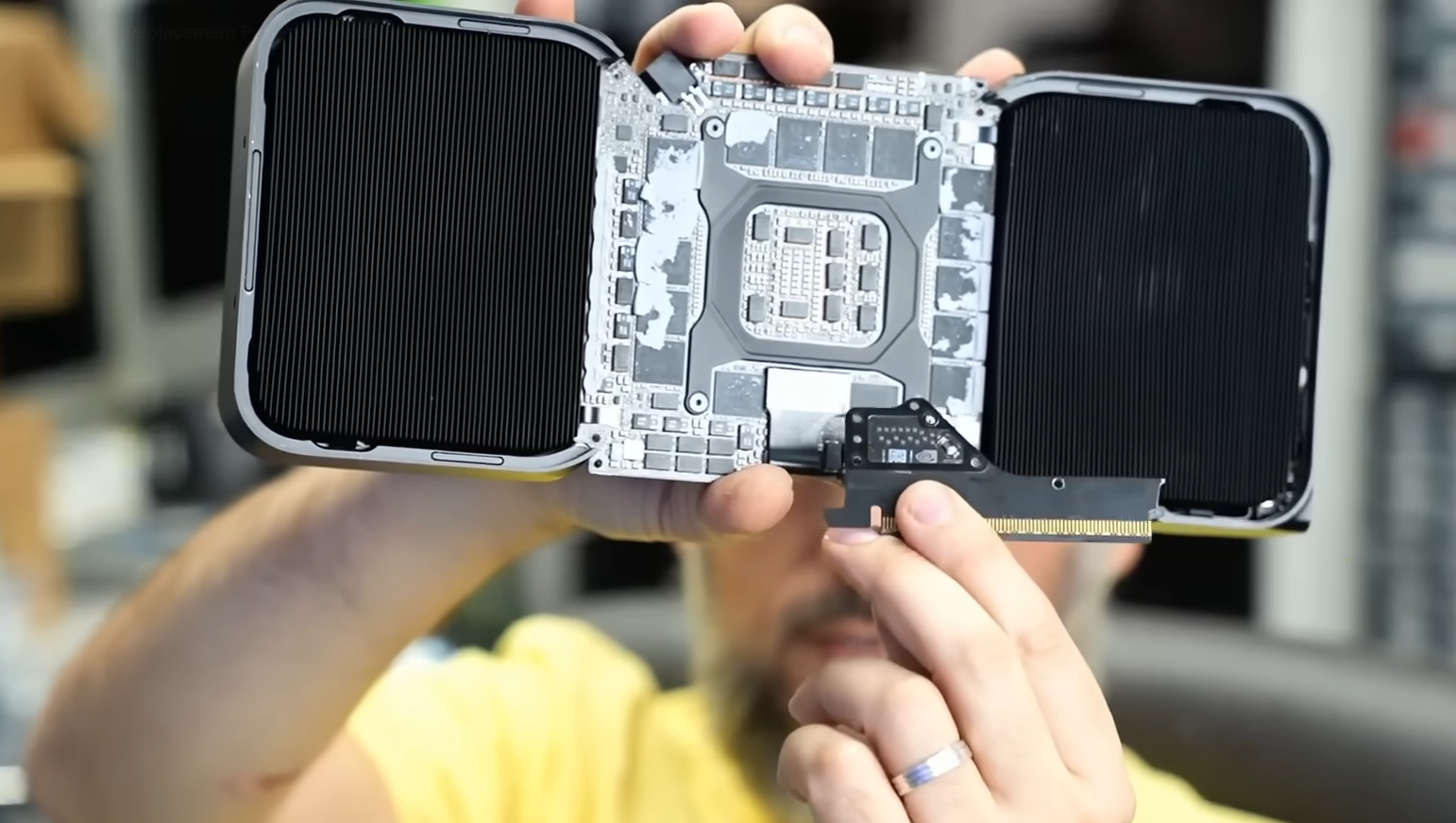
That is exactly what happened to an owner of an NVIDIA Blackwell RTX Pro 6000, a card positioned as a premium work tool for studios, engineers and creators, yet vulnerable to a surprisingly fragile piece of hardware and a closed spare parts policy.
The card in question was sent to a well known repair specialist after it stopped working. At first glance, the main PCB, memory and GPU core were intact. The real problem was hidden at the bottom edge of the card, where NVIDIA now uses a modular design: instead of the PCIe edge being part of the main PCB, there is a separate daughterboard that plugs into the GPU board and then into the motherboard slot. The same approach appears on the RTX 5090 Founders Edition, which has already been criticized for prioritizing compact design over long term serviceability.
In this case, the owner made a mistake that a lot of people have made at some point: they shipped the entire assembled PC with the heavy GPU still mounted. During transit, the mass of the RTX Pro 6000 and the inevitable bumps combined to flex the card. The result was brutal. The little PCIe daughterboard cracked in half, taking the connector with it. The main GPU board and its PCIe pads remained perfectly fine and could technically accept a fresh connector board, but there was no spare to be found.
That is where the bigger issue appears. NVIDIA does not sell these PCIe boards as standalone parts, and they are not stocked by distributors. They are proprietary, undocumented components reserved for internal repairs and authorized service centers. In an earlier incident with a damaged RTX 5090, the company chose to replace the entire card rather than ship a small part. For that lucky owner, a brand new GPU solved everything. For this RTX Pro 6000 user, there is no such guarantee, and the cost difference is painful when the card is roughly four to five times more expensive.
From a repair perspective, this is frustrating. The card is not truly dead in any technical sense. With a replacement PCIe daughterboard, a capable technician could reconnect the two PCBs and return a ten thousand dollar tool to service. Instead, the whole product becomes extremely expensive scrap, all because a tiny board that probably costs a few dollars to manufacture is locked behind corporate policy. It is a textbook example of how modern modular design can be hostile to independent repair if replacement modules are not available.
The controversy also feeds into a wider conversation about right to repair and e waste. In parts of Europe, regulations already require manufacturers to provide spare parts for many categories of household electronics for several years. Computer components sit in a grey zone, but cases like this make it very clear why advocates want clearer obligations for high end hardware as well. When a professional card this expensive is effectively disposable after a relatively minor physical failure, the environmental and economic costs are hard to justify.
Commenters watching the repair video reflect that tension. Some argue that NVIDIA will simply handle it the corporate way, replacing the entire card under warranty and quietly refurbishing the broken unit to send to someone else later. Others push back on repair channels, accusing them of sensationalizing design flaws for clicks. At the same time, many professionals are simply shocked at how fragile such critical parts can be and how little recourse they have if they fall outside a friendly warranty decision.
Practical lessons are obvious. Never ship a system with a large, heavy GPU still installed, especially workstation models that can weigh more than the rest of the build. Always remove the card, use anti static bags and thick foam, and secure the cooler so it does not flex the PCB. Yet good shipping discipline should be a second line of defense, not the only barrier between a working ten thousand dollar card and financial disaster. A robust design ought to tolerate a reasonable amount of mishandling, and a modular design should be backed by modular support.
The irony is that the modular PCIe board likely makes life easier for NVIDIA during manufacturing and quality control. It allows them to reuse common parts, swap boards on their own repair benches and optimize assembly. For customers, however, it becomes an invisible single point of failure. Some viewers even joke that the only way to get a spare PCIe board for an RTX Pro 6000 is to buy a second card and cannibalize it, a darkly comic reminder of how little ownership people really have over the hardware they pay for.
Right now, there are no custom partner versions of the Blackwell RTX Pro 6000, so professionals have no alternative design to choose from. If you want this level of performance, you are locked into this exact layout and its trade offs. Until NVIDIA decides to provide replacement connector boards, or rethinks the design in a future revision, owners are left walking a tightrope. One cracked daughterboard can separate a studio from the computing power it relies on, turning a premium workstation investment into an avoidable e waste tragedy.