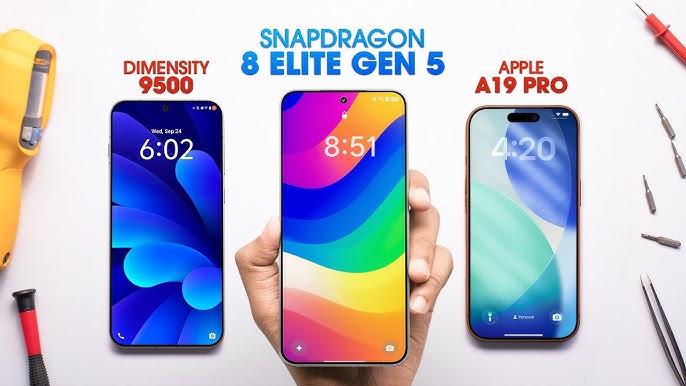
Realme GT8 Pro Benchmarks Explained: Snapdragon 8 Elite Gen 5 vs Dimensity 9500 vs Apple A19 Pro
The Realme GT8 Pro has moved from an intriguing prototype to a retail-ready flagship, and that means we can finally put its Snapdragon 8 Elite Gen 5 platform through a full, apples-to-apples set of tests. Over the last several weeks we’ve also measured multiple rival devices running the same Qualcomm silicon, MediaTek’s Dimensity 9500, and Apple’s A19 Pro. With that wider context, the GT8 Pro’s numbers tell a much richer story than a single score screenshot can. Below, we unpack what the benchmarks actually mean, why two phones with the same chip can land in very different places, and where each platform truly shines – from bursty daily tasks to marathon gaming sessions with heavy graphics and ray tracing.
Why this comparison matters right now
2025’s Android flagships are anchored by two architectures: Qualcomm’s Snapdragon 8 Elite Gen 5 and MediaTek’s Dimensity 9500. Apple’s A19 Pro sets the reference on the iOS side and remains the single-core pace-setter. Realme’s GT8 Pro is one of the first widely available handsets with Qualcomm’s newest Adreno 840 GPU, and it goes head-to-head with phones like the Xiaomi 17 Pro Max (same Snapdragon) and the vivo X300 Pro/Oppo Find X9 Pro (both on Dimensity 9500). We also keep a few last-gen heavyweights in the mix – Oppo Find X8 Ultra, Xiaomi 15 Ultra, Realme GT 7 Pro – to see how much real advancement you’re getting year over year.
AnTuTu: the kitchen-sink benchmark (and why scores jump between versions)
Let’s start with AnTuTu because it blends CPU, GPU, memory, storage, and UX tasks into one composite figure. Our move to AnTuTu v11 shows the GT8 Pro’s Snapdragon 8 Elite Gen 5 leading by a healthy margin over competing 8 Elite Gen 5 devices, including a roughly nine percent edge over the Xiaomi 17 Pro Max in our like-for-like runs. The same Qualcomm platform also posts an advantage over Dimensity 9500 phones in v11, even though in v10 some Dimensity devices could creep ahead.
Two caveats matter here. First, do not compare v10 and v11 scores directly; AnTuTu adjusts its workloads every major revision, which naturally inflates the absolute numbers over time. Second, because AnTuTu mixes in memory bandwidth and storage behavior, the surrounding hardware and OEM tuning heavily influence results. The GT8 Pro’s fast RAM configuration and aggressive performance mode help Qualcomm’s silicon stretch its legs in v11. When we pivot to the older v10 for continuity with prior generations, the GT8 Pro’s uplift over last year’s GT 7 Pro lands around eight percent – solid, but not the night-and-day leap a raw score could imply.
Geekbench 6: single-core, multi-core, and what they imply
Geekbench 6 isolates CPU throughput. In single-core, Apple’s A19 Pro stays ahead – about six percent over the Snapdragon 8 Elite Gen 5 in our testing. That gap essentially vanishes once you move to multi-core where Qualcomm pulls level, and variations fall within typical run-to-run noise. MediaTek’s Dimensity 9500 trails the Snapdragon 8 Elite Gen 5 by roughly nine percent in both single- and multi-core, placing it closer to last year’s Snapdragon 8 Elite CPU cluster than to Qualcomm’s newest peak.
What does this mean in the real world? Single-core dominance influences those one-off interactions – snappy app launches, quick UI logic, lightweight scripting. Multi-core parity tells you that heavy multitasking, parallel workloads, and background processing are now competitive across Snapdragon and Apple. MediaTek’s cluster is comfortably fast for daily use but gives up a bit of peak headroom on intensive compiles, multi-threaded encodes, or pro-grade photo stacks.
GPU (3DMark Wild Life Extreme): peak vs sustained – the real plot twist
On paper, Qualcomm’s Adreno 840 is a monster – and the GT8 Pro proves it. In Wild Life Extreme “Highest” (the best of multiple back-to-back runs), the Realme peaks at the top of the chart, narrowly ahead of Dimensity 9500 phones and decisively clear of last-gen Adreno 830 devices. That validates Qualcomm’s architectural gains and Realme’s willingness to let the chip draw power for a big first lap.
But the second tab – “Lowest” – is where the narrative flips. After thermal saturation, the GT8 Pro’s sustained score collapses by about sixty-seven percent from its best burst. Meanwhile, the Xiaomi 17 Pro Max (same Snapdragon) drops by roughly forty percent and ends up well ahead of the Realme over a long run. Dimensity 9500 handsets also look better under heat, and the surprise overachiever is the Oppo Find X8 Ultra with last year’s Snapdragon 8 Elite/Adreno 830: it never reaches the new-gen peaks, but its consistency keeps it in front of several fresh 2025 rivals after throttling. If your use case is ten-minute gaming sprints between meetings, the GT8 Pro’s rocket-like first minute is a win. If you grind thirty-to-sixty-minute sessions with max graphics, Realme’s current software and cooling balance need work.
Ray tracing (3DMark Solar Bay): MediaTek’s quiet triumph
Solar Bay targets hardware-accelerated ray tracing, and the gains generation-to-generation are stark. MediaTek’s second-gen RT hardware inside the Dimensity 9500 pushes the top scores here. Qualcomm shows clear progress versus last year, and the GT8 Pro’s Adreno 840 posts a strong number – but still trails Dimensity’s best. Apple’s A19 Pro is in the mix, yet it doesn’t set the ceiling in this specific RT scenario. For games that deploy reflections, soft shadows, or hybrid GI with RT toggles, Dimensity-based phones currently look like the pragmatic “enable and forget” choice.
So why do identical chips score differently across phones?
Two reasons dominate: thermal envelope and OEM performance curves. Smartphones have a sustained heat dissipation window of roughly six to seven watts under typical circumstances without external aids. New top-tier SoCs can spike far higher – north of twenty watts briefly on an all-core GPU blast. OEMs then decide how aggressively to front-load that performance. That’s the “race to idle” playbook: finish the frame or the task as fast as possible at a high instantaneous wattage, then drop to low power states. It can feel great for short runs and UI fluidity, but if the cooling stack can’t hold the line, clocks tumble after a few loops. In our sample, Realme appears to prioritize peak snappiness, where Xiaomi tunes for a more conservative slope that yields better sustained scores. Neither is universally “right”; they’re choices aligned with different user expectations.
Context for the claims vs reality debate
Pre-launch marketing and early engineering numbers often float idealized targets: 4M+ in AnTuTu, 4,000/12,000 in Geekbench 6, unprecedented sustained GPU gains. Retail devices sit between ambition and physics. Once you factor in handset thickness, vapor chamber area, graphite layering, back cover materials, chassis conductivity, and how a vendor caps power under skin temperature limits, the picture gets messier. Our data suggests that while peak numbers are up across the board, sustained behavior is where 2025 phones – and Qualcomm’s 8 Elite Gen 5 in particular – still wrestle with thermals unless the OEM builds for it (gaming phones with more copper, active fan cases, or deliberately thicker frames).
What the Realme GT8 Pro is excellent at
- Instant responsiveness: App launches, UI transitions, camera fire-to-capture, and short creative exports benefit from Realme’s aggressive front-loading. It often “wins the first minute.”
- CPU balance: Multi-core parity with Apple’s A19 Pro and leadership over Dimensity 9500 in our runs make it a dependable productivity phone. Whether you’re batch-editing images, running heavy web apps, or juggling multiple workspaces, the GT8 Pro holds up.
- Feature-forward GPU: The Adreno 840 has the headroom to push high-refresh screens and complex scenes – if you keep sessions short or cool the device.
Where the GT8 Pro needs improvement
- Sustained GPU thermals: That striking sixty-seven percent drop in Wild Life Extreme lowest score is the headline drawback. Gamers will notice frame pacing swings over time at top settings.
- Thermal governance: The performance mode appears eager initially but may need smarter ramp-down logic to stabilize the experience instead of cliff-like throttles.
- Ray tracing: It’s better than last year’s Snapdragon parts, but Dimensity 9500 leads in Solar Bay. Expect to dial back some toggles or rely on upscalers to keep RT playable in long sessions.
How to read the charts like a pro
Do not compare AnTuTu v10 to v11. Treat them as separate datasets. Within any one version, focus less on the absolute number and more on the spread between devices with the same chip. If the same SoC posts a big delta, you’re seeing memory config differences and OEM tuning.
On Geekbench 6, single-core is your “tap-to-open” smoothness barometer; multi-core speaks to pro workflows and longevity under CPU-heavy multitasking. A six percent single-core gap is perceptible in benchmarks, minor in hand. Multi-core ties are functionally indistinguishable outside edge workloads.
For 3DMark Wild Life Extreme, always open the “Lowest” tab. That’s your proxy for a game after the heat soaks in. A phone that looks average at “Highest” but barely drops at “Lowest” may actually feel better in a real match than a chart-topping sprinter that nose-dives at minute eight.
How to get the most out of the GT8 Pro (practical tips)
- Use the right performance profile: Realme’s performance/balanced modes matter. Balanced can hold steadier frame rates across a full game, while Performance shines for quick bursts.
- Mind your case and environment: Thick cases trap heat. If you’re playing for more than ten minutes, consider removing the case and avoiding sunny spots.
- Lock to a smart frame target: If a game offers 60/90/120fps options with resolution sliders, try 90fps with a medium-high resolution rather than 120fps at max. You’ll get smoother overall play.
- Consider cooling accessories: Clip-on fans or backplates aren’t just gimmicks for this generation – sustained wattage requirements make them genuinely useful.
- Keep drivers and updates current: GPU stability often improves in the first few firmware updates. Realme and game studios routinely ship fixes that reduce throttling spikes.
What about the Galaxy variant and last year’s champs?
Samsung’s “for Galaxy” Snapdragon bins tend to be tuned slightly differently. In our datasets, the S25 Ultra’s sustained numbers sit in a conservative, stable envelope – good for long camera use and steady gaming, less showy on the first loop. Meanwhile, 2024’s Oppo Find X8 Ultra exemplifies why consistency matters: an older Adreno 830 can overtake newer chips once the new guys throttle. If you value unwavering frame times over five-minute highs, last year’s premium phones remain excellent.
Apple A19 Pro in perspective
Apple’s single-core lead lives on, but the A19 Pro no longer enjoys the two-generation cushion it once had. Multi-core parity with Snapdragon in Geekbench 6 means iOS and Android buyers are choosing ecosystems and features, not raw CPU dominance. On the GPU side, Apple’s sustained behavior is decent but not exceptional versus the best Dimensity/Adreno competitors this cycle. For RT, the iPhone trails Dimensity’s best Solar Bay scores and can’t simply brute-force its way out of the thermal box on long runs.
Dimensity 9500’s value proposition
MediaTek’s pitch is clear: excellent RT hardware, strong sustained behavior, and CPU performance that – while a step behind Snapdragon 8 Elite Gen 5 – remains more than sufficient for daily flagship duties. If you prioritize long, stable gaming sessions with RT effects enabled, a Dimensity 9500 phone like the vivo X300 Pro or Oppo Find X9 Pro presents a well-balanced package.
Scoreboard in plain English
- Fastest bursts (general): Realme GT8 Pro on Snapdragon 8 Elite Gen 5.
- Best sustained GPU (among our Android sample): Dimensity 9500 phones and some last-gen Snapdragon 8 Elite devices with conservative tuning.
- Ray tracing leader: Dimensity 9500 family.
- Single-core CPU crown: Apple A19 Pro (small margin), with Snapdragon essentially tied in multi-core.
- Most controversial stat: GT8 Pro’s ~67% GPU drop under sustained load.
Buying guidance by user type
Casual users and creators: The GT8 Pro is a joy. It’s lightning-fast in the day-to-day, renders short edits briskly, and makes the UI feel ultra-responsive. If you don’t play heavy games for more than ten minutes at a stretch, its weaknesses won’t show.
Competitive mobile gamers: Consider a Snapdragon 8 Elite Gen 5 device with more conservative thermal tuning (e.g., Xiaomi’s approach), a gaming-focused Snapdragon model with bigger vapor chambers, or a Dimensity 9500 phone if you crave stable RT. Pairing any of these with a clip-on cooler pays dividends.
Long-haul power users: If your workload involves hour-long navigation in hot cars, 4K video capture, or extended rendering, prioritize devices with proven sustained graphs – even a top 2024 model can be the smarter pick.
Final verdict on the Realme GT8 Pro
Realme built a phone that wins the sprint. In the synthetic world of “first loop” charts, the GT8 Pro’s Snapdragon 8 Elite Gen 5 and Adreno 840 combination sets the pace, backed by quick RAM and assertive power policies. Shift to long races, however, and the GT8 Pro’s thermal cliff arrives early, letting better-balanced rivals stride past by the midway point. None of this makes the device a poor buy; it simply clarifies who it’s for. If you value instant zip, love chasing the highest possible score, or spend your time in bursts rather than sessions, the GT8 Pro will feel sensational. If your definition of performance is “the same smooth frame 30 minutes later,” look to a cooler-tuned Snapdragon, a Dimensity 9500 flagship, or a gaming model designed for the grind.
As firmware matures and game engines add smarter frame reconstruction, we expect the GT8 Pro’s sustained profile to improve. For now, treat it as a very fast sports car: devastating off the line, thrilling on a good road, and a bit temperamental when heat builds. Know that, drive it right, and you’ll love the ride.
1 comment
Dimensity cooking in Solar Bay is wild. RT finally looks usable on mobile