Qualcomm is doubling down on its ambition to challenge Intel and AMD in the laptop space with the launch of its new Snapdragon X2 Elite family, which includes the Snapdragon X2 Elite and the more powerful Snapdragon X2 Elite Extreme. 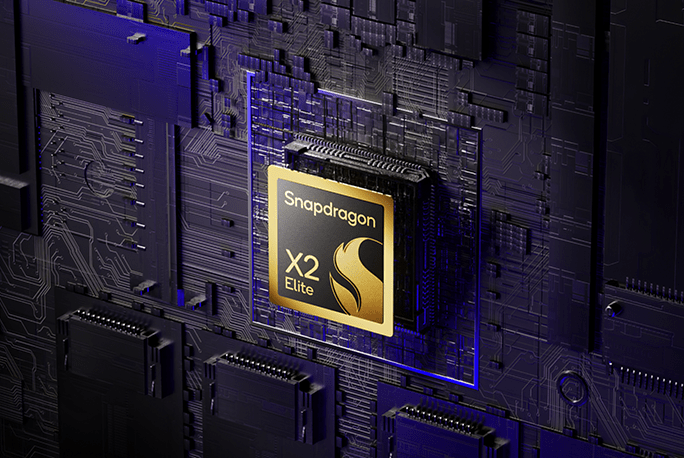
These new processors mark Qualcomm’s second major push into Windows on Arm laptops and arrive with bold claims of significant improvements in both raw performance and energy efficiency compared to the first-generation Snapdragon X Elite.
The new lineup features three distinct models. The baseline X2 Elite (X2E-80-100) comes with 12 CPU cores, while the X2 Elite (X2E-88-100) and the top-tier X2 Elite Extreme (X2E-96-100) both feature 18 cores. All are manufactured on TSMC’s advanced 3 nm process node, allowing Qualcomm to pack in more power while promising better thermals and efficiency. At the high end, the X2 Elite Extreme is designed for what the company describes as “expert-level workloads,” while the standard Elite models are positioned for demanding productivity and creative use cases on premium laptops.
The Extreme variant showcases Qualcomm’s most aggressive configuration yet, with 12 prime cores clocked at 4.4 GHz and capable of boosting up to 5.0 GHz, while six performance cores reach up to 3.6 GHz. The other 18-core X2 Elite model maintains slightly lower frequencies, while the 12-core variant offers a more balanced split between efficiency and performance. All chips share Qualcomm’s third-generation Oryon CPU architecture – the same family of cores that power the Snapdragon 8 Elite Gen 5 smartphone chip, but scaled up for the PC environment.
Performance claims are bold: Qualcomm touts up to 31% faster CPU speeds at the same power levels and 43% lower power consumption compared to its previous X Elite generation. This kind of improvement could prove vital, especially as Windows on Arm systems have long struggled with performance-per-watt metrics when compared to Apple’s M-series Macs or traditional x86 laptops. In terms of graphics, the new Adreno GPU promises a 2.3x increase in performance per watt, alongside support for DirectX 12.2 Ultimate, Vulkan 1.4, and OpenCL 3.0 – features aimed at making the platform more competitive for gaming and graphics-heavy tasks.
AI is also at the forefront. Each X2 Elite variant integrates Qualcomm’s latest Hexagon NPU, capable of 80 TOPS (trillions of operations per second) of AI processing, which the company claims is the fastest neural processing unit available for laptops. This aligns with the current industry-wide emphasis on AI-accelerated workflows, from productivity assistants to creative tools. Combined with LPDDR5X RAM support, UFS 4.0 storage, and a massive memory bandwidth of up to 228 GB/s on the Extreme chip, Qualcomm is clearly trying to position its processors as cutting-edge for both work and play.
Still, excitement is tempered by long-standing concerns around software. While the hardware looks capable on paper, Windows on Arm has historically struggled with app compatibility, forcing users to rely on emulation layers for many third-party programs. Native ARM app support is slowly improving, with more developers producing optimized versions, but the ecosystem remains less mature than traditional x86 Windows machines. For many enthusiasts, this remains the single biggest question mark hanging over Qualcomm’s PC ambitions.
The first laptops powered by Snapdragon X2 Elite processors are slated to arrive in Spring 2026. That timeline has sparked frustration among some observers, who point out that Qualcomm risks missing the crucial holiday shopping window and giving competitors a head start. Intel and AMD, never slow to react, are expected to update their lineups within the same period, and they maintain the key advantage of broad native software support.
For consumers, the Snapdragon X2 Elite series offers an intriguing promise: sleek, fan-efficient Windows laptops with potentially multi-day battery life and strong AI acceleration. But for Qualcomm, the challenge lies not just in delivering raw silicon power – it must convince buyers and developers alike that Windows on Arm is finally ready to go mainstream. If it succeeds, the X2 Elite Extreme could become a genuine rival to Apple’s M-series laptops and perhaps inject some much-needed energy into a stagnant Windows PC market. If not, the X2 Elite might end up another ambitious but niche experiment in a space still dominated by x86 giants.
1 comment
gpu perf boost looks good but software must catch up, else pointless