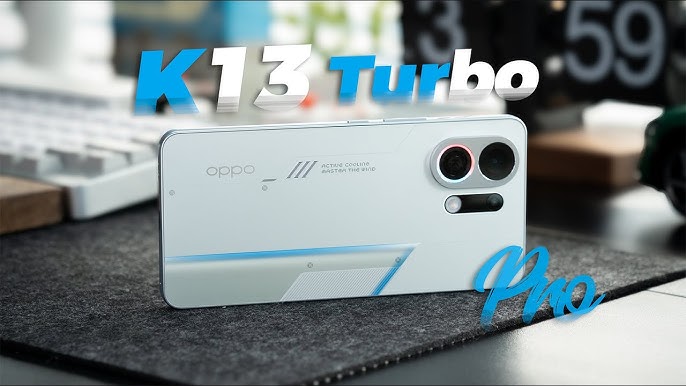
Oppo K13 Turbo Pro Hands-On Review: Massive Battery, Built-In Cooling Fan, and Mid-Range Ambitions
The mid-range smartphone market has become an arms race of specifications and gimmicks, and Oppo’s latest contender, the K13 Turbo Pro, represents a bold swing at standing out. Unveiled in China in July and now introduced in India, the K13 Turbo Pro arrives with a unique proposition: a huge 7,000 mAh battery paired with a built-in cooling fan. It’s a phone designed to convince gamers and heavy users that they can push their device harder without overheating. But is it a game-changer or just another clever marketing ploy?
We spent extensive time with the K13 Turbo Pro to see how it performs in real-world usage, how its active cooling stacks up against competitors, and whether its extra-large battery really delivers on endurance. Along the way, we also compared it to rivals like the Poco F7 and Nothing Phone (3), while factoring in user perspectives on whether built-in fans are practical or just gimmicks. Let’s dive in.
Design, Build Quality, and In-Hand Feel
The Oppo K13 Turbo Pro arrives in a bold purple retail box that immediately positions it as a phone with flair. Inside, the package includes the essentials: a SIM ejector tool, protective case, documents, USB-C charging cable, and an 80W power adapter. Oppo clearly wants buyers to feel the value right out of the box, as the charger is included rather than sold separately – a detail increasingly rare in today’s market.
At the front, you’ll find a massive 6.8-inch AMOLED display with a crisp 2800×1280 resolution and smooth 120Hz refresh rate. Oppo opts for LTPS AMOLED protected by AGC DT-Star D+ glass, with impressive specs such as 10-bit color depth, 240Hz touch sampling, and peak brightness of 1,600 nits. Whether gaming indoors or streaming content under bright sunlight, visibility is excellent. The display supports Dolby Vision, HDR10+, HDR10, and HLG codecs, while Widevine L1 certification ensures full HD streaming across major platforms.
The refresh rate can be adjusted manually (60Hz, 90Hz, or 120Hz) or left to Auto-select mode, which balances smoothness and battery efficiency. Oppo also adds unique touches like Wet Touch (usable when screen or fingers are damp) and Glove Mode, supporting operation even with cotton, wool, or sheepskin gloves under 5mm thickness. These additions reflect Oppo’s attempt to stand out through practical usability features rather than just raw specs.
That said, the K13 Turbo Pro is a large device. At 6.8 inches, one-handed usage is difficult, and its boxy back lacks the curvature that would make it more comfortable. The Silver Knight edition – the version we tested – has a matte finish inspired by “high-speed motorcycle metal,” resisting fingerprints while providing decent grip. Branding phrases like “Active Cooling” and “Master The Wind” are printed on the back, hammering home the fan gimmickry. While the device doesn’t feel as premium as ultra-flagships, it doesn’t feel cheap either.
Camera Setup and the Built-In Cooling Fan
At first glance, the rear squircle-shaped camera module seems like it hosts three cameras. But in reality, Oppo fits two cameras plus its unique cooling system. The primary sensor is a 50MP OmniVision OV50D40 with optical image stabilization, capable of shooting 4K at 60fps. The secondary is a simple monochrome OmniVision OV02B1B, more of an afterthought than a serious shooter.
Where you’d expect another lens sits the cooling fan, surrounded by RGB Mist Shadow breathing LEDs. It’s here Oppo’s engineering experiments shine. The fan uses 0.1mm blades spinning up to 18,000 RPM, with an arc-shaped vortex design intended to optimize airflow. Oppo claims the fan boosts air intake by 10% and heat dissipation efficiency by three times compared to conventional methods. Combined with a 7,000mm² vapor chamber, the system is meant to keep performance steady under heavy gaming or long sessions.
The fan isn’t just technical – it’s customizable. Users can toggle between Smart Shifting and Full Speed cooling modes, set auto-activation during gaming or charging, and even select startup sound effects like Storm, Howl, or Battle. The RGB lights support eight color effects, appealing directly to mobile gamers who love customization.
However, there are caveats. The fan only runs when the screen is on, meaning background cooling is impossible. Benchmark tests even revealed an oddity: scores sometimes dipped when the fan was active. Despite the impressive specs, users are left wondering if the cooling is a true benefit or just a flashy gimmick.
Performance: Benchmarks vs Real-World Gaming
Under the hood, the K13 Turbo Pro is powered by the Snapdragon 8s Gen 4 with up to 12GB LPDDR5X RAM and 256GB UFS 4.0 storage. Our unit, with 12GB RAM/256GB storage, ran ColorOS 15 on Android 15. Oppo promises two years of OS updates and three years of security patches, which is competitive in this segment but still lags behind companies offering longer support windows.
Out of the box, Oppo ships the device with more than 15 preinstalled third-party apps and games. While uninstallable, the bloat is frustrating for those expecting a cleaner experience.
We ran a battery of benchmarks: AnTuTu, Geekbench 6, and 3DMark. The results aligned with other Snapdragon 8s Gen 4 devices but raised eyebrows in some areas. For instance, Solar Bay scores in 3DMark were unexpectedly low, likely due to a software glitch. More notably, benchmark performance often declined when the fan was engaged, contradicting the phone’s marketing narrative. This led some users to dismiss the fan as “a gimmick like fake 0.08MP sensors.”
Yet, in sustained load tests like 3DMark’s 20-minute Wild Life Extreme Stress Test, the fan did help. Stability jumped from about 50% (fan off) to 75–83% (fan on). Thermal differences were marginal, around 1–2°C, but enough to keep gameplay smooth over extended sessions. In one-hour gaming runs at max graphics, frame rates stayed consistent, though the phone’s top area near the camera grew warm without the fan. With the fan spinning, it remained more comfortable to hold.
Battery Life and Charging
The other headline feature is the 7,000 mAh battery, one of the largest capacities in a mainstream phone today. Coupled with 80W SuperVOOC charging, Oppo promises 1–68% charge in 30 minutes and full in 54 minutes. Our tests were close: 33% in 15 minutes, 58% in 30 minutes, and a full charge in 58 minutes.
While not the fastest on the market – Poco’s 90W charging beats it – the balance of capacity and speed is strong. More importantly, the K13 Turbo Pro supports bypass charging, which powers the device directly while gaming to reduce battery wear. Daily endurance is excellent; even heavy users will struggle to kill the 7,000 mAh pack in one day.
Software, Usability, and Extras
Oppo’s ColorOS 15 builds on Android 15 with the usual mix of customization and quirks. Features like app-specific refresh rates, glove mode, and customizable fan settings stand out. However, the lack of longer OS support could be a drawback for buyers planning to keep their phone beyond two years.
The optical under-display fingerprint scanner is quick and accurate but positioned a bit low. Audio is delivered through stereo speakers, with Dolby Vision support on the display enhancing multimedia consumption. The device also retains IR blaster functionality – a rare extra increasingly absent in competitors.
Verdict: Gimmick or Innovation?
The Oppo K13 Turbo Pro is an ambitious device trying to merge a massive battery with a built-in cooling fan. On paper, it’s a dream for gamers who want sustained performance. In practice, the fan’s impact is situational: benchmark numbers sometimes dip, but sustained load stability improves. Whether that’s worth sacrificing space for a larger battery or better water resistance (the fan compromises both) is debatable.
At INR 37,999 for 8GB/256GB and INR 39,999 for 12GB/256GB, the K13 Turbo Pro isn’t cheap. Its rivals – the Poco F7 and Nothing Phone (3) – offer comparable or even stronger performance without needing a fan. The K13 Turbo Pro does shine with its 7,000 mAh battery, strong display, and unique features like glove mode and RGB fan customization. But many will see the fan as a gimmick rather than a necessity.
Ultimately, the K13 Turbo Pro is a bold experiment. It won’t appeal to everyone, but it will intrigue those who value battery life above all else and want a phone that looks and feels like a gaming machine. For others, it’s yet another reminder that not every flashy feature delivers real-world value.
Final Thoughts
In an increasingly competitive mid-range segment, Oppo deserves credit for pushing boundaries with cooling tech and battery size. But the execution leaves questions. If Oppo can refine the fan design to deliver clear performance benefits without odd benchmark drops, it could lead to genuine innovation. For now, though, the K13 Turbo Pro sits between gimmick and utility, offering a taste of what’s possible but not yet a must-buy. Enthusiasts may appreciate it, but skeptics will point to more balanced rivals like the Poco F7 as safer bets.
5 comments
bruh no shoulder buttons? for a gaming phone? missed opportunity
lol fan makes scores lower 😂 so what’s the point? feels like just for show
ngl i would rather have bigger battery instead of these toy fans. looks cool but not needed
time for phones to come with built-in air conditioner lol
battery is insane tho, 7000 mAh is legit 🔥