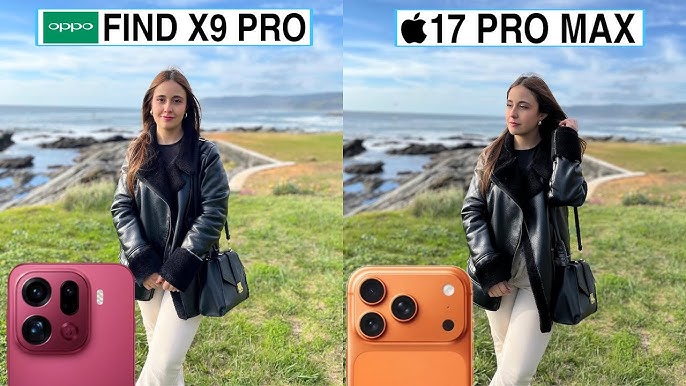
Oppo Find X9 Pro vs iPhone 17 Pro Max: A New Age Camera Clash Between East and West
The smartphone camera wars are alive and well, and few matchups embody that competition as intensely as the battle between the Oppo Find X9 Pro and the iPhone 17 Pro Max. While Apple’s flagship continues to dominate globally with its blend of polish, software magic, and brand prestige, Oppo’s latest creation from China is pushing the boundaries of what camera hardware can achieve. The Find X9 Pro isn’t just another Android phone; it’s a serious photographic powerhouse that could redefine mobile photography expectations in 2025.
At first glance, the Find X9 Pro’s triple-camera setup is enough to make even Apple loyalists curious. It’s the kind of hardware that photographers dream of in a pocket-sized device. Oppo isn’t just iterating here; it’s aiming to claim the throne outright with specs that sound more like those from a dedicated mirrorless camera than a phone.
Hardware Breakdown: Oppo Flexes Its Muscles
The main event is the 200MP telephoto camera, a monstrous sensor rarely seen on a mainstream flagship. The 1/1.56-inch Samsung ISOCELL HP5 sensor combined with an f/2.1 aperture delivers staggering light intake and detail, especially in low-light scenes. It supports up to 120x digital zoom and 6x lossless optical zoom, meaning distant subjects appear crisp without digital artifacts. Even more impressively, Oppo has built in a macro mode that leverages the telephoto’s optics to capture stunning close-ups with up to 30x magnification – ideal for nature photographers or product enthusiasts capturing fine textures.
The main camera is just as ambitious. It features Sony’s brand-new LYT-828 sensor, a 1/1.28-inch powerhouse with Hybrid-Frame HDR (HF HDR), offering a dynamic range of up to 17 stops. In simpler terms, it captures more detail across shadows and highlights than ever before. This gives the Find X9 Pro an incredible ability to handle complex lighting – think sunsets, neon-lit streets, or high-contrast interiors – without blowing out highlights or crushing shadows.
Completing the trio, the ultrawide camera also comes in strong at 50MP, featuring the Samsung ISOCELL JN5 sensor with an f/2.0 aperture and 1/2.76-inch size. The uniform megapixel count across the three rear cameras ensures a cohesive image quality no matter which lens you’re using – something that’s often overlooked in multi-camera systems. Even the selfie shooter gets serious treatment with another 50MP JN5 sensor and autofocus, setting a new standard for front-facing photography.
Apple’s Turn: The iPhone 17 Pro Max Refines Its Formula
Apple’s approach has always been more restrained, prioritizing computational photography and consistency over raw specs. The iPhone 17 Pro Max continues that philosophy with a familiar triple-camera setup. The main sensor is 48MP with an f/1.6 aperture and 1/1.3-inch size – smaller than Oppo’s but still excellent. Apple’s software-driven image processing remains its biggest asset, optimizing tone, color, and sharpness automatically to produce what many consider the most natural-looking photos out of the box.
The major change this year lies in the telephoto system. Apple has swapped the previous 5x lens for a shorter 4x zoom (100mm equivalent) paired with a 48MP sensor. This choice may seem like a downgrade, but it enables higher light intake and faster focusing, particularly useful for portrait photography – an area Apple is heavily invested in. Through in-sensor cropping, the iPhone achieves up to 8x near-optical zoom, which, combined with Apple’s Deep Fusion and Smart HDR algorithms, maintains exceptional sharpness.
The ultrawide camera remains at 48MP with an f/2.2 aperture and solid edge correction. Meanwhile, the front-facing ‘Center Stage’ camera has evolved into something uniquely Apple: a sensor that not only captures 18MP stills but can track your face, adjust framing dynamically, and stabilize selfie videos using AI. It’s less about specs and more about smart usability – ideal for vloggers and video callers alike.
Real-World Testing: Silicon Versus Software
To truly understand these devices, we tested both in real-world conditions. The Oppo Find X9 Pro tends to deliver more detail and dynamic range in daylight shots, particularly from its main and telephoto lenses. Skies look richer, textures more lifelike, and zoom shots maintain impressive clarity even beyond 10x. Its HDR capabilities produce cinematic results with balanced highlights and shadows, while colors remain vibrant yet accurate.
The iPhone 17 Pro Max, in contrast, delivers photos that feel effortlessly polished. While it doesn’t resolve as much micro-detail, Apple’s color calibration gives a natural warmth and realistic skin tones that users have come to love. In night shots, Apple’s Night Mode still leads, with superior noise handling and realistic light gradients. Oppo’s night performance is excellent too, but its tendency to brighten shadows can sometimes lead to less contrasty images.
In portrait mode, Apple retains its edge thanks to refined edge detection and subject isolation, though Oppo’s large telephoto sensor produces more depth of field blur, mimicking DSLR results. When it comes to video, Apple once again reigns supreme – smoother stabilization, better exposure control, and near-perfect color grading make the iPhone a filmmaker’s dream. Oppo’s 8K video mode impresses on paper but still feels more experimental than Apple’s mature implementation.
Macro and Selfie Capabilities
Oppo’s macro capabilities blow Apple out of the water. The 30x tele-macro system captures minuscule details – from the veins of a leaf to the texture of fabric – with unmatched precision. Apple’s macro mode, while improved, doesn’t offer nearly the same flexibility or magnification range.
On the selfie front, both phones excel, but in different ways. Oppo’s 50MP front camera delivers studio-like clarity, perfect for social media creators. Apple’s Center Stage experience, however, adds a touch of cinematic flair – ideal for video calls and horizontal framing, even if raw detail lags behind Oppo’s powerhouse sensor.
Verdict: Two Philosophies, One Winner (Depending on You)
The Oppo Find X9 Pro is a technical marvel – its camera hardware represents one of the most ambitious designs in mobile photography to date. For those who crave maximum control, resolution, and versatility, it’s easily one of the most exciting smartphones ever made. However, the iPhone 17 Pro Max continues to dominate in video quality, ease of use, and color accuracy, proving that Apple’s mastery lies not in brute-force specs but in its deep integration between hardware and software.
Ultimately, choosing between these two comes down to your creative priorities. If you love experimenting, zooming, and editing raw files, Oppo’s the better tool. If you want effortless perfection straight out of the box, Apple still wears the crown. Either way, we’re witnessing one of the most thrilling camera rivalries in years – and that can only mean good news for every smartphone photographer out there.