Every year smartphone makers promise tougher glass, stronger metal and smarter software, yet many of us still baby our expensive phones because one bad drop or a couple of years of use can turn them into chipped, sluggish bricks. The contrast between Apple’s soft aluminium iPhone 17 Pro experiment and Oppo’s new durability push could not be sharper. While early iPhone 17 Pro owners are already sharing photos of dents and scratches from ordinary, day-to-day use, Oppo is publicly throwing down a challenge with a full technology suite called Apex Guard.
Redefining what “quality” means in a smartphone
Rather than being a single feature, Apex Guard is Oppo’s attempt to rethink what “quality” should mean in a smartphone. 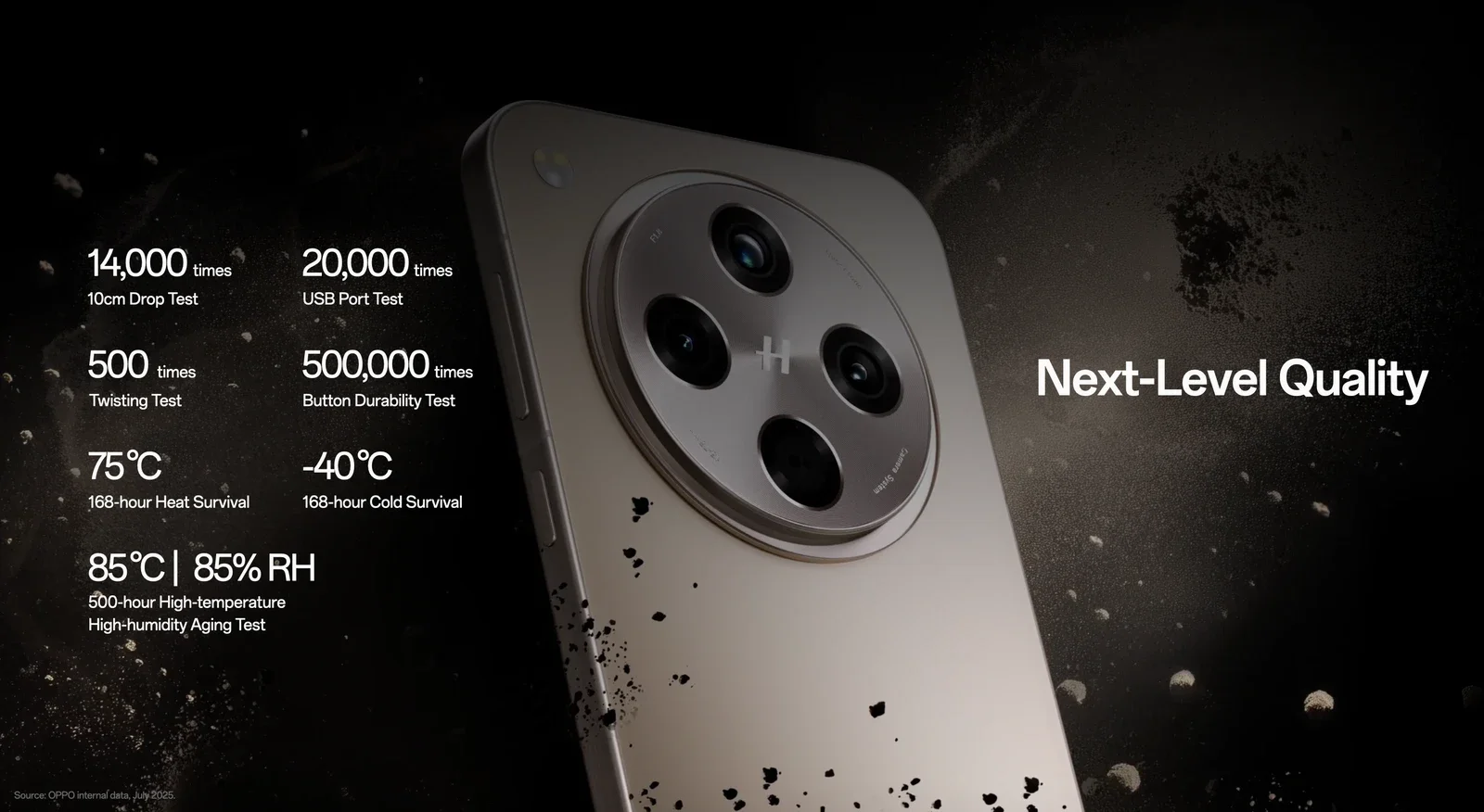
At a recent closed-door event, the company described quality as the foundation of everything it makes and linked it directly to user freedom: a phone that does not bend, crack or slow to a crawl lets you capture and keep more of your life without worrying about babying your device or upgrading every other autumn.
Oppo pitches Apex Guard as a complete framework that runs from the bones of the hardware to the fine details of the software experience. The goal is simple but ambitious: build phones that stay durable, smooth and reliable far beyond the usual two- to three-year window where many handsets start to feel tired. In an era when a lot of consumers are convinced phones are designed with near-term obsolescence baked in, that is a bold claim.
Tougher materials, smarter structure
The hardware story starts with the chassis. Instead of relying primarily on soft aluminium that can pick up marks whenever it meets a set of keys, Oppo combines ultra-high-strength steel with aerospace-grade AM04 aluminium for the core structure of its devices. Around that skeleton, the company has engineered what it calls Armour Shield, a set of structural reinforcements intended to distribute impact forces more evenly when a phone hits the ground or flexes in a pocket. The idea is not that your handset becomes indestructible, but that it survives the kinds of slips, bumps and daily abuse that so often send fragile phones straight to the repair shop.
Durability on the outside, however, is only half the problem. A phone that looks pristine but dies at lunchtime because the battery has aged badly is not much use. Here, Apex Guard leans on a Silicon-Carbon Battery design that uses customised spherical silicon-carbon material. In practical terms, this should mean better energy density and improved safety, but also slower degradation over time. Oppo claims that by adding up to around 400 extra charging cycles before noticeable wear sets in, the phone can keep performing “like new” years after you first take it out of the box, instead of hitting that depressing point where it hardly lasts a day.
Testing for a six-year lifespan
To back those claims, Oppo is putting its hardware through long-term torture tests that go well beyond the basic drop and bend demos you usually see on stage. The company is working with well-known testing and certification organisations such as TÜV Rheinland, TÜV SÜD and SGS. Together they run more than 180 checks from the earliest research phase right through to so-called end-of-life testing. Those tests include simulations that model 48, 60 and even 72 months of real-world use, repeatedly stressing components to see whether performance, stability and responsiveness can truly hold up over time.
That long horizon matters. Many phones feel fine in their first 18 months, only to become laggy, glitchy and hot as batteries wear out and software demands grow. By designing for a six-year use case from the start, Oppo is trying to flip that script. If Apex Guard delivers, you should be able to hold on to the same phone for much longer without feeling punished for not upgrading on schedule.
Software smoothness as part of durability
Software is treated as a first-class part of durability rather than an afterthought. On the ColorOS 16 side, Oppo is adding low-level tools such as Instant Refresh, designed to reduce data fragmentation and clean up leftover junk in the background, even on affordable entry-level models. Less fragmentation means apps launch more consistently, animations stutter less and storage performance stays closer to day-one speed.
To prove that smoothness instead of just talking about it, Oppo uses its own Smoothness Baseline Test together with a metric it calls Parallel Animation Standard 6 Zero. In plain language, that system tracks problems people actually notice: laggy swipes, home-screen freezes, apps that crash or mislaunch, and visual flickers. The aim is for every transition and tap to feel controlled and predictable, even after several major software updates and thousands of app installs.
Not just a flagship privilege
Another important detail is that Apex Guard is not reserved solely for expensive halo devices. Oppo says the suite will scale from its budget-friendly A-series all the way to premium lines like Find X. If that promise holds, a student buying an affordable phone and a power user picking up a flagship should both see the benefits of tougher hardware, batteries that last longer and software tuned for the long haul, instead of longevity being treated as a luxury feature.
A challenge to built-in obsolescence
All of this lands at a very particular moment in the industry. Many users have the strong feeling that modern electronics are deliberately built to feel old far too quickly: batteries that tank after two years, updates that mysteriously slow devices down, fragile frames that insist on a case on day one. Oppo’s message with Apex Guard is the opposite: by over-engineering the frame, partnering with independent testers and promising multi-year smoothness, it wants to position durability and longevity as selling points rather than acceptable casualties of progress.
Of course, marketing slides and carefully staged demos are the easy part. Personally, I am far less interested in glossy slogans than I am in whether a phone still feels solid and responsive after three or four years of daily use. If Apex Guard genuinely keeps Oppo phones running smoothly and structurally sound well past the typical upgrade cycle, that could pressure rivals to take similar steps and finally treat longevity as a core spec rather than an optional bonus.
For Apple, which is currently dealing with headlines about the iPhone 17 Pro’s dent-prone aluminium and quickly scuffed frames, the timing is awkward. Oppo is effectively holding up Apex Guard as an example of how things could be done differently, and the comparison is not flattering. If consumers begin to expect six-year durability, stutter-free software and batteries that do not collapse after a couple of thousand charges, future iPhones will have to evolve as well.
In the end, the real test will not be performed in spotless labs but in pockets, backpacks and concrete pavements around the world. Still, a major manufacturer openly committing to longer lifespans and more rigorous quality standards is a welcome shift in a market where near-term obsolescence has too often felt like part of the business model. If Apex Guard can turn that promise into reality, the fragile iPhone 17 might eventually be remembered less for its dents and more for the competition it inspired.