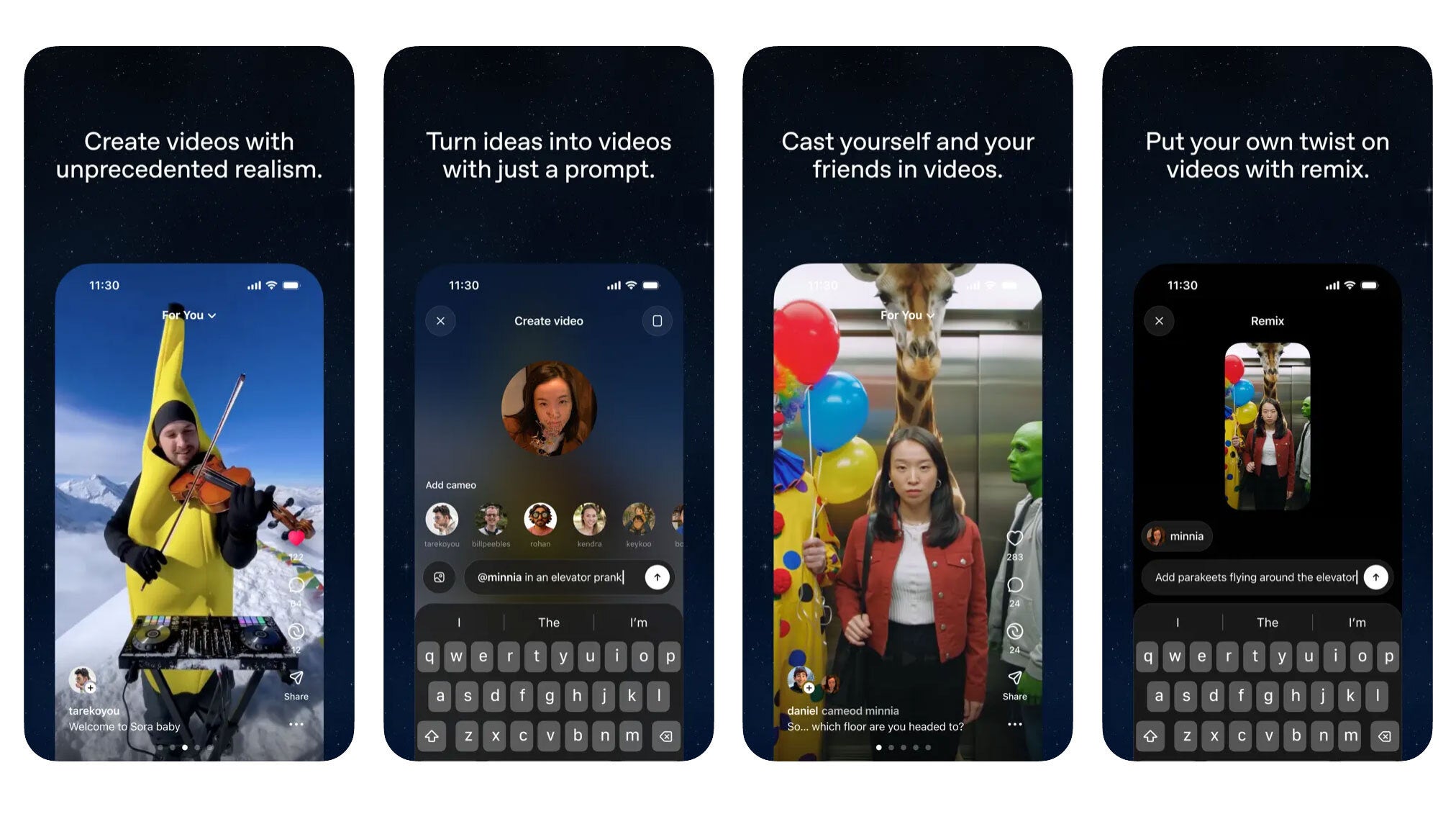
OpenAI’s newest creation, Sora, has become a viral sensation – reaching one million downloads in less than five days, outpacing even ChatGPT’s record-breaking debut. This milestone is remarkable not just for the speed of adoption but for what it signals: the public’s growing appetite for AI-generated entertainment. Sora’s rise suggests that video generation could be the next frontier for artificial intelligence in mainstream consumer use.
A record-breaking start
Launched on September 30, 2025, Sora quickly became the talk of the tech world. Despite being invite-only and restricted to users in the US and Canada, the app stormed past one million downloads in under a week. Bill Peebles, head of Sora at OpenAI, shared the news on X (formerly Twitter), expressing both excitement and disbelief at the rapid growth. He emphasized that the team was working nonstop to manage the surge and address early issues, including overmoderation and feature stability.
What makes Sora so special?
Sora combines the addictive scrolling mechanics of TikTok with the creative chaos of generative AI. Users can browse through an endless feed of 10-second videos – each one fully generated by OpenAI’s Sora 2 model. The app doesn’t just allow random creations; it gives users the option to include themselves through a feature called cameos. By uploading a reference image, users can star in AI-generated clips that mimic their likeness, placing them in surreal, cinematic, or downright absurd scenarios. Friends can also share their cameos publicly, letting others feature them in videos too.
Fun meets controversy
OpenAI insists that Sora’s invite-only approach isn’t about exclusivity but about fostering safe, friend-oriented experimentation. The idea is to encourage playful collaboration rather than mass distribution. However, like many creative AI tools, Sora’s launch wasn’t without problems. Within days, users began flooding the feed with clips that raised copyright concerns – many of them featuring recognizable characters, music, and imagery from popular media. This quickly sparked debates about the legality and ethics of AI-generated content, especially regarding what data Sora’s model was trained on. OpenAI responded by tightening moderation and promising clearer transparency on data sources.
The broader implications
Sora’s runaway success is another reminder of how fast AI entertainment is evolving. The app highlights both the promise and the perils of democratized video generation – where anyone can become the director and star of their own short film. But it also ushers in a new era of digital confusion, where the line between creativity and imitation, authenticity and artifice, keeps blurring. As users flood social feeds with “deepfake fun,” the question lingers: will audiences grow tired of AI-generated slop, or is this the new normal for visual storytelling?
For now, Sora stands as both a triumph of innovation and a warning sign of things to come – proof that the future of content creation will be equal parts thrilling and unsettling.
2 comments
bro this app is insane 😂 made a video of me riding a dragon in 2 mins
ngl feels cool but also creepy seeing my face in random vids lol