MSI is wasting no time expanding its OLED gaming monitor lineup, and the latest arrival is aimed squarely at players who want premium image quality without paying four-figure flagship prices. The new MSI MAG 274QP QD-OLED X24 has quietly appeared on Amazon US at 499 dollars, targeting the increasingly competitive mid-range OLED segment where most gamers actually shop.
On paper, the MAG 274QP QD-OLED looks like a very close relative of the MAG 272QP QD-OLED that MSI introduced earlier this year. Both models sit in the 27 inch class with a 26.5 inch QHD panel, push up to 240 Hz refresh rates, and focus on delivering the trademark deep blacks and vivid colors that have made OLED and QD-OLED panels so desirable for gaming. The interesting twist is that MSI is now clearly labeling the MAG 274QP as using Samsung’s third generation QD-OLED panel, while the earlier 272QP was only described vaguely as using the “latest OLED” technology on MSI’s site.
This explicit mention of Samsung’s 3rd gen QD-OLED is more than just marketing language. 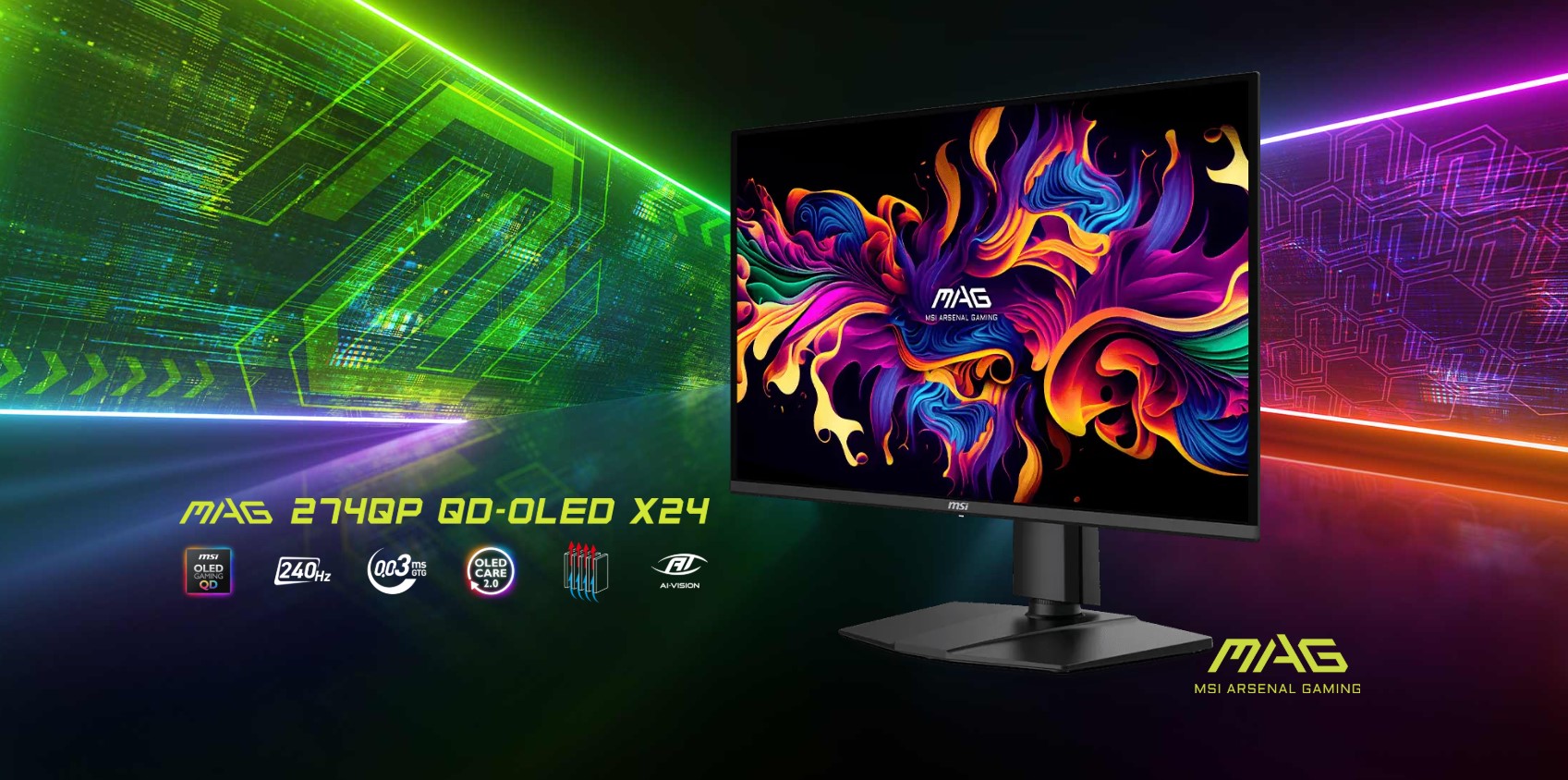
Each generation typically refines panel efficiency, color uniformity, and overall text clarity, making it easier to recommend these displays not just for gaming, but also for everyday use and creative work. In practice, though, the two models remain extremely close in core specifications, with the newer 274QP feeling more like a refined variant than a completely new class of product.
QHD resolution and 240 Hz for smooth, sharp gameplay
The MAG 274QP QD-OLED features a 26.5 inch panel with a 1440p class resolution of 2440 × 1440. This resolution hits a sweet spot for modern gaming rigs, offering a noticeable step up in sharpness compared with 1080p without being as demanding on the GPU as 4K. Paired with a refresh rate of up to 240 Hz, the monitor is built for fast paced titles where smooth motion and low latency can be the difference between winning and losing.
Adaptive Sync support helps keep frames synchronized between the GPU and the display, eliminating tearing and reducing stutter when the frame rate fluctuates. MSI also highlights a VESA ClearMR 13000 certification, which is designed to quantify motion clarity more transparently than traditional response time claims. Combined with an extremely fast 0.03 ms gray to gray response, the MAG 274QP QD-OLED should deliver exceptionally clean motion with minimal blur, making it a strong candidate for competitive shooters, racing games, and any title where responsiveness is critical.
Wide color gamut and accuracy for creators and enthusiasts
While the MAG 274QP QD-OLED is marketed as a gaming monitor, its color capabilities make it equally appealing for content creators and color conscious users. The panel covers 99 percent of the DCI P3 color space, 98 percent of Adobe RGB, and an impressive 138 percent of sRGB. That broad coverage means the monitor can reproduce saturated, cinema grade colors for movies and games while also remaining suitable for photo and video work that targets professional color spaces.
Color accuracy is rated at Delta E less than 2, which is generally considered the threshold where differences from the reference become difficult to notice for most users. Coupled with true 10 bit color depth, supporting up to 1.07 billion shades, the MAG 274QP QD-OLED is capable of smooth gradients and subtle tonal transitions. For players who also edit footage, tweak screenshots, or handle graphic design on the same machine they game on, these specs make the monitor far more versatile than a typical budget gaming display.
Brightness limitations and HDR expectations
Where the MAG 274QP QD-OLED looks more modest is in its brightness figures. In SDR mode, MSI rates the panel at around 200 nits, and HDR content can push the brightness up to roughly 400 nits. That is consistent with the earlier MAG 272QP QD-OLED and reflects a broader reality of many mid range OLED gaming monitors: they do not reach the searing peak brightness of the most expensive mini LED or high end OLED TVs.
In practical use, this means the monitor is best suited to controlled lighting environments rather than sun drenched rooms. However, it is important to remember that OLED’s defining strength is contrast, not raw brightness. With each pixel capable of turning completely off, the panel can deliver effectively infinite contrast and deep blacks that even very bright LCDs struggle to match. For dark room gaming and cinematic HDR scenes, that contrast often matters more than peak luminance numbers alone.
Connectivity trade offs versus the MAG 272QP
The biggest functional difference between the MAG 274QP QD-OLED and its MAG 272QP sibling lies in connectivity. According to the spec sheets, the newer model drops the USB Type C port with DisplayPort Alt Mode that some users appreciated on the older screen. For laptop owners or those who liked running a single cable setup for display plus potential power and data, that omission will be disappointing.
Display outputs otherwise remain familiar. The MAG 274QP QD-OLED offers two HDMI 2.1 ports and one DisplayPort 1.4a connector. That combination covers modern gaming PCs and current generation consoles comfortably, with HDMI 2.1 opening the door to 120 Hz gaming on PlayStation 5 and Xbox Series X alongside high refresh PC use. MSI also lists the 274QP as roughly one kilogram heavier than the 272QP, which may not matter for a typical desk setup but could be relevant if you are mounting the monitor on a lighter arm or bracket.
Pricing and position in the OLED market
Perhaps the most curious detail is how MSI has chosen to price the newer model. The MAG 272QP QD-OLED launched at around 420 dollars in China, positioning it as a relatively aggressive entry in the QD-OLED space. The MAG 274QP QD-OLED, by contrast, is currently listed at 499 dollars on Amazon US. Regional pricing, taxes, and retailer margins all play a role here, but the end result is that the slightly less feature rich model arrives at a higher publicly visible price point in this market.
Even so, 499 dollars still places the MAG 274QP QD-OLED below many flagship OLED gaming monitors that climb into the 800 to 1000 dollar range, especially those pushing extreme refresh rates like 360 Hz or 500 Hz. MSI appears to be targeting the sweet spot for enthusiasts who care about OLED image quality and 240 Hz responsiveness but are not chasing the absolute highest specs at any cost. As competition heats up, it would not be surprising to see the price of the 274QP drift downward, especially if the 272QP remains available and undercuts it.
Ultimately, the MSI MAG 274QP QD-OLED X24 is a carefully tuned evolution rather than a revolution. It delivers a 26.5 inch QHD 240 Hz Samsung QD-OLED panel, strong color coverage, fast response times, and a console friendly port layout, while sacrificing USB C convenience and coming in slightly heavier than its sibling. For many gamers, the choice between the MAG 272QP and MAG 274QP may simply come down to which model is cheaper in their region on a given day. For everyone else, the arrival of yet another mid range QD-OLED option is a clear sign that OLED gaming monitors are steadily becoming more attainable.