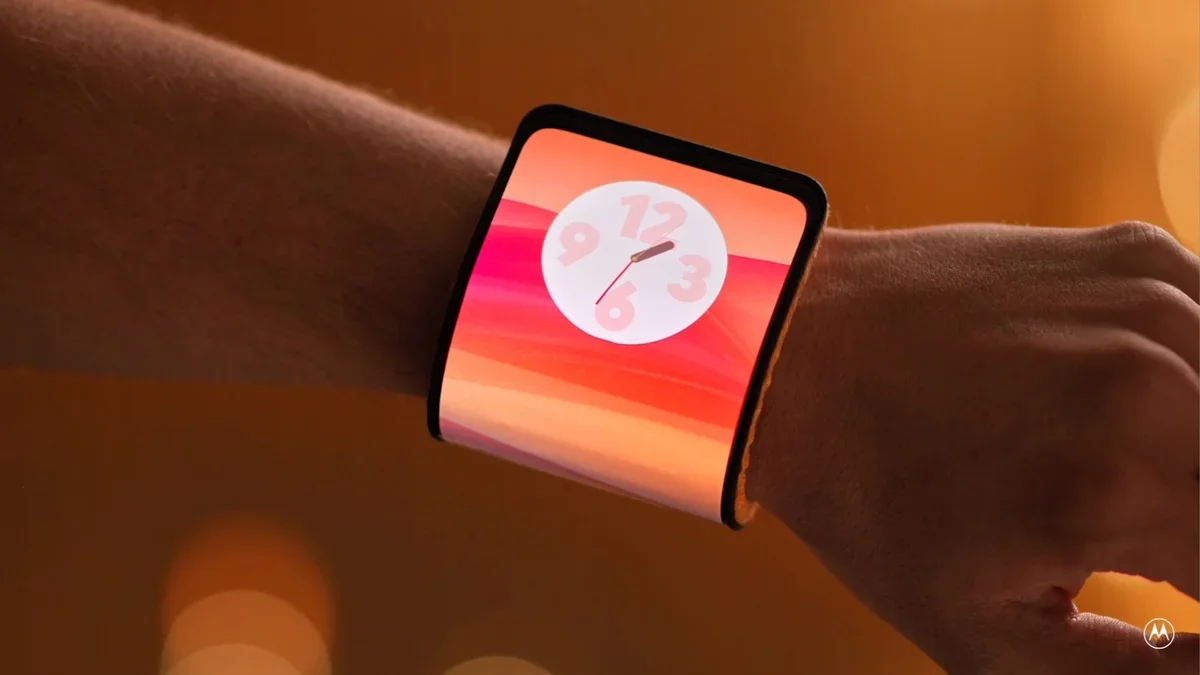
Motorola’s Vision: A Phone You Wear on Your Wrist
When it comes to ambitious gadget design, Motorola continues to push the boundaries. Recently, a newly discovered patent filing reveals the company’s persistent interest in a device that transcends traditional form-factors – a smartphone you can actually wear on your wrist. Far from being a one-off concept, this appears to be a serious exploration of a hybrid device that blends a wearable smartwatch and a full-blown smartphone.
### From Bendable Bracelets to Rollable Screens
Back in 2023, Motorola teased a bendable phone prototype – one that could wrap around the wrist like a stylish bracelet. While intriguing, it remained a futuristic demo rather than a product heading to store shelves. Now however, this fresh patent filing registered with the United States Patent and Trademark Office (USPTO) suggests the idea hasn’t been abandoned. Instead, it signals that Motorola’s R&D team is evolving their concept, refining it with newer technologies such as rollable displays and adaptive sensor systems.
The sketches accompanying the patent present a device with a flexible, extendable screen. When fully compacted, it resembles a smartwatch on the wrist. But when pulled out or unrolled, it becomes a small smartphone – providing a more expansive display for calls, messages, video or multitasking. It’s not just folding; it’s literally stretching the display to meet two distinct usage scenarios.
### What the Patent Tells Us (and What It Doesn’t)
The design highlights several intriguing elements: a structural frame to support rolling and unfolding, a display that transitions between wearable and phone modes, and sensors that detect shape and orientation to adapt the UI accordingly. While the patent is detailed in its mechanical vision, it remains vague on other critical aspects – battery life, camera quality, connectivity, durability under wear and tear – all of which are essential for a real-world product.
Importantly, a patent doesn’t guarantee a product launch. It merely signals that the company is exploring possibilities. But the strategic move here is significant: by patenting this concept, Motorola stakes its claim in the race to redefine wearable computing. Should they follow through, this device could disrupt both the smartwatch and smartphone markets.
### Why a Phone-Wearable Hybrid Could Actually Work
At first glance, the idea of combining a phone and a smartwatch might sound gimmicky. But dig deeper and several practical advantages emerge:
– **Consolidation of devices**: Rather than carrying both a smartphone and a smartwatch, you’d have a single gadget that covers communication, wrist-based glanceability, and on-the-go flexibility.
– **Reduced screen time**: A wrist-worn device could encourage more intentional usage – quick check, if needed, vs. habitual scrolling on a large slab smartphone.
– **Novel user experiences**: Imagine quick voice or gesture commands, glance widgets on your wrist that expand into full apps when you pull the display out – an entirely fresh UX paradigm.
That said, these advantages come with caveats. Motorola has a history of hardware innovation (remember the iconic Razr flip phone and its recent foldable iterations) but less consistent performance when it comes to software updates and long-term support. For a device this bold, the software experience – the transitions between wearable and phone modes, battery optimization, durability – will matter just as much as the hardware itself.
### Where This Fits in Motorola’s Lineage
Motorola has long been willing to experiment. Its original Razr flip phone was a cultural icon, and when foldables re-emerged, it embraced the ninja toward that segment. However, the pivot to a true hybrid wearable device pushes them into new territory – one that overlaps with smartwatches, fitness trackers, and ultra-compact phones.
Other players have dabbled in wrist-worn communicators, but none have yet delivered a mainstream product that convincingly switches between full smartphone and smartwatch modes. If Motorola gets this right, they could carve out a unique niche – and potentially lead the next wave of wearable tech.
### Challenges Ahead (And Why They Matter)
There are formidable obstacles in realizing this vision:
1. **Display durability**: A rollable, stretchable screen used around the wrist must withstand constant flexing, sweat, impact, and environmental stress. Conventional smartphone display tech struggles in such scenarios.
2. **Battery & thickness**: Packing sufficient battery capacity into a wrist-worn form while keeping the device comfortable and stylish is non-trivial. The thicker the device, the less likely people will want to wear it.
3. **Software transition and experience**: Seamless switching between modes (wrist glance to full smartphone) requires robust firmware and UI adaptation. A laggy or clunky experience could kill the concept.
4. **Market readiness**: Are consumers ready for such form-factor shift? Will they embrace a device on their wrist that functions as their main phone – especially given existing smartphone habits and accessory ecosystems?
### What to Watch For Next
Though no release date has been announced, keep an eye on these indicators:
– Motorola filing additional patents around this concept (e.g., battery modules, folding hinge tech, wear-sensor calibrations).
– Teaser prototypes or demonstrations at industry events like Mobile World Congress or Consumer Electronics Show.
– Partnerships with display manufacturers specializing in rollable or stretch-displays (for instance, LG Display or BOE Technology Group).
– Software updates or new OS modes optimized for dual form-factor use (wrist-wear vs phone mode).
### Final Thoughts
In the crowded world of smartphones and wearables, true differentiation is rare. With its new patent, Motorola is daring to rethink what a connected device can be – no longer just a slab in your pocket, but something you strap to your wrist, ready to extend into full smartphone mode when you need it. While the path from patent sketch to retail product is long and fraught with risk, the idea itself is exciting – a glimpse of what the future might hold if manufacturers stop asking “What is a phone?” and start imagining “Where could my phone be?”.
For now, this wearable phone concept remains on the horizon – but if Motorola executes well, we could soon be wearing our smartphones in a way that feels as natural as wearing a watch. And that, in itself, might just change everything.