Motorola Edge 70 Ultra hits Geekbench: an early, realistic look at Snapdragon 8 Gen 5
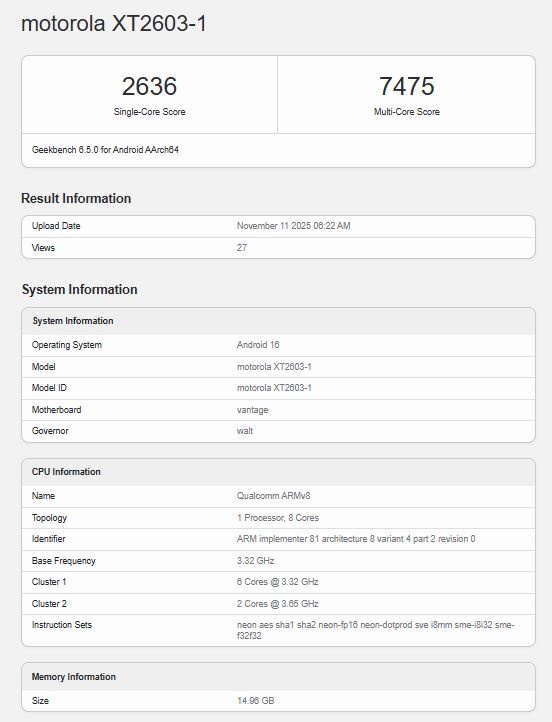
Motorola’s next premium phone, widely believed to be the Edge 70 Ultra (XT2603-1, likely the Moto X70 Ultra in China), has surfaced on Geekbench. While Qualcomm hasn’t fully detailed the non-Elite Snapdragon 8 Gen 5 yet, the listing offers a concrete preview of how the new generation performs without the Elite badge – and without the hype cycle getting in the way.
Why this matters
This is the first non-Elite Snapdragon to adopt Qualcomm’s in-house Oryon CPU cores, moving away from Arm’s off-the-shelf Cortex designs. That shift has implications for efficiency, thermals, and sustained performance – areas where last-gen flagships often dazzled in short benchmarks but struggled during long gaming sessions or heavy camera work.
Scores at a glance
- Single-core: ~2,600
- Multi-core: ~7,500
Those numbers comfortably clear typical Snapdragon 8 Gen 3 results (roughly 2,100–2,200 single / 6,500–6,600 multi). They land below the Elite tier, which spans roughly 3,000–3,100 single and 8,700–9,800 multi, and behind the latest Snapdragon 8 Elite Gen 5 entries that push 3,500–3,600 single and 10,000–11,000 multi. In other words: meaningful gen-over-gen gains for the mainstream flagship tier, without chasing the absolute peak (and peak heat) of Elite silicon.
The silicon picture: CPU, GPU, memory
The Motorola unit is recorded with a 2+6 CPU layout: 2× 3.65GHz prime cores and 6× 3.32GHz performance cores. Paired with 16GB RAM and Android 16, this is a configuration designed to feel fast everywhere rather than to win every synthetic race. Geekbench also lists an Adreno 829 GPU – positioned by model number between the Adreno 825 (Snapdragon 8s Gen 4) and Adreno 830 (Elite), suggesting graphics that should outpace upper-mid devices while staying just shy of the Elite tier’s ceiling. Remember, Geekbench doesn’t measure GPU, but the identifier helps set expectations.
What the numbers really mean
Short, single-run benchmarks are a sanity check, not a verdict. The leap over 8 Gen 3 indicates Oryon is delivering higher per-core output and stronger multi-threaded scaling, but the bigger story will be sustained performance. If Motorola’s cooling keeps clocks steadier than last year’s thin-and-light designs, the non-Elite 8 Gen 5 could feel faster over a 10–20 minute gaming session than a nominally stronger chip that throttles sooner. That’s where power delivery, graphite stacks, vapor chambers, and software governors separate great phones from spec sheets.
Positioning: not Elite on purpose
Qualcomm’s branding shift (skipping an “8 Gen 4” label for this tier and carving out Elite above it) clarifies the ladder: Elite is the halo chip for record books; 8 Gen 5 is the dependable flagship motor for devices that prioritize balance. For OEMs, that means fewer heat sinks, less aggressive binning, and – ideally – more predictable cost structures.
Reader questions, answered
“Why isn’t Motorola using the Elite chip?” Two likely reasons: thermals and price. Elite silicon can be costly and demanding to cool; many brands reserve it for big, heavy hero models. A non-Elite 8 Gen 5 keeps the phone thinner, cheaper, and – crucially – more consistent under load. It’s a strategic choice, not necessarily a compromise.
“So this is just an 8s Gen 5 with new paint?” The numbers say otherwise. CPU scores clearly outpace 8 Gen 3 and the 8s family. The Adreno 829 ID also places graphics between upper-mid and Elite. The aim seems to be mainstream flagship performance without Elite thermals and BOM pressure.
“Does this make phones like the OnePlus Ace 6T weaker?” Model-to-model comparisons depend on cooling, RAM, storage speeds, and software governors. On raw CPU, early 8 Gen 5 results do look stronger than older upper-mid chips. But sustained tests and GPU-heavy workloads will tell the fuller story once retail firmware ships.
Launch timing
There’s no official launch date for the Edge 70/X70 Ultra. Motorola has already kicked off the generation with the Edge 70 (aka X70 Air), announced recently, so an Ultra reveal could follow once Qualcomm formally details the non-Elite 8 Gen 5.
Bottom line
The Motorola Edge 70 Ultra’s early Geekbench run paints a clear picture: the non-Elite Snapdragon 8 Gen 5 delivers a healthy CPU jump over last year and slots neatly under Elite’s blistering but harder-to-cool top end. If Motorola nails thermals and pricing, this could be the year its “almost-flagship” feels like the smarter flagship for real-world users.
1 comment
so moto again skipping the top chip? probably cheaper + cooler. i’ll take stable fps over hot potato 🔥