Microsoft Azure has entered a new era of AI computing with its massive integration of NVIDIA’s GB300 “Blackwell Ultra” GPUs. This marks one of the most significant leaps in cloud infrastructure to date, positioning Microsoft at the forefront of the AI race alongside NVIDIA’s cutting-edge hardware. 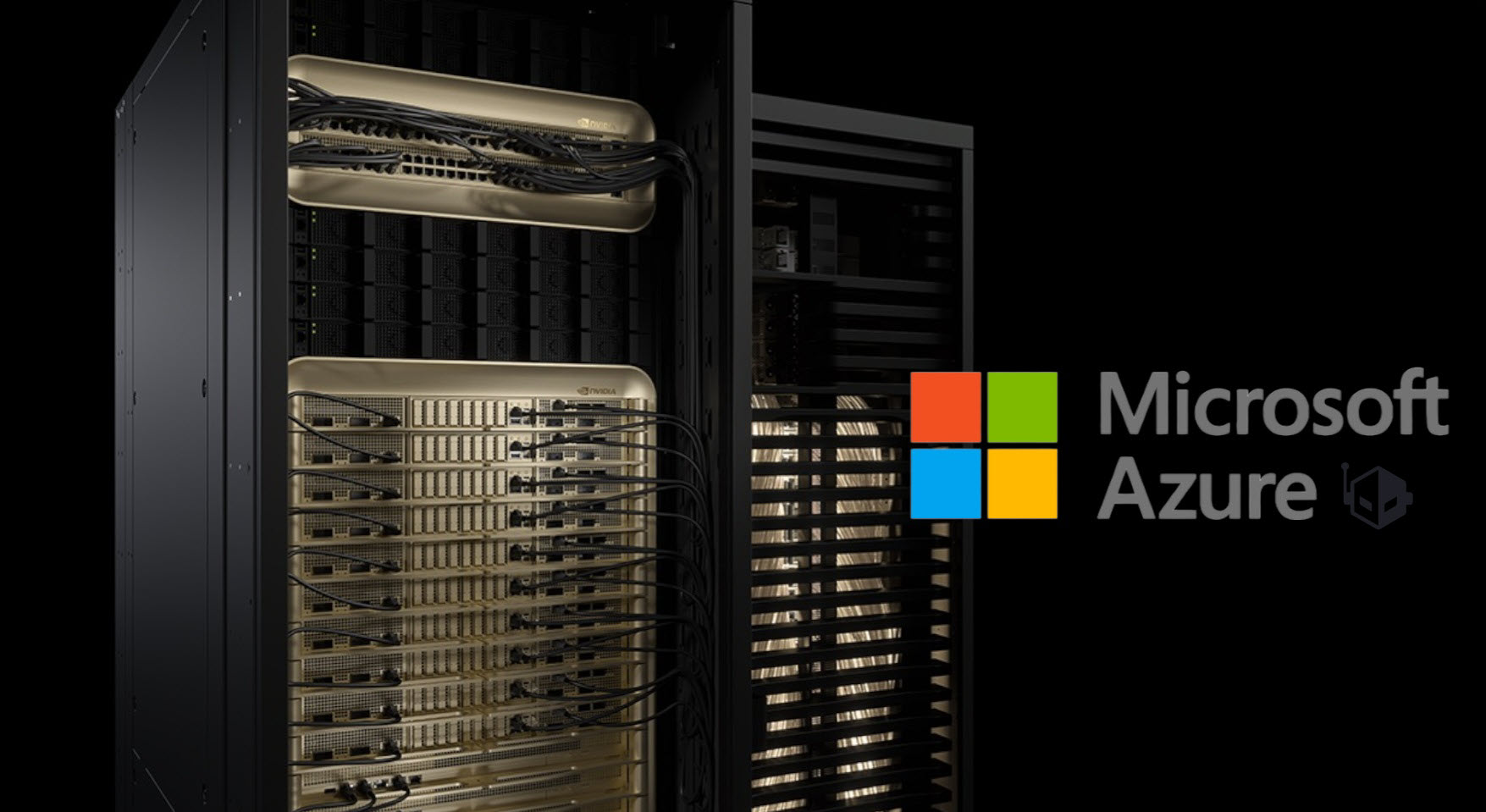
The newly announced Azure ND GB300 v6 virtual machines represent an entirely new class of supercomputing capability, purpose-built for reasoning models, multimodal generative AI, and agentic systems designed to think, adapt, and respond faster than ever before.
At the heart of this deployment lies an enormous production cluster with over 4,600 GB300 NVL72 GPUs connected through NVIDIA’s latest Quantum-X800 InfiniBand technology. Each rack integrates 18 VMs containing 72 GPUs, forming an interlinked lattice of compute power capable of handling AI models that scale into the hundreds of trillions of parameters. For context, that’s beyond what most labs on the planet can even simulate today.
By combining 36 Grace CPUs per rack with 72 GPUs and 37TB of lightning-fast memory, the cluster achieves 1,440 petaflops of FP4 Tensor Core performance – a staggering level of compute that can train models once requiring months, in just weeks. Each rack is designed to act as a high-speed brain of its own, moving 130TB per second of data via NVLink and NVSwitch, ensuring no GPU sits idle waiting for data. This architecture transforms Azure’s datacenters into synchronized AI ecosystems, where every rack contributes to the collective reasoning of ultra-large models.
Microsoft’s engineers co-designed this infrastructure with NVIDIA to optimize bandwidth, latency, and energy efficiency. The non-blocking fat-tree topology ensures near-zero communication delays between GPUs across datacenters, while SHARP-enabled switches perform mathematical operations directly within the network layer. This effectively doubles the usable bandwidth and makes distributed training dramatically faster and more reliable – a huge step forward for developers building massive multimodal systems like GPT-style models or autonomous agents that handle dynamic workflows.
Beyond raw performance, Azure’s innovation extends into sustainability. Each GB300 rack uses standalone heat exchangers and advanced liquid cooling systems that minimize water usage and energy waste. These systems maintain thermal equilibrium under extreme load, a necessity for the dense and power-hungry GPU clusters now running in Microsoft’s facilities. In parallel, new adaptive power distribution models ensure that compute density scales without risking hardware or stability, paving the way for even denser AI deployments in future ND-series VMs.
For researchers, enterprises, and AI startups alike, this new Azure generation promises a radical shift in accessibility to frontier-scale compute. Microsoft’s stated goal is to scale from thousands to hundreds of thousands of interconnected Blackwell Ultra GPUs worldwide, democratizing access to trillion-parameter training capabilities that were previously limited to only a handful of AI labs.
NVIDIA’s CEO Jensen Huang called this moment “a milestone in AI infrastructure evolution,” emphasizing that this partnership with Microsoft positions the United States at the helm of the next industrial wave driven by intelligent computing. Still, some critics online questioned the scale and cost of such projects, noting that AI’s usefulness must go beyond text summarization or chatbots to justify its astronomical expense. Others speculated whether competitors like AMD could ever field GPU clusters at similar scale, while more cynical users mocked the U.S. government’s growing reliance on private tech giants to lead national AI strategies.
Regardless of skepticism, Azure’s Blackwell Ultra deployment represents a concrete foundation for the next decade of AI innovation. From real-time translation models that comprehend context across languages, to large agentic systems that reason through complex scientific problems, the infrastructure now exists to make those ambitions tangible. Whether the world is ready for it or not, Microsoft just lit the fuse on the next great AI arms race.
1 comment
trash tier investment if it can’t do more than summarize text smh