Michael J. Fox has long been celebrated as one of Hollywood’s most enduring and beloved actors. But even legends have complicated stories buried in the past. 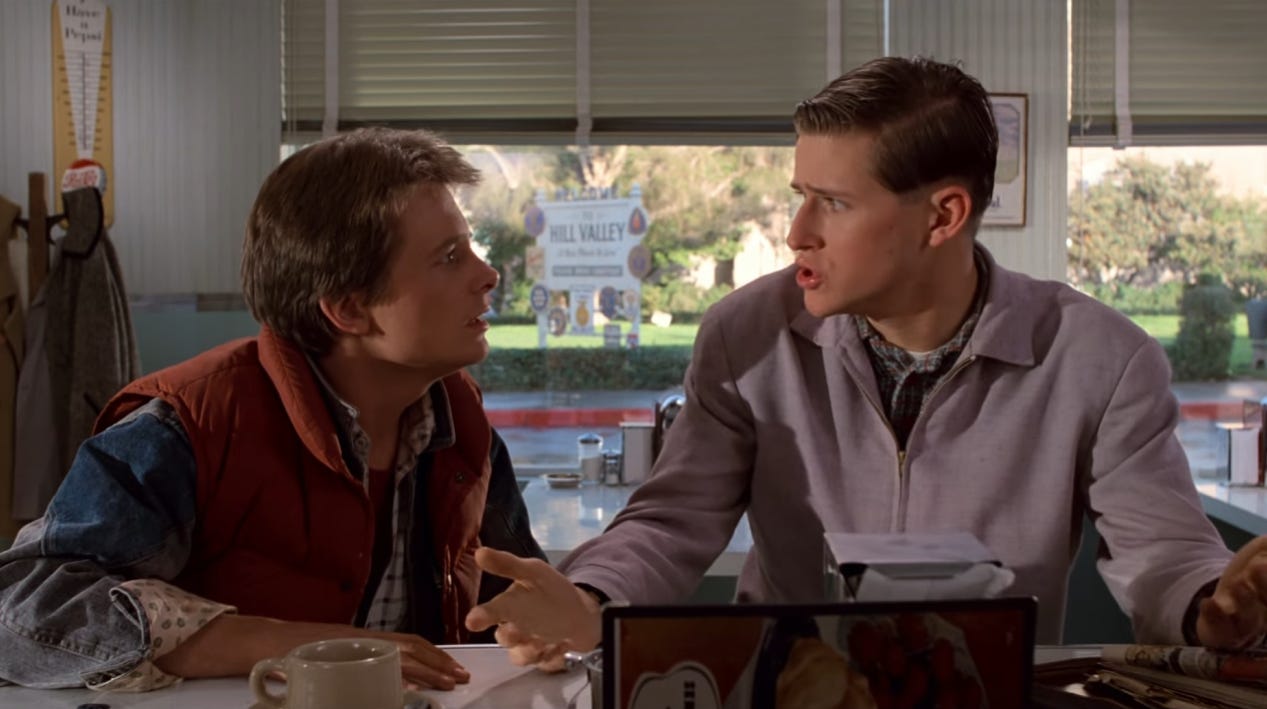
In his newly released memoir, Future Boy: Back to the Future and My Journey Through the Space-Time Continuum, Fox revisits the whirlwind production of the 1985 classic Back to the Future, and sheds light on a long-rumored creative clash with his on-screen father, Crispin Glover.
When Fox joined the cast as Marty McFly, the film’s energy was already chaotic. Glover, who played Marty’s awkward father George, was notoriously eccentric, and according to Fox, his unconventional acting approach sometimes created tension on set. “Nobody puts Crispin in a box,” Fox recalled with a laugh – though, ironically, the camera crew once did just that. Glover’s unpredictable movements often made it hard to shoot scenes consistently, forcing the crew to build literal boundaries around him. “He had his own vision of how George should move,” Fox wrote. “He saw him as this wandering, offbeat dreamer who didn’t quite fit into any frame – and that sometimes included the camera’s.”
Despite the friction, Fox emphasized his admiration for Glover’s artistic commitment. “His talent was undeniable. His methods? Sometimes difficult. But I respected his complete immersion in George McFly – no one else could’ve played him quite like that.”
For Fox, Glover’s intensity wasn’t malicious; it was part of his unique artistry. Those who’ve followed Glover’s career – from his surreal Letterman appearances to his avant-garde film projects – would hardly be surprised. “There’s no way to prepare for Crispin,” Fox admitted, describing their scenes together as a mix of challenge and inspiration.
Interestingly, Fox’s book doesn’t stop at revisiting Glover. The actor also writes about another key figure in the movie’s history – Eric Stoltz, the original Marty McFly before Fox took over the role six weeks into filming. For decades, Fox and Stoltz never directly discussed the change, and Fox assumed Stoltz preferred to keep that chapter closed. Still, he felt compelled to reach out. In a letter he wrote, Fox even joked, “If your answer is ‘piss off and leave me alone,’ that works too.”
To his delight, Stoltz responded warmly – beginning his reply with the same cheeky phrase, followed by “I jest…” The two eventually met in person, and Fox recalled the meeting as unexpectedly healing. “Eric came into my home smiling,” he wrote. “We realized there was never bad blood between us. We were just two actors giving everything we had to the same role. What happened wasn’t personal – it was filmmaking.” The pair ended up sharing stories about their careers, families, and the strange way their lives had orbited the same pop-culture universe.
Fox also playfully dives into some of Back to the Future’s geekier mysteries, like the so-called “temporal inconsistency” in Marty’s guitar solo scene – something that has sparked fan debates for decades. His reflections show not only his humor but his enduring fondness for the time-travel saga that defined his career. Even forty years later, he approaches it all with gratitude and warmth, describing it as a project that “changed my life in ways I could never have imagined.”
In the end, Fox’s memoir is less about feuds and more about perspective – about the strange chemistry that makes creative partnerships both chaotic and magical. His take on Glover is especially generous: an acknowledgment that sometimes, the most difficult collaborators can also be the most unforgettable. “Crispin’s methods may have been unorthodox,” Fox concludes, “but they made George McFly real. He made you believe.”
Future Boy is now available everywhere books are sold – and for fans of Back to the Future, it’s a trip worth taking down memory lane and through time itself.
1 comment
Glover probably made everyone crazy but tbh he MADE George McFly iconic