Anime styled PC hardware has moved from niche imports to a full blown subculture, and Maxsun is one of the brands leaning all the way in. The new Maxsun MS-iCraft B850 AIGA is a full size ATX motherboard that tries to mix that playful anime aesthetic with very serious next generation AMD Ryzen support. 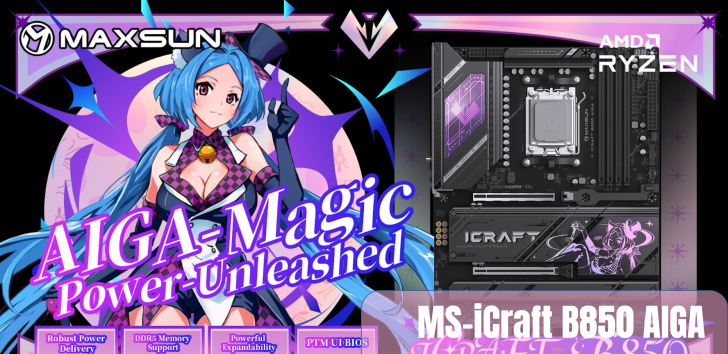
Instead of treating the artwork as a gimmick slapped on a budget board, Maxsun is packing in high end features that should interest gamers, streamers and creators who want a system that can be both a showcase build and a long term platform.
As the name suggests, the board is built around an AMD B850 class platform and is advertised as being ready for upcoming Ryzen desktop processors. That means buyers looking at a Ryzen upgrade path can start with current chips today and keep the same board when the next wave of CPUs arrives, assuming the usual BIOS update support from the vendor. Platform longevity has become one of the key selling points in the AMD ecosystem, and Maxsun clearly wants this model to sit alongside the better known brands rather than underneath them.
Power delivery is often where cheaper boards quietly cut corners, but on paper the MS-iCraft B850 AIGA looks surprisingly robust. The VRM uses a 16 plus 2 plus 1 phase design with 50 amp stages, fed by a pair of 8 pin EPS connectors. That is the kind of configuration you normally expect on enthusiast boards that are meant to handle high core count chips and boosting behaviour without throttling. Paired with adequate heatsinks, this layout should be capable of sustaining heavy all core workloads and offers headroom for Precision Boost tweaks or light manual overclocking when future CPUs arrive.
Memory support is equally forward looking. The board provides four DDR5 DIMM slots, allowing up to 256 GB of RAM, which is more than enough even for demanding workstation style setups. Official support stretches up to 8400 mega transfers per second, suggesting a well tuned trace layout and BIOS training for high speed kits. Most users will likely run far more modest frequencies, but knowing the board is validated at aggressive speeds is reassuring for enthusiasts who like to experiment with memory tuning or leverage fast DDR5 to squeeze extra performance out of Ryzen processors.
On the expansion side, Maxsun goes all in on PCI Express 5.0. There are two full length PCIe 5.0 x16 slots wired so that the primary operates at x16 when used alone or both drop to x8 or x8 when populated together. While multi GPU gaming is largely a thing of the past, this configuration is ideal for pairing a modern graphics card with high bandwidth add in cards such as capture devices, storage controllers or AI accelerators that will benefit from PCIe 5.0 throughput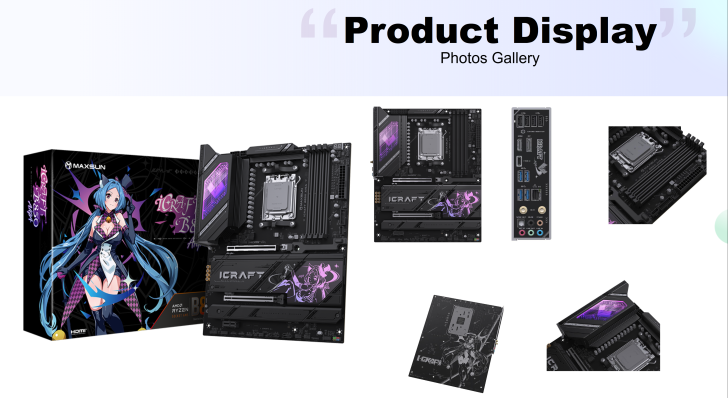
. A smaller PCIe 3.0 x1 slot rounds out the lineup for legacy sound cards, network adapters or other small add ons.
Storage is clearly biased toward modern solid state drives. The MS-iCraft B850 AIGA offers four M.2 slots in total. Two are wired for PCIe Gen5 x4 operation, lining up nicely with the new wave of blisteringly fast NVMe drives, while the remaining two support PCIe Gen4 x4. This makes it trivial to dedicate one drive for the operating system, another for games, another for scratch files and still keep a spare slot for future upgrades. There are only two SATA III ports on the board, which will be enough for a couple of 2.5 inch SSDs or archival hard drives, but users planning huge farms of SATA storage will need to factor that limitation into their build.
Connectivity is another area where this board aims to punch above its weight. On the rear panel you get a generous selection of USB ports: one 10 gigabit per second Type C connector, four 10 gigabit Type A ports for fast external drives or DACs, and four USB 2.0 Type A ports for keyboards, mice and dongles. Internally, headers provide six more USB connections, including a 20 gigabit front panel Type C, two 5 gigabit ports and three additional USB 2.0 lines for cases, hubs and AIO coolers. For a typical modern build that relies heavily on USB peripherals, this mix should feel comfortably future proof.
Networking is a standout specification. Instead of the usual 1 GbE or 2.5 GbE port, Maxsun equips the board with a 5 GbE controller based on the Realtek RTL8126 chip. For anyone with a multigig home network or a fast NAS, that is a genuine performance upgrade that shrinks file transfer times and improves streaming from local storage. Wireless connectivity is handled by a Mediatek MT7925 module that brings WiFi 7 and Bluetooth 5.4 to the table, giving early adopters access to the latest wireless standards. Even if you are still on WiFi 6, having the newer radio means better longevity as routers evolve.
Builders who care about clean cable management and cooling will appreciate the internal header layout. The board includes three ARGB headers for individually addressable lighting strips or fans, plus one traditional non addressable RGB header. There are dedicated headers for a CPU fan and a pump, making the board ready for custom loops or high end AIO liquid coolers. Four additional chassis fan headers allow fine grained control over case airflow. Utility headers such as a COM port and a clear CMOS jumper are also present, ensuring that even tinkerers and overclockers have the tools they expect.
On the firmware side, Maxsun introduces its PTM UI BIOS, a new interface that aims to make tuning less intimidating. The layout surfaces common options like memory profiles, fan curves and storage settings in a cleaner way, while still leaving deeper menus for advanced users who want to push voltages and frequency limits. For owners eyeing next generation Ryzen CPUs, BIOS support will be the critical piece, and Maxsun clearly wants to signal that this board is being built with future updates and CPU drop in upgrades in mind.
Of course, what instantly sets the MS-iCraft B850 AIGA apart on a shelf is the Magic of AIGA theme. The PCB, heatsinks and shrouds stick to a mostly all black foundation, but the IO cover, PCH heatsink and even the rear of the board carry anime inspired artwork. It is the kind of design that makes anime fans joke that their big brother from a favourite show would be proud of the build. At the same time, the colour palette is restrained enough that the board can disappear into a tinted glass case if you tone down the RGB lighting, so it does not lock you into a single colour scheme.
Brand perception is where Maxsun still faces some hesitation in Western markets. Some enthusiasts casually dismiss lesser known Chinese brands as throwaway gear and insist that only long established names like MSI are truly safe bets. The MS-iCraft B850 AIGA looks like a direct response to that scepticism. Its specification sheet is competitive with mainstream offerings, and features such as 5 GbE, WiFi 7 and multiple PCIe 5.0 x16 slots are not typical on bargain boards. That said, buyers should still check local warranty terms, regional distribution and BIOS support history, just as they would with any vendor, before deciding to trust their next Ryzen chip to a new name.
Pricing and availability remain officially unannounced, though the board is expected to reach global markets in the near future. Where Maxsun positions it will determine how disruptive it can be. Priced in line with mid to upper mid range B series boards, the MS-iCraft B850 AIGA could be an attractive option for gamers who want showpiece anime styling without giving up on high end connectivity. If it undercuts better known competitors while maintaining BIOS support and build quality, it might be the board that convinces more people that anime themed hardware can be more than a novelty and that emerging brands can stand toe to toe with the traditional giants.