Maxsun is turning Intel’s Arc Pro B60 Dual into something far more interesting than yet another workstation board. The company has built a small family of cards around Intel’s Battlemage silicon, pairing two BMG-G21 GPUs and a huge 48 GB pool of VRAM with radically different cooling options aimed squarely at AI inference and LLM workloads rather than gaming benchmarks.
Dual Battlemage in a surprisingly slim package
At the heart of every Arc Pro B60 Dual sits a copper baseplate that sandwiches two Battlemage dies and their memory, wired up to a 16-pin 12V-2×6 power connector. 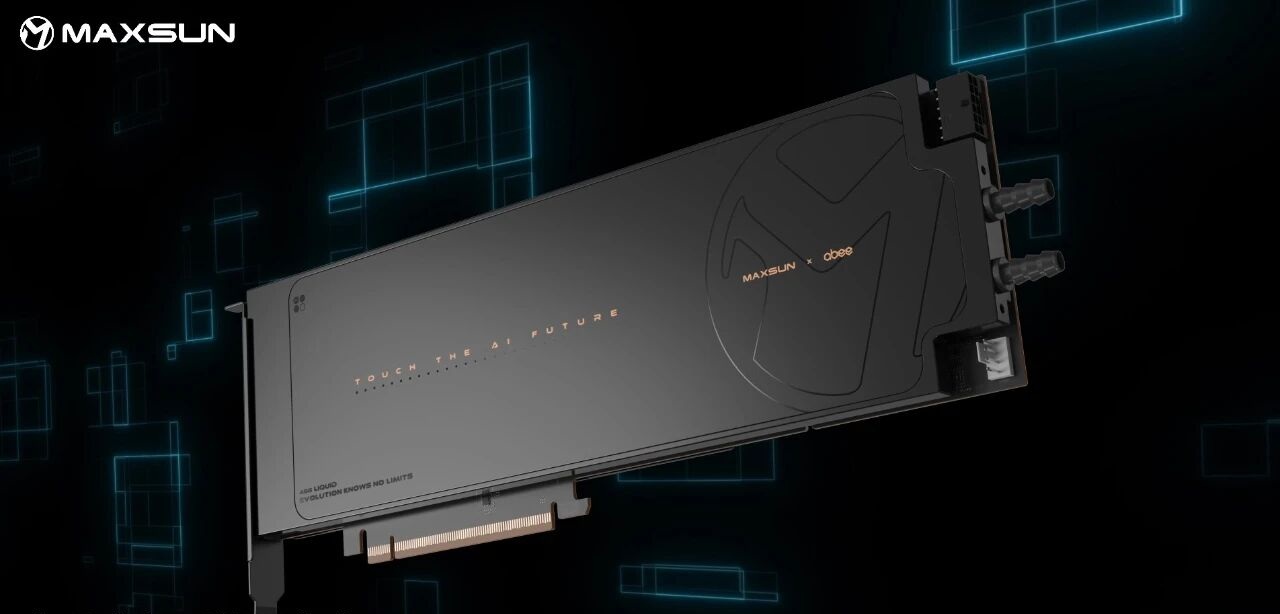
Maxsun equips the flagship liquid-cooled model with a closed-loop AIO, routing the tubing out of the rear so the card itself occupies just a single PCIe slot. That matters because a seven-slot motherboard can theoretically host seven of these boards, adding up to 336 GB of on-board VRAM for heavyweight language models, vector databases or mixed media pipelines.
Maxsun claims that under continuous load the liquid-cooled card tops out at around 61 °C, which is exactly what operators want to see on 24/7 inference boxes. The goal here is not to chase the last few frames per second in games, but to keep clocks predictable while streaming tokens all day for chatbots and agents.
Good for AI, underwhelming for games
That focus is why many enthusiasts jokingly call the B60 Dual ‘DOA’ for gamers. In raster performance it trails Intel’s own B580, so as a pure gaming upgrade it makes little sense. Where the card starts to shine is when tools like vLLM can spread a large model across multiple GPUs. Stack two to four B60 Duals in one chassis and you get a dense island of VRAM that can host sizeable 70B-style models for local experimentation, fine-tuning or serving a small fleet of users.
The catch is price. Talk in the community puts the notional MSRP at roughly 1,200 USD, a level where a 48 GB, dual-GPU Pro board actually looks compelling for shops that only care about throughput per dollar and do not need CUDA. But in markets like the US reports of street prices creeping toward 3,000 USD flip the math completely. At that point, buyers start looking at alternatives such as two Radeon 9700-class cards or even grey-market 48 GB GeForce 4080-style boards from China, all of which offer stronger gaming and broadly similar AI grunt.
Fanless, liquid and blower: the cooling debate
To its credit, Maxsun is not betting on a single cooler. Alongside the AIO version, the firm has shown a chunky dual-slot fanless model with an oversized heatsink hiding under a minimalist shroud. In a well-ventilated chassis this can quietly churn through inference jobs that rarely hit 100% load for long stretches. For cramped racks and serious multi-GPU setups, however, many builders still swear by blower cards or full water loops. Years of burnt 3090 backplates have convinced data-center tinkerers that pushing hot air straight out of the case is better than letting it swirl around banks of tightly packed VRAM chips.
Blowers remain noisy and unfashionable on desktop, but in a server closet the priority is survival, not acoustics. Maxsun’s previously shown active-cooled Arc Pro B-series variant fits squarely into that niche, giving integrators a choice between near-silent fanless builds, slim AIO rigs and classic blower walls.
Intel’s Arc Pro push is just beginning
Intel is expected to double down on Arc Pro over the next year, and Maxsun’s trio of B60 Dual designs hints at where things are going. If the cards can actually be bought near their intended price in more regions than China and Russia, they could become an accessible entry point into serious local AI for small studios, researchers and power users who value VRAM and efficiency over flashy gaming numbers.
If, on the other hand, scalpers keep nudging prices into halo-GPU territory, the B60 Dual risks becoming exactly what some commenters fear: a niche curiosity that is excellent at one job, merely adequate at everything else and simply too expensive to recommend widely. For now, it is one of the most intriguing showcases of what Intel’s Battlemage silicon can do when vendors design for LLMs first and frame rates second.
2 comments
Another DOAmage special lol. Great for AI stuff maybe, but as a gaming card this thing already feels dead on arrival
Good little AI workhorse, but for everything else it totally shat the bed 😂 VRAM sprinkles on weak sauce silicon