AM5 is finally getting the kind of compact, genuinely high-end motherboards enthusiasts have been asking for, and Maxsun is clearly aiming straight at that niche with its new iCraft X870M. This micro-ATX board is built around AMD’s X870 chipset, is ready for current Ryzen 7000 and upcoming Ryzen 8000/9000 processors, and even advertises support for future next-gen Ryzen chips with power headroom that frankly looks more like an overclocking lab than a small-form-factor gaming rig.
Designed for flagship Ryzen, not just entry builds
At the heart of the Maxsun iCraft X870M is a 16+2+1 phase power design using 50A Dr.MOS stages. 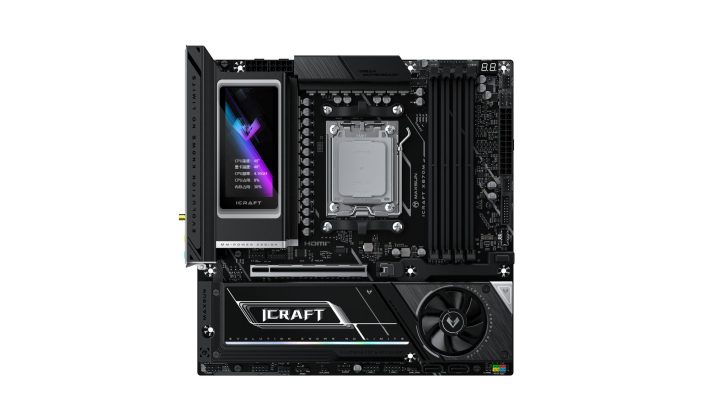
In normal English, that means the VRM is clearly overbuilt for typical 65–105 W Ryzen parts and is instead tuned for heavy hitters like a Ryzen 9 9950X3D running at sustained boost clocks. Maxsun officially talks about stable operation around the 300 W TDP mark and, more interestingly, an unlocked mode that allows the board to feed up to 400 W to the CPU under extreme loads. That is well beyond what most micro-ATX designs will comfortably handle and positions this board as a serious option for people who want to experiment with aggressive Precision Boost Overdrive, manual overclocking, or simply want guaranteed headroom for future Ryzen generations.
The AM5 socket support list includes Ryzen 7000, 8000, and 9000 series processors, and Maxsun explicitly markets the iCraft X870M as ready for upcoming next-gen Ryzen chips as long as they share the same platform. For anyone who likes to keep a motherboard across multiple CPU upgrades, this future-proofing is a big part of the value proposition.
High-speed DDR5 and triple M.2 in a compact layout
Memory support is equally ambitious. The iCraft X870M offers four DDR5 DIMM slots with support for up to 192 GB of RAM and overclocked speeds up to 8400 MT/s when using AMD EXPO profiles. That combination makes the board viable not just for gaming but also for compact workstations where heavy multitasking, content creation, or virtual machines benefit from high capacity and high frequency memory.
For storage, Maxsun equips the board with three M.2 slots. One slot runs at PCIe 5.0 x4, giving you access to the fastest next-gen NVMe SSDs, while the other two operate at PCIe 4.0 x4. One of these M.2 connectors is mounted on the rear of the PCB, which helps free up space on the front side while still keeping high-speed storage within reach. The front-facing M.2 slots sit under a large heatsink assembly that works in tandem with an active PCH fan, aiming to keep temperatures under control even when you pair a power-hungry GPU with hot PCIe 5.0 SSDs.
Single PCIe 5.0 x16 slot – a deliberate compromise
The main expansion slot is a reinforced PCIe 5.0 x16, fed directly from the CPU, and placed in the top position so that even bulky graphics cards have breathing room in tight micro-ATX cases. This is perfect for a single high-end GPU, which is exactly how most gaming and creator rigs are built today. However, the flip side is that you only get that one full-size PCIe slot; there is no second mechanical x16 slot and no mention of PCIe 5.0 bifurcation (x8/x8 or x8/x4/x4 modes). For a board pitched as "high-end," some power users will inevitably wish Maxsun had enabled proper bifurcation so they could run a PCIe 5.0 riser card with multiple NVMe drives or a capture card alongside their GPU. If you rely on add-in cards beyond your graphics card, this is the main structural limitation you need to be aware of.
Cooling, PCH fan, and thermals in a small case
Cooling is a critical part of any compact, high-power build, and Maxsun clearly knows it. The iCraft X870M uses chunky heatsinks over the VRM stages, linked with a heatpipe, and extends metal coverage over the front M.2 slots. The X870 chipset itself is actively cooled with a small fan that also helps pull heat away from that M.2 area. This kind of design can be a big help when you drop a 300–400 W CPU and a high-end GPU into a small enclosure, where airflow is naturally restricted.
Of course, active chipset coolers are divisive. Some enthusiasts dislike the potential for extra noise or dust build-up long-term. On the other hand, if you are building in a dense micro-ATX or compact mid-tower case and expect to hammer PCIe 5.0 SSDs and a hot flagship Ryzen, a PCH fan is arguably a reasonable trade-off for lower operating temperatures and better stability over long gaming or rendering sessions.
Next-gen connectivity: USB4, Wi-Fi 7, and 5GbE
Where the Maxsun iCraft X870M really flexes is I/O. On the rear panel you get two 40 Gbps USB4 Type-C ports for ultra-fast external drives, docks, and displays, backed up by six 5 Gbps USB ports and two classic USB 2.0 ports for peripherals. Front-panel connectivity includes a 10 Gbps USB-C header, a 5 Gbps USB-A header, and two USB 2.0 headers for case I/O and internal devices.
Networking is equally forward-looking. The board carries a 5GbE LAN port for wired connections, a notable upgrade over the more common 1GbE on mainstream boards. Wireless is handled by a Wi-Fi 7 module with Bluetooth 5.4, promising very low latency and high throughput for online gaming, streaming, or large file transfers across a modern home network. For audio, Maxsun uses the Realtek ALC1220 codec with five analog jacks and an S/PDIF output, providing a solid base for gaming headsets and multi-speaker setups without needing a dedicated sound card.
Maxsun View display and revamped PTM UI BIOS
One of the most distinctive features of the iCraft X870M is the large onboard display that Maxsun calls "Maxsun View." Instead of a tiny debug readout, you get a bigger, more versatile screen that can show real-time system metrics such as CPU temperature, clock speeds, fan curves, or even custom graphics. For enthusiasts who like to peek inside their case or build with a side window, this turns the motherboard itself into a status dashboard and a visual centerpiece.
Complementing that hardware is a new PTM UI BIOS. Maxsun has gone for a simplified, modern layout that makes basic tasks – enabling EXPO, adjusting fan curves, or changing boot order – much faster for regular users, while still keeping advanced tuning options for overclockers. Voltage controls, memory timings, PBO, and curve optimizer tweaks are all there; they are just buried a little deeper so novices do not accidentally break a stable configuration. It is the kind of firmware approach more vendors are adopting as AM5 matures and features like BCLK tweaking and advanced power controls become increasingly common.
DIY-friendly touches for small-form-factor builds
Beyond raw specs, the iCraft X870M comes with a set of practical quality-of-life features. There is a quick release mechanism for the GPU, making it far easier to remove a large graphics card in a cramped micro-ATX build where reaching the PCIe latch is usually a nightmare. A rear Clear CMOS button lets you recover from a failed memory or CPU overclock without opening the case. The Wi-Fi antennas use a snap-on design instead of fiddly screw-in connectors, which is especially nice if you move your system around. And because the PCIe x16 slot sits in the first lane at the very top, cable management and airflow are a bit easier compared to boards that push the GPU further down.
Aesthetic and build quality
Visually, Maxsun opts for an all-black aesthetic with subtle accents, reinforced primary PCIe slot, and three ARGB headers for lighting. That makes it easy to pair with almost any color scheme, whether you are going stealth-black or RGB-heavy. The board clearly aims to look premium inside a glass-side-panel case without going overboard on flashy sculpted armor.
Positioning, pricing, and verdict
On paper, the Maxsun iCraft X870M reads like one of the most feature-rich micro-ATX X870 boards announced so far: 400 W-ready VRM, triple M.2 with PCIe 5.0, USB4, Wi-Fi 7, 5GbE, onboard display, and a modern BIOS experience – all in a compact form factor. The trade-offs are just as clear: you only get a single full-length PCIe 5.0 slot with no apparent bifurcation support, and the active chipset cooling will not appeal to everyone.
Maxsun has not yet confirmed official pricing, but based on its specification and target segment, it is reasonable to expect the iCraft X870M to land somewhere around the 250–300 USD range. That would place it up against premium ATX X870 boards from more established global brands, but it also means you are getting a dense feature stack in a smaller footprint that many competitors simply do not offer yet.
If your ideal Ryzen 9000 or next-gen AM5 build is a compact gaming or creator system with a single powerful GPU, loads of fast storage, and cutting-edge connectivity, the Maxsun iCraft X870M looks like a very compelling foundation. Just be sure you are happy living with one PCIe 5.0 x16 slot and an active chipset fan, because those are the two design decisions that most clearly define this otherwise very ambitious micro-ATX motherboard.
2 comments
ngl the Maxsun View screen is kinda sick, imagine slapping temps + a dumb gif on the mobo and just flexing through the glass side panel 😎
Thank you for your sharing. I am worried that I lack creative ideas. It is your article that makes me full of hope. Thank you. But, I have a question, can you help me?