The M5 MacBook Pro may not look all that different on the outside, but under the hood, Apple’s latest professional laptop has undergone a dramatic transformation – especially in its storage performance. A new comparison between the M5 MacBook Pro and its predecessor, the M4 MacBook Pro, has revealed astonishing results: the M5’s SSD is a staggering 211 percent faster in read speeds, and nearly twice as quick when writing data. That’s not just a small bump – it’s a leap that pushes the MacBook Pro’s storage capabilities into the realm of high-end desktop-grade NVMe drives.
On paper, the M5 MacBook Pro looks almost identical to the M4 model, right down to the same cooling setup with a single fan and one heat pipe. 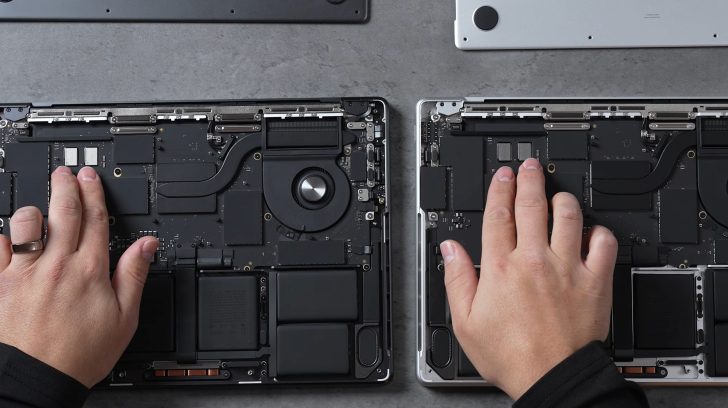
Both systems also rely on two NAND flash chips to maximize throughput. But while the physical design may remain familiar, Apple seems to have made deep technical improvements where it matters most: inside the SSD controller and firmware optimization. Those unseen tweaks are what drive the astonishing performance gains seen in benchmarks.
The tests were conducted by Max Tech, a popular YouTube channel known for its in-depth Apple reviews. Using the Blackmagic Disk Speed Test utility, the reviewers clocked the M5 MacBook Pro’s sequential read speed at an eye-watering 6,323MB/s – more than triple the M4’s 2,031MB/s result. On the write side, the M5 delivered 6,068MB/s compared to the M4’s 3,293MB/s. These figures firmly place Apple’s new laptop in the same class as PCIe Gen 4 NVMe SSDs typically found in enthusiast gaming rigs or high-performance workstations.
While Apple hasn’t officially confirmed what’s behind this dramatic leap, it’s highly likely that the company quietly introduced a new SSD controller optimized for the M5’s architecture. This also suggests improved NAND management and possibly better power efficiency when under load. However, the trade-off appears to be thermal: during sustained heavy workloads, the M5 model reportedly gets quite warm, with temperatures reaching up to 99°C. Even so, it still manages to run cooler on average than the M4 version, hinting that Apple’s thermal algorithms have been fine-tuned to balance performance and heat dissipation more effectively.
In day-to-day use, this SSD upgrade translates to a noticeably more responsive experience – apps launch faster, file transfers feel instantaneous, and large creative projects open in seconds. For professionals dealing with massive files, this difference could mean hours saved over the course of a week. The M5 MacBook Pro effectively blurs the line between portable computing and desktop-class performance.
For those tempted to upgrade, Apple’s base M5 MacBook Pro is available on Amazon for $1,583 in the sleek Space Black finish. Meanwhile, the still-capable M4 MacBook Pro – with 16GB of unified memory, 512GB of SSD storage, and a 10-core CPU and GPU – can be found for $1,349. While the M4 remains a solid performer, the M5’s SSD leap alone might justify the price difference for anyone who values speed and efficiency in their daily workflow.
1 comment
those numbers are wild. wonder if it’s even noticeable in daily stuff tho