Loongson has quietly outlined the next big step in its server roadmap, and it’s a far more ambitious leap than many expected. The Chinese chip designer is working on a new family of processors called the 3D7000 series, built around chiplets that pack 32 or more CPU cores each and manufactured on a sub-10 nm process that should be ready around 2027. 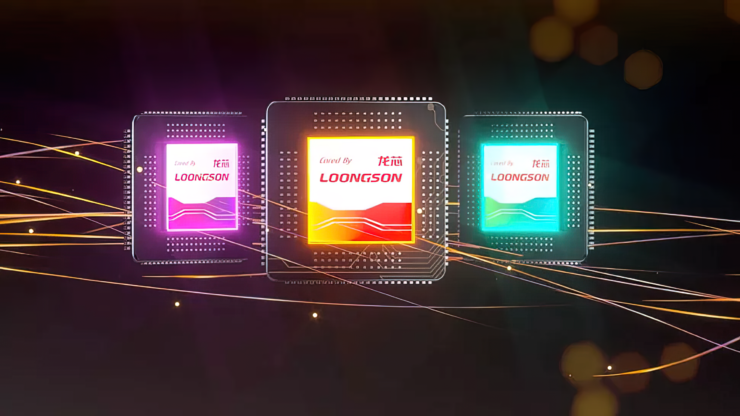
On paper, that would roughly double the core density of Loongson’s current server parts and mark another stage in China’s rapid, if uneven, attempt to close the gap with Western semiconductor giants.
To understand why the 3D7000 matters, it helps to look at where Loongson is today. The company’s existing 3C6000 server chips are believed to be produced on an approximately 12 nm node and use 16-core chiplets that can be combined in up to four-chiplet configurations for as many as 64 cores and roughly 300 W TDP. For workstation buyers there is also the 3D5000 line, which tops out at 32 cores running around 2.0 GHz. These platforms are not performance leaders, but they have become a crucial piece of China’s efforts to reduce reliance on US and offshore suppliers.
The 3D7000 generation is meant to push that strategy further. Loongson says it has already started IP design work for what it describes as an advanced X-nanometer process, a placeholder term for sub-10 nm manufacturing. Alongside the CPU cores themselves, the company is developing key blocks such as phase-locked loops, multi-port register files, and modern PHYs for DDR5 memory and PCIe 5.0 connectivity. Moving to 32+ cores per chiplet not only boosts total core counts but also helps amortize platform costs across more compute, which is critical in China’s state-backed push to build productive forces in its domestic tech industry.
Even with this progress, expectations need to stay grounded. Commenters inside and outside China have pointed out that, if the schedules hold, Loongson’s 3D7000 chips will likely land a few years behind AMD’s and Intel’s cutting-edge offerings. AMD, for example, is preparing its Zen 6 generation with a 32-core dense CCD for servers long before 2027, meaning that by the time 3D7000 systems ship in volume, they may be roughly comparable to what leading x86 platforms were delivering four or five years earlier. That is still a significant milestone for Loongson: moving from decades behind to only several years behind is a real change in the strategic equation, even if it does not threaten the front of the performance race.
The bigger question is what process technology will actually sit behind the sub-10 nm label. Industry watchers suspect the chips could rely on an enhanced Chinese foundry node rather than a truly bleeding-edge EUV process, something closer to SMIC’s N+1 or N+2 classes. That raises doubts about power efficiency and clock speeds; packing 32 or more relatively simple cores into each chiplet could lead to very high power draw if the node behaves more like a tweaked 12 nm than a genuine 7 nm-class technology. Skeptics are already joking that such designs might end up in the 400–500 W range, emphasizing brute-force core counts over elegance.
Yet dismissing these processors as toys would miss the broader context. China’s government and major tech firms are deliberately steering procurement toward home-grown hardware, even when it trails behind foreign options. For cloud providers, state agencies, and research institutions that are already locked out of the latest US technology by sanctions, a domestically designed 32+ core server chip with DDR5 and PCIe 5.0 support is far better than standing still on aging platforms. More suppliers also mean less risk of the kind of oligopolistic market structures we see today in areas like DRAM, where just a handful of companies dominate pricing and capacity.
Loongson’s plans are not limited to CPUs either. In parallel with the 3D7000 work, the company says its 9A1000 discrete GPU is approaching readiness. Positioned as an entry-level accelerator for so-called AI PCs and mainstream graphics, the 9A1000 has reportedly reached tape-out and is being paired with driver work for Windows. Together, the 3D7000 processors and 9A1000 GPUs sketch a picture of a slowly maturing domestic ecosystem that can handle general-purpose compute, graphics, and at least some machine-learning workloads without leaning on US-controlled technologies.
For now, huge blanks remain in the story. Loongson has not shared detailed architectural diagrams, base clocks, SKU breakdowns, or firm performance targets for the 3D7000 line. We do not know how many chiplets will be supported per socket, how the memory hierarchy is arranged, or whether there will be specialized accelerators for AI and encryption. We also do not know how many of these chips will escape China’s borders; given the political climate, 3D7000 systems may end up serving almost exclusively domestic data centers and government projects. But taken together, the roadmap sends a clear signal: China’s home-grown CPU efforts are no longer a sideshow. They are evolving into a parallel track of the server world that the rest of the industry can no longer afford to ignore, even if the first generations arrive with rough edges and plenty of skeptics watching from the sidelines.