Double Fine has a history of creating games that are as quirky as they are creative. From the cult classic Psychonauts to the ambitious (but ultimately flawed) Brütal Legend, the studio has always embraced the oddball side of gaming. But after the commercial success of Psychonauts 2, they took a break from large-scale releases. 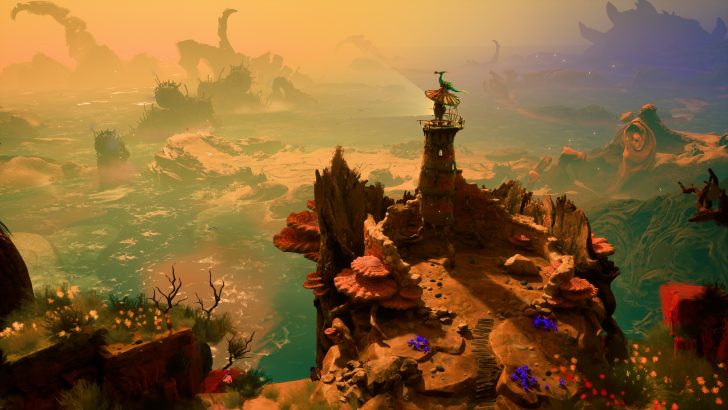
Now, in 2025, we have their latest title: Keeper, a game that blends adventure and walking-simulator elements in an attempt to deliver something uniquely artistic and thought-provoking.
At first glance, Keeper is unmistakably a Double Fine game. The art style is as eye-catching as ever, with strange, whimsical landscapes that transport you into a surreal world. The narrative, on the other hand, is more elusive – partly because the game thrives on ambiguity. You play as a sentient lighthouse, brought to life by the inexplicable crash of a bird. How did the lighthouse gain consciousness? Why does it retain its sentience after undergoing numerous transformations, including turning into a ship, a Beyblade, and even a crab-ship? These questions remain unanswered, leaving you to simply enjoy the journey.
Despite its narrative complexity, Keeper is a relatively simple game in terms of gameplay. It’s best categorized as a walking simulator, with light puzzle elements that rarely require deep thought. The puzzles often involve guiding your character’s light to illuminate objects, unlocking new paths, or freeing trapped creatures. However, it’s not a challenging puzzle game by any stretch – solving these “puzzles” feels more like following a predetermined path rather than engaging with anything that tests your intellect. But that’s the point: Keeper is more about the experience than the challenge. It’s a game that invites you to explore and soak in its world, rather than solve complex riddles.
The game’s central theme is that of light battling darkness. It’s a familiar trope, and though Double Fine encourages players to draw their own conclusions, the symbolism feels a little too on-the-nose at times. The opening cinematic evokes the iconic scene from The Lord of the Rings where Gandalf uses light to repel the Nazgûl. The parallels are clear, and while the theme of light fighting off darkness is compelling, it feels a bit too obvious. Perhaps that’s intentional – perhaps Double Fine wanted to create a more straightforward message that players could interpret in their own way – but it didn’t resonate deeply with me.
Visually, though, the game is stunning. The art design is one of Keeper’s greatest strengths. The environments are full of life, with surreal magic-infused settings that could easily be mistaken for living paintings. The world is a pleasure to look at, and it’s worth taking your time to explore it, if only to find some of the game’s small secrets hidden throughout. The visual experience is one of the game’s biggest selling points, and even if the story falters at times, the breathtaking scenery helps keep you engaged.
However, while the game looks great, its pacing leaves much to be desired. Keeper does manage to open up a bit halfway through, introducing platforming segments that offer a refreshing change of pace. There’s a certain joy to be found in these sections, especially when your character is transformed into a candyfloss-like form that allows you to jump and float through the environment. It’s an utterly fun experience, but it doesn’t last long. The problem is that these moments of excitement are fleeting. Soon, you’re back to walking through linear paths, switching between various forms, and feeling like the game’s progression lacks cohesion.
As you progress through the game, you switch between forms: Lighthouse, boat, Beyblade, and crab. Each transformation offers something new, but none of them feel entirely satisfying. At first, these changes feel like a natural evolution, but as you cycle through them, it becomes apparent that the game is padding itself out. After the novelty wears off, the repetitive nature of the gameplay begins to dull the experience. Keeper offers variety in its forms, but this variety feels more like a way to extend the game’s length than a meaningful part of its design.
This issue with pacing is especially noticeable when you realize that the game could have been more effective if it had been trimmed down. The thirty-nine stages that make up the game can feel like they’re stretching on for too long, especially when the more enjoyable gameplay segments are swapped out for mundane, linear sections. It’s a shame, because there are moments when the game hits its stride, and it’s easy to imagine a more focused version of Keeper being a tighter, more impactful experience.
All in all, Keeper is a game that’s hard to pin down. It’s gorgeous, it’s imaginative, and it’s certainly full of moments that made me smile. But it also feels like it overstays its welcome. The thirty-nine stages could have been condensed into something more digestible, and I can’t help but feel that the game would have benefited from being a bit shorter. Even at a length of eight hours, it starts to feel like it’s spinning its wheels, and I found myself occasionally sighing in boredom. Ultimately, I’d say that if you’re a fan of Double Fine’s quirky style, it’s worth checking out, but be prepared for some repetitive gameplay that can drag down the experience.
Pros:
- Gorgeous art and animation
- The Keeper and its bird companion are well characterized despite the lack of dialogue
- Some gameplay moments are genuinely fun
Cons:
- The fun moments are short-lived and often replaced by more mundane tasks
- Some sections feel repetitive, and the game can outstay its welcome
- The pacing feels inconsistent
Rating: 6.5/10
Would I recommend Keeper? For its art style alone, probably. The visuals are truly impressive, and there were moments that brought a genuine smile to my face. However, I can’t deny that there were times when the game simply became a chore. If you’re looking for a unique experience, it’s worth playing, but don’t expect it to be the perfect adventure you might hope for.
1 comment
I get what they’re saying about the story, but I didn’t mind the weirdness. It was kinda fun figuring things out without all the answers