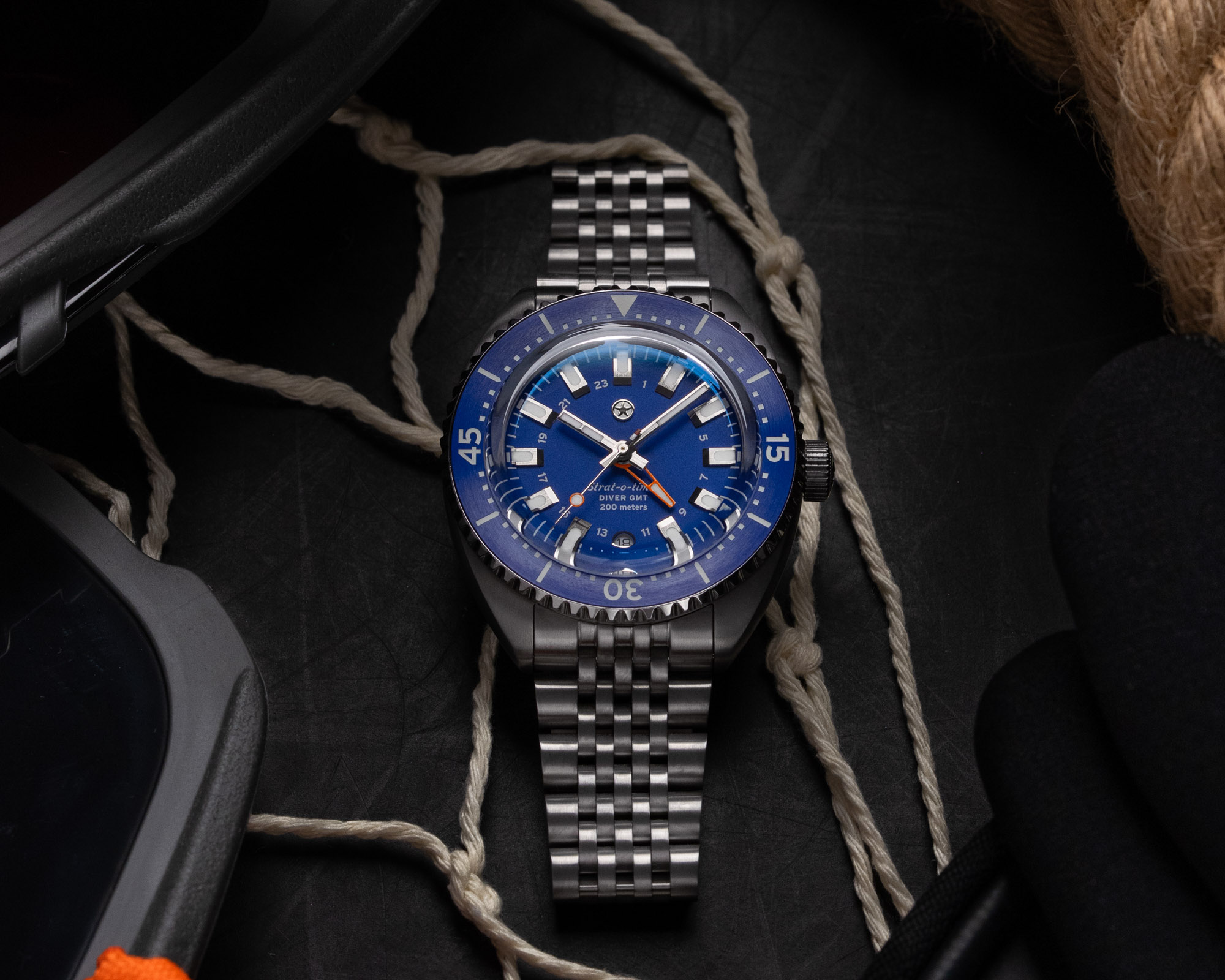
Jack Mason Strat-O-Timer Titanium Diver GMT: a lighter, tougher take on the fan-favorite travel watch
When Jack Mason launched the Strat-O-Timer back in 2022, it quickly became one of those word-of-mouth hits that move from niche forums to real wrists. The formula was familiar – clean cushion case, Jubilee-style bracelet, and a rotating 24-hour bezel inspired by classic travel watches – but the execution and price made it feel fresh. Limited collaborations (yes, even the playful Dr. Pepper and A&W editions) widened the audience, and the collection matured without losing its accessible charm.
For 2025, the Dallas-based brand has taken a confident step sideways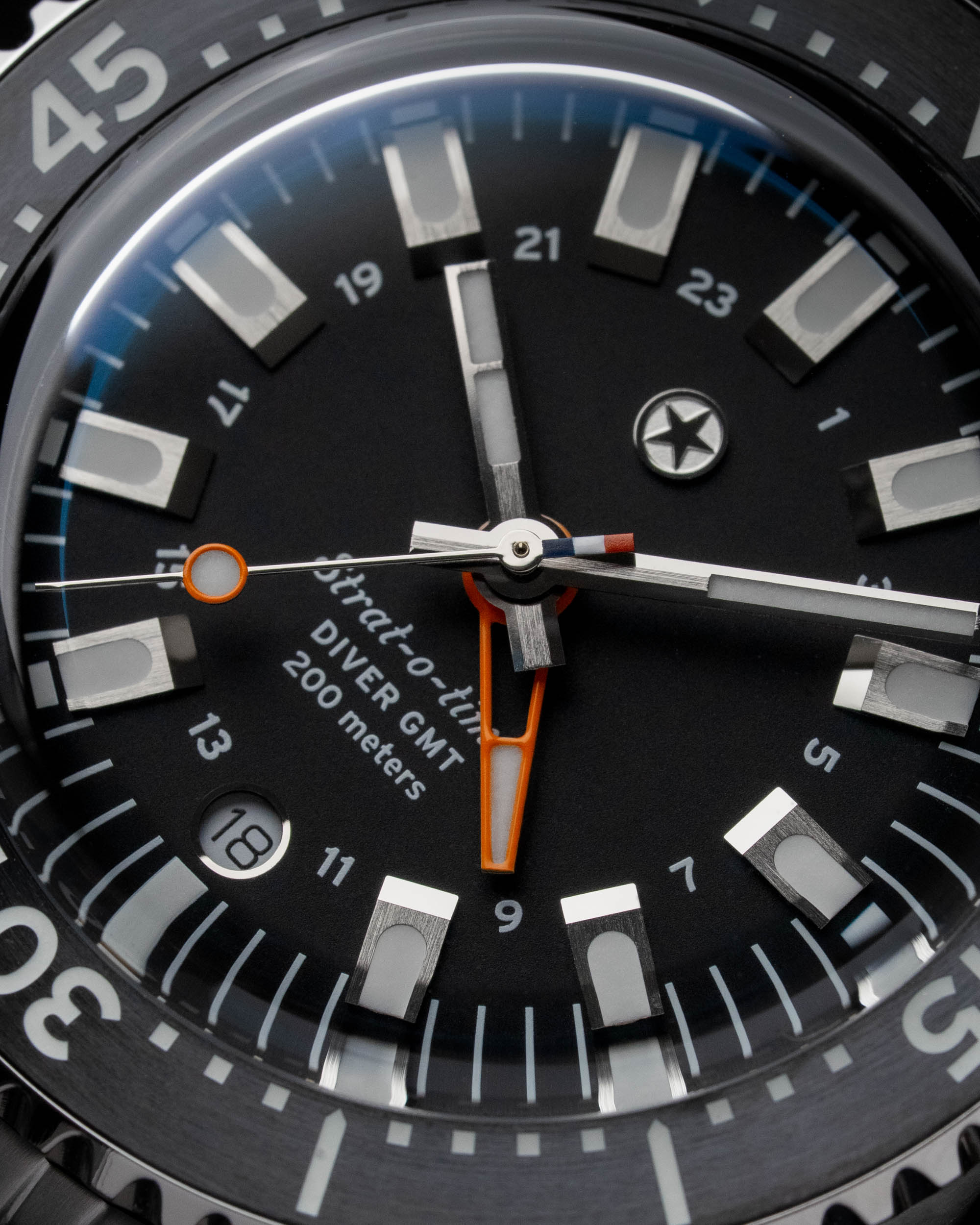
. The new Strat-O-Timer Titanium Diver GMT keeps the soul of the original but reframes the concept: rather than a travel watch that can swim, it is effectively a dive watch that travels. The headline changes sound simple – grade 2 titanium instead of steel, a unidirectional 60-minute ceramic bezel instead of a rotating 24-hour ring, and the GMT scale moved onto the dial – but together they give the Strat-O-Timer a distinctly more tool-ish, ocean-ready identity.
Why a diver’s bezel on a GMT?
Modern flier-style GMT movements like the Miyota 9075 don’t need a 24-hour bezel to track a second time zone. With the local hour hand independently adjustable – in one-hour jumps forward or backward – you already have two zones at a glance: local and home (via the 24-hour hand and printed track). 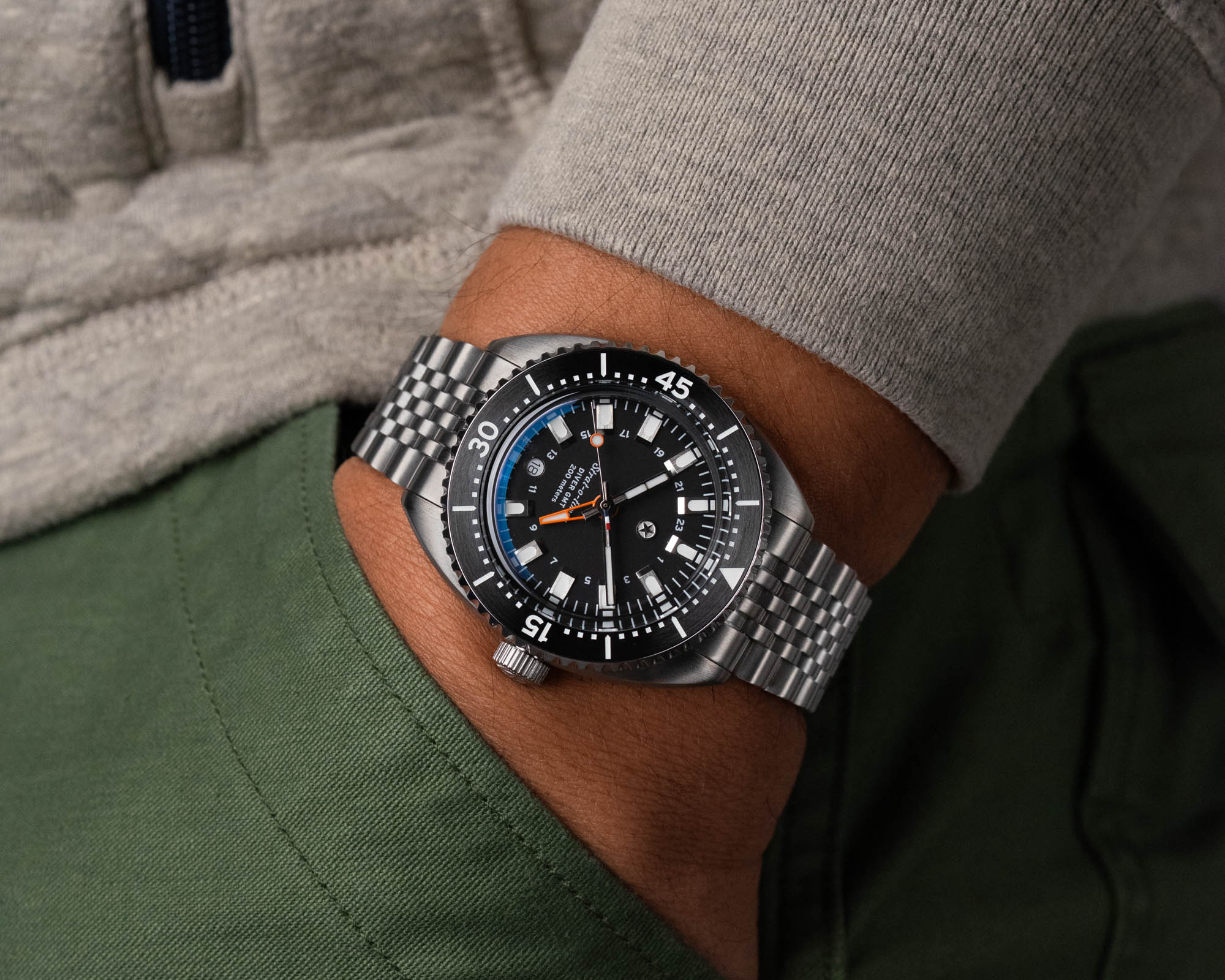
That frees the bezel to do something arguably more useful day-to-day: measure elapsed time. Whether you’re diving, timing a pour-over, or tracking a parking meter, a 60-minute scale is universally practical. Jack Mason leans into that logic here, and it’s a move more brands should consider.
The movement that made the Strat-O-Timer
Jack Mason was among the early adopters of the Miyota 9075, a true flier GMT with a jumping local hour hand – much rarer in this price bracket than caller-style GMTs that jump the 24-hour hand. The 9075 beats at 28,800 vph (4 Hz) and offers a 42-hour power reserve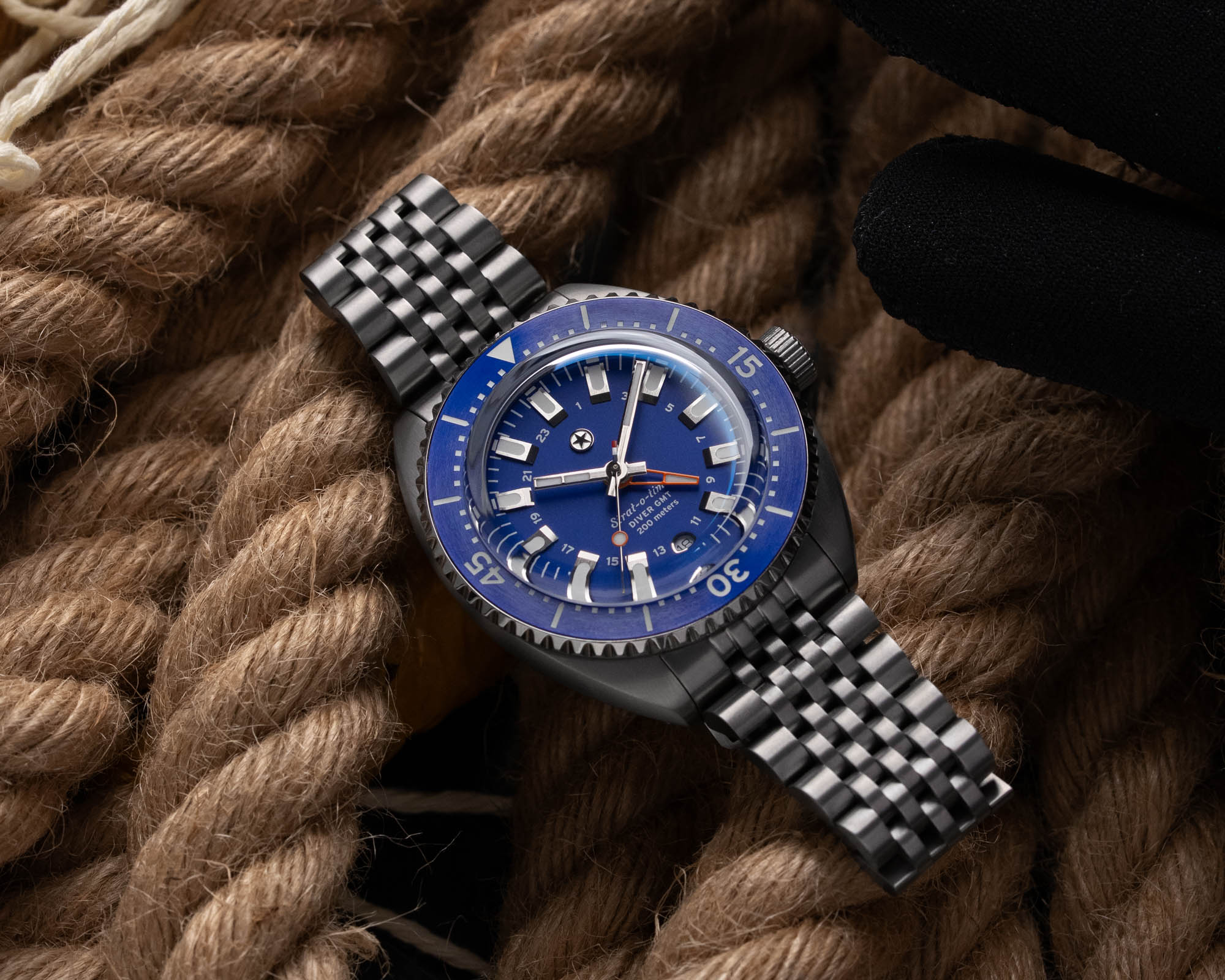
. In this titanium Diver GMT, the brand continues to regulate the caliber in-house to about ±5 seconds per day, a figure that many owners of previous Strat-O-Timers reported hitting in real-world use. The upshot: you get that frictionless airport experience – unscrew crown, jump the hour hand, land – and an accuracy envelope that feels premium for the segment.
Titanium done the right way
The case keeps the Strat-O-Timer’s now-signature cushion silhouette but swaps steel for grade 2 titanium with a fully brushed finish. It measures a very wearable 40 mm in diameter, roughly 13 mm thick, with a 47 mm lug-to-lug span and a versatile 20 mm lug width. A domed sapphire crystal caps the dial, and the screw-down crown at three supports a confident 200 m water resistance. The weight drop is immediately noticeable: titanium yields about a 30% reduction versus the steel Strat-O-Timer, turning an already comfy watch into an all-day ghost on the wrist.
Finish choices are deliberate. Unlike some steel siblings that mix polished accents, the titanium Diver GMT goes all-brushed, emphasizing function over flash. That matte attitude extends to the bracelet: the familiar rounded five-link (think Jubilee vibes) is here rendered in titanium and likewise fully brushed, paired to a folding clasp with built-in micro-adjust. Worth noting for strap fans: at launch there are no strap-equipped variants; the watch ships exclusively on the bracelet. 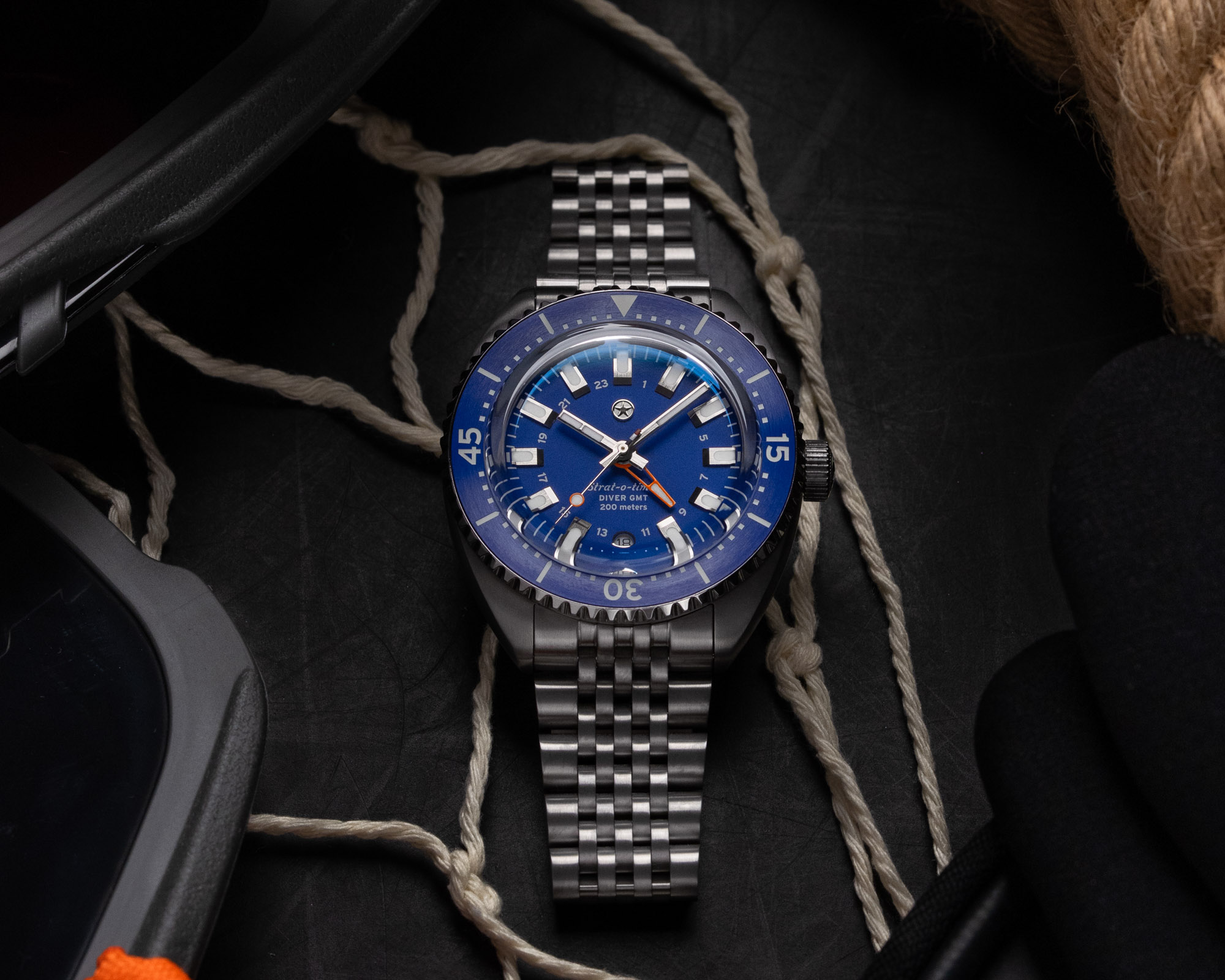
The good news is that a 20 mm lug width means your own sailcloth, FKM, or NATO experiments are a spring-bar swap away.
Dial, bezel, and the glow factor
Jack Mason relocates the 24-hour track to the dial, neatly tucked inside the ring of applied hour markers. The unidirectional ceramic bezel gets a crisp 60-minute diving scale, and legibility is excellent in both light and dark thanks to a blanket of BGW9 Super-LumiNova across hands, markers, and even the bezel insert. BGW9’s blue glow complements the watch’s two launch colorways – black and blue – each enlivened by judicious orange accents, including a re-shaped orange 24-hour hand that reads clearly against the dial’s 24-hour ring.
Small detail, big effect: Jack Mason has switched the date aperture from a rectangle to a circle on these titanium GMTs. On wrist, the round window feels more integrated with the hour plots and helps the dial read as a cohesive instrument rather than a collage of borrowed motifs. It’s a smart, modernizing tweak.
On-wrist experience
Specs only tell part of the story. The Strat-O-Timer Titanium Diver GMT wears compact and balanced. The domed crystal adds a touch of vintage charm without ballooning height; the cushion case hugs rather than overhangs; the micro-adjust clasp dials comfort quickly as the day warms. Titanium’s thermal neutrality matters, too – it never feels cold when you first strap it on. The all-brushed surfaces shrug off hairline scuffs that polished mid-links tend to collect. In other words, it’s made to be used, not babied.
Flier vs caller GMT: an honest take
The 9075’s flier behavior is a core appeal: travelers can shift local time independently and keep home locked. That said, some enthusiasts will always prefer caller GMTs because those often bring a quick-set date, whereas a flier GMT typically ties date advancement to the local hour hand. If you habitually cycle watches or frequently adjust the date at your desk rather than in transit, that’s a real trade-off. In practice, the 9075 mitigates annoyance by letting you jump hours backward as well as forward – cross the date line in either direction and you can correct quickly – yet the preference for a true quick-set date is understandable. In my view, it’s the only meaningful gripe in an otherwise well-rounded spec sheet.
Dive-GMT in the wild: use cases that make sense
- Travel days: Land, unscrew, jump the hour hand, done. Keep an eye on home with the orange 24-hour hand and dial track.
- Daily timing: The 60-minute bezel tracks a pasta pot, a meeting block, or a gym circuit more intuitively than a 24-hour ring.
- Water weekends: With 200 m water resistance, a screw-down crown, and legible BGW9, the watch is genuinely swim and snorkel ready.
- Desk diving: The titanium build and brushed bracelet are scratch-forgiving, so keyboard life won’t turn it into a swirl-fest.
Design lineage without cosplay
The original Strat-O-Timer nodded to a certain famous crown-bearing GMT icon – call it part of the genre’s shared vocabulary. This titanium Diver GMT feels less referential. The dial-based GMT track, the circular date, the monochrome matte finishing, and the ceramic diver insert drive it toward a more purposeful identity. It’s recognizably a Strat-O-Timer, but one that’s shed the costume jewelry and picked up a tool belt.
Specifications
| Case | Grade 2 titanium, 40 mm diameter, ~13 mm thick, 47 mm lug-to-lug, 20 mm lugs |
| Crystal | Domed sapphire |
| Bezel | Unidirectional ceramic insert, 60-minute scale |
| Water resistance | 200 meters |
| Movement | Miyota 9075, 28,800 vph (4 Hz), 42-hour power reserve |
| Regulation | In-house to approximately ±5 s/day |
| Bracelet | Five-link titanium (Jubilee-style), fully brushed, folding clasp with micro-adjust |
| Lume | BGW9 Super-LumiNova on dial, hands, bezel |
| Variants | Black or Blue, both with orange accents |
| Price | $1,399 USD at launch |
How it stacks up
In today’s sub-$1,500 bracket, most travel-capable divers either compromise on movement (caller GMTs that are less convenient when flying) or on materials (steel instead of titanium). The Strat-O-Timer Titanium Diver GMT splits the difference intelligently: true flier functionality, a ceramic timing bezel, and a titanium case/bracelet at a modest premium – about $250 more than comparable steel Strat-O-Timers. If you value comfort and everyday timing utility as much as second-zone tracking, this configuration makes more sense than a traditional 24-hour ring.
Details that show the brief was understood
- All-brushed finishing aligns with the tool-first intent and hides wear.
- Orange GMT hand contrasts clearly against both dial colors and their 24-hour rings.
- Circular date window harmonizes with round markers for a cleaner, modern dial.
- Dial-integrated 24-hour track keeps the bezel free for timing while preserving at-a-glance home time.
Any misses?
Beyond the lack of a quick-set date (intrinsic to flier architecture) and the absence of a factory strap option at launch, there’s not much to nitpick. Some may wish for a slightly longer power reserve, but at 42 hours and with easy wearability, it’s rarely problematic. A left-field desire would be a fully lumed bezel insert for night dives, but the current BGW9 application is already generous and bright.
Verdict: a versatile, function-forward evolution
The Jack Mason Strat-O-Timer Titanium Diver GMT takes a platform enthusiasts already trusted and reorients it toward real-world utility. Titanium makes it lighter and tougher. The diver’s bezel makes it more useful, more often. The 9075 keeps it traveler-friendly, and the brand’s regulation target means you can rely on it. At $1,399, the premium over steel is sensible rather than speculative. This is, in the best sense, a basic diver that hurts nobody – and actually helps you do more. If Jack Mason decides to spin out additional colorways (history suggests they will), this titanium Diver GMT could become the most broadly appealing member of the Strat-O-Timer family.
In short: if you’ve been waiting for a Strat-O-Timer that feels purpose-built rather than playful, this is the one to try on first.
1 comment
nice clean diver vibes, doesn’t try too hard. i could daily this easy