The iPhone Air has already sparked curiosity among tech enthusiasts, but the latest teardown from WekiHome gives perhaps the clearest view yet of just how Apple pulled off its ultra-thin 5.6mm design. Instead of being just another disassembly, the video exposes the sheer complexity of what can only be described as a three-dimensional puzzle – components are layered with surgical precision, leaving almost no room for error.
One of the first surprising revelations was the thickness of the rear glass panel. 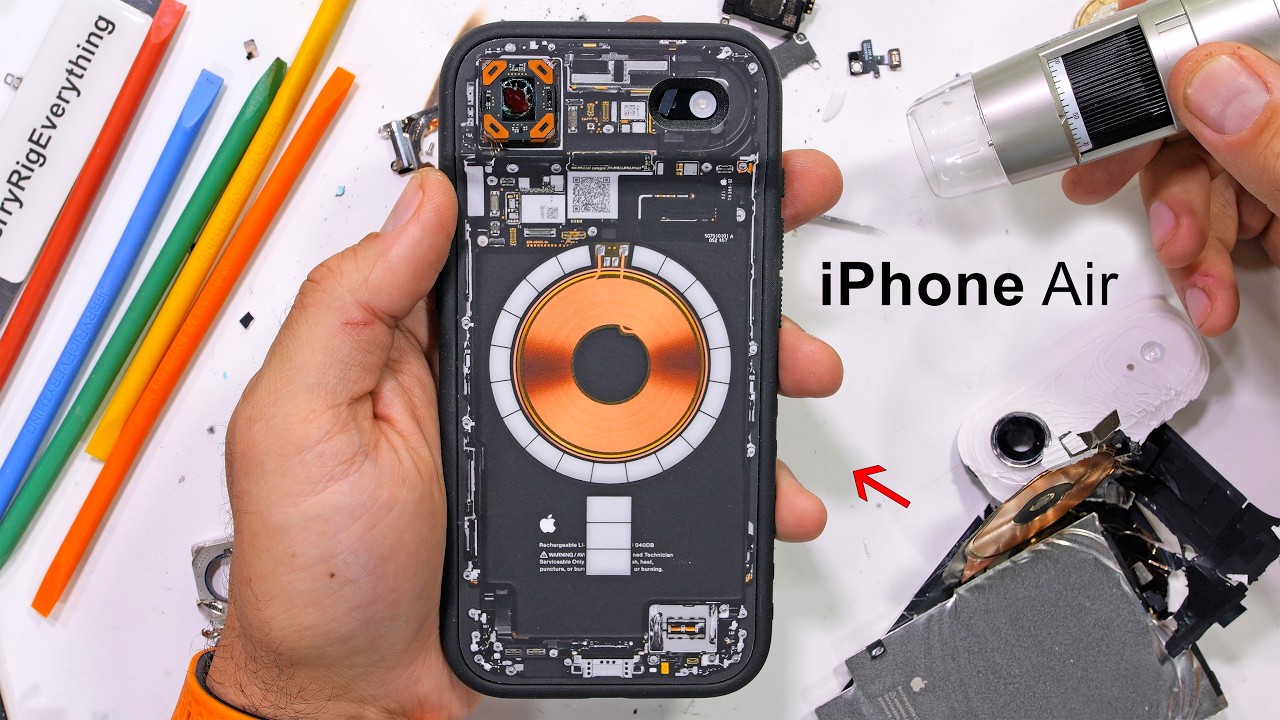
At 0.6mm, the iPhone Air’s back glass is actually thicker than that of the iPhone 17 Pro, which measures 0.45mm. Yet Apple balanced this by slimming down the display itself: the Air’s screen is only 0.919mm thick compared to 0.987mm on the Pro. In essence, Apple traded glass thickness for screen thinness to keep the Air’s overall profile razor-sharp.
The logic board is another standout. It takes up more physical space than the iPhone 17 Pro’s motherboard, not because Apple is regressing, but because engineers had to avoid stacking too many elements vertically. In pursuit of a flat, wafer-thin body, Apple spread components across a broader footprint. WekiHome also highlighted how the FaceID module appears mirrored between the two models, a small but intriguing design tweak that suggests Apple is experimenting with spatial layouts as it pushes toward foldable tech.
The Air’s internal frame is a patchwork of materials. Its perimeter uses titanium for rigidity, as confirmed by durability tests, while much of the internal skeleton is crafted from aluminum – sometimes so thin it’s almost shocking. For example, the aluminum layer near the battery bay measures just 0.255mm thick, barely more substantial than kitchen foil, which averages around 0.016mm. This balance between strength and extreme thinness is a delicate act that only a handful of manufacturers dare to attempt at scale.
Then there’s the battery – perhaps the most challenging part of the build. At only 2.8mm thick, it carries a 3,149mAh capacity (12.263Wh). WekiHome calculated its volumetric energy density at around 783Wh/L, but noted the true figure is closer to 800Wh/L. For comparison, the Samsung Galaxy S25 Edge houses a 3,900mAh unit with a density of 758Wh/L. Vivo has already surpassed both with the X200 FE’s 845Wh/L battery, while Realme is working on prototypes that blow all these out of the water: a 10,000mAh cell at 887Wh/L and even a 15,000mAh monster boasting an unprecedented 1,200Wh/L.
Clearly, Apple’s ambition with the iPhone Air isn’t to lead in battery innovation. Instead, the Air feels like a testbed – a practice run for the company’s long-rumored foldable device. By mastering ultra-thin designs and pushing manufacturing limits, Apple is preparing itself for the next leap in mobile hardware. WekiHome’s meticulous teardown doesn’t just reveal the guts of a phone; it hints at Apple’s broader strategy and the lengths it’s willing to go to redefine what thin means in modern smartphones.
For anyone fascinated by engineering wizardry and the evolution of mobile design, this teardown is worth watching. It’s not just about how Apple squeezed so much into so little space – it’s a preview of where the iPhone, and perhaps the entire industry, is heading next.
3 comments
I’ll wait for Air 2, this feels like a beta run
Foldable iphone incoming?? mark my words
WekiHome vids always 🔥