iPhone 17 vs Pixel 10 Pro: Wi-Fi 7 showdown and the rise of Apple’s N1 chip
For most people, Wi-Fi only gets attention when it stops working. Yet in 2025, the wireless connection on your phone matters almost as much as the processor or camera. Streaming in 4K, endless cloud backups, console-level mobile gaming, smart homes buzzing with connected gadgets – all of that leans on a stable, fast, and low-latency Wi-Fi link.
This year’s heavyweight battle is happening between Apple’s iPhone 17 lineup, powered by a new in-house N1 networking chip, and Google’s Pixel 10 Pro, which brings a highly tuned Wi-Fi 7 implementation of its own. Throw in Samsung’s Galaxy S25 family, Xiaomi’s 15T Pro, and Huawei’s Pura 80 series, and you get one of the most interesting generations of wireless competition we’ve seen in years.
Fresh performance data based on real-world Speedtest results paints a surprisingly nuanced picture. Apple’s N1 chip helps the iPhone 17 crush weak Wi-Fi scenarios and dominate North America, while Google’s Pixel 10 Pro quietly walks away with the global crown for median Wi-Fi speeds. Xiaomi and Samsung carve out their own niches in uploads and latency, and Huawei has to fight harder due to missing 6 GHz support.
Inside Apple’s N1 chip: more than just Wi-Fi 7 on a spec sheet
The N1 networking chip is Apple’s latest attempt to pull more critical components in-house. Instead of relying solely on a generic off-the-shelf solution, Apple bundling Wi-Fi 7, Bluetooth 6, and Thread radios into a custom silicon block means tighter integration with iOS, the A-series processor, and the overall power-management system.
On paper, the N1 doesn’t look flashy. It still uses 160 MHz channels, just like last year’s iPhone 16, and it can’t stretch to the ultra-wide 320 MHz channels that Wi-Fi 7 supports in theory. If you stare only at spec sheets, you would expect Android flagships that do support 320 MHz to walk all over Apple. That’s not what happens.
Instead, Apple appears to be squeezing more out of the same bandwidth through smarter signal processing, improved antenna tuning, and aggressive software optimization. Wi-Fi performance is not just about the width of the channel; it’s also about how efficiently a phone holds on to the signal, how it handles interference from neighbors, and how quickly it recovers from drops.
Huge gains over iPhone 16 – especially where Wi-Fi is bad
Data gathered in the first six weeks after the iPhone 17 launch shows that Apple’s new lineup delivers a dramatic leap over the iPhone 16 family. Across global measurements, median download and upload speeds are up by as much as 40% compared to last year’s phones. Those are not lab numbers; they’re aggregated from people using their phones in real homes, offices, and public spaces.
The most striking improvement shows up in the tough spots – the places where Wi-Fi usually makes you angry. At the 10th percentile (essentially the “bad Wi-Fi corner” of your life), the iPhone 17 is roughly 60% faster than the iPhone 16. Think basement bedrooms, rooms behind thick concrete walls, your friend’s overcrowded apartment, or that café where everyone is camped on the same network.
In those scenarios, you’re not chasing record-breaking top speeds; you just want your video call not to freeze and your apps not to spin on loading screens. Here, Apple’s N1 chip really earns its keep: fewer dropouts, less buffering, and a connection that feels more like “plugged-in broadband” than “fading in and out through two walls and a fridge.”
North America: iPhone 17 takes the lead despite 320 MHz Android advantage
Things get even more interesting when you zoom into regional data. In North America, where Wi-Fi 7 devices already have access to triple 320 MHz channels on 6 GHz, you would expect Android phones that can use those enormous lanes to crush Apple’s 160 MHz-limited setup.
That’s not what the numbers show. During the testing window, the iPhone 17 family delivered the highest median Wi-Fi download speed in North America at about 416.14 Mbps. At the higher end of the curve, the iPhone 17 also posted a stunning 90th-percentile download speed of 976.39 Mbps, flirting with gigabit-class performance under good network conditions.
In other words, even in a region where the competition supposedly has a raw bandwidth advantage thanks to 320 MHz channels, Apple’s tuning still pushes the iPhone 17 to the front in everyday usage. This may not last forever – as 320 MHz-capable routers become more common in homes and offices, Android phones might unlock more of their theoretical headroom – but right now, the N1 chip is clearly doing something right.
Global picture: Pixel 10 Pro grabs a narrow Wi-Fi victory
Zoom out from North America to the entire world, and the story changes subtly. Across global measurements, Google’s Pixel 10 Pro manages to inch ahead of the iPhone 17 lineup. The Pixel 10 Pro posts a median download speed of roughly 335.33 Mbps, while the iPhone 17 family sits very close behind at around 329.56 Mbps.
That gap is small enough that most people would never feel it in daily use. Still, it’s a genuine bragging right for Google. It suggests that the Pixel 10 Pro makes excellent use of Wi-Fi 7 and 6 GHz in markets where those frequencies are widely available and where the router infrastructure is a bit more modern.
The global numbers also highlight how quickly the industry is moving. Across Android devices as a whole, median speeds on 6 GHz Wi-Fi are at least 77% faster than on 5 GHz. And upgrading from Wi-Fi 6 to Wi-Fi 7 offers a similar jump again. The takeaway is simple: if your router and phone both support 6 GHz and Wi-Fi 7, you’re in for a noticeably smoother experience, especially in dense apartment buildings where the 2.4 and 5 GHz bands are crowded.
Xiaomi 15T Pro: upload monster with impressive latency
While Apple and Google trade blows on download speeds, Xiaomi’s 15T Pro quietly steals the spotlight in other areas. Packed with a MediaTek Dimensity 9400(+) platform and its advanced Wi-Fi system, this phone posted one of the strongest sets of wireless results in the entire report.
On the download side, Xiaomi’s 15T Pro reached around 887.25 Mbps at the 90th percentile, which is deep into premium territory. But it’s the upstream performance and responsiveness that really stand out. The 15T Pro leads in upload speeds globally and manages a median latency of about 15 ms, making it a dream device if you care about sending data as much as receiving it.
That matters more than people think. Fast uploads and low latency help if you’re constantly pushing large photo libraries to the cloud, livestreaming, backing up 4K video, joining video calls on the move, or gaming on servers half a continent away. For power users who live in the creator or gamer lane, Xiaomi’s approach to Wi-Fi tuning is genuinely appealing.
Galaxy S25: king of latency in North America
Samsung’s Galaxy S25 family doesn’t top the global charts in any single headline metric, but it performs consistently well across categories. Overall, it lands squarely in the upper mid-tier of flagship Wi-Fi performance, which in 2025 still means very fast and very capable.
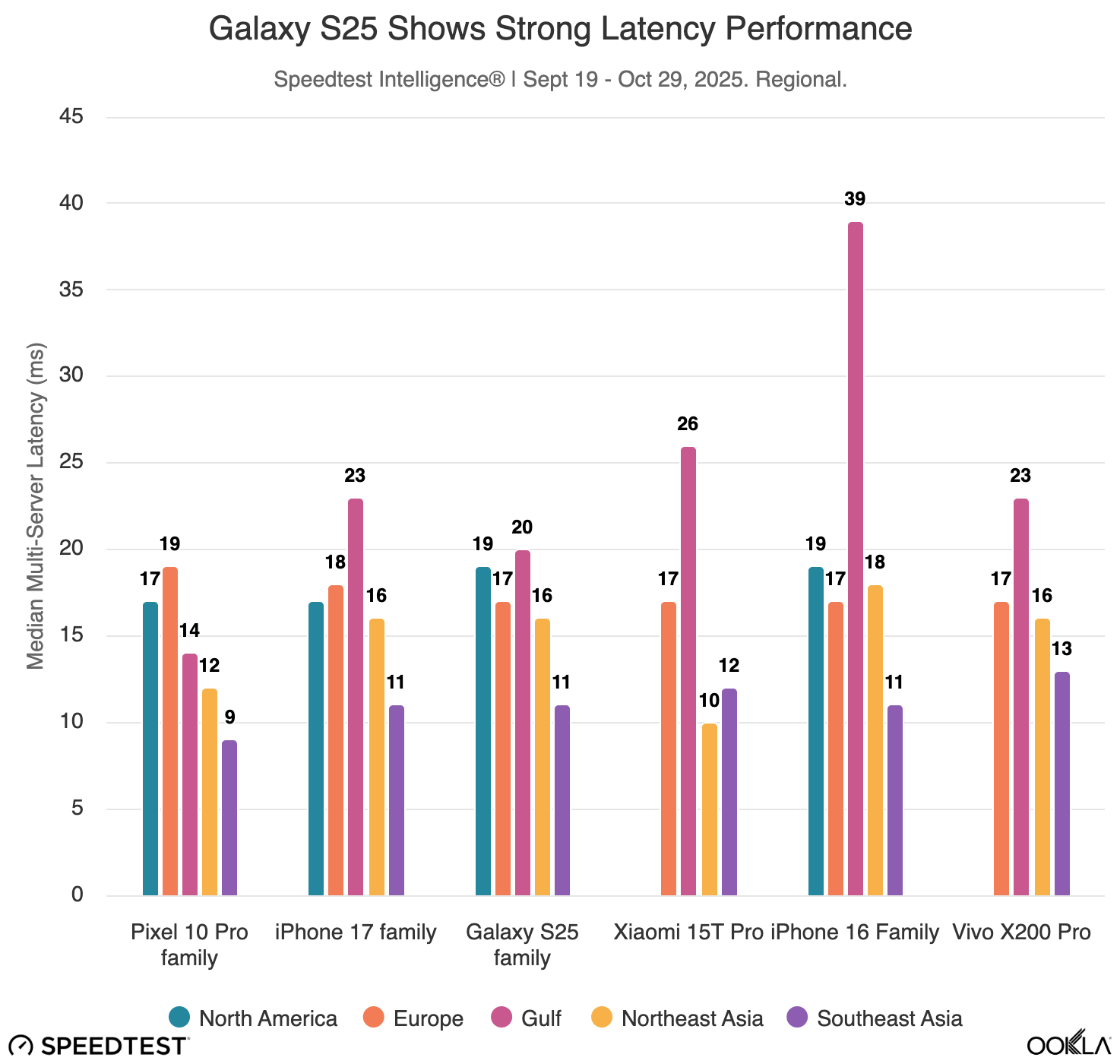
The standout achievement for Samsung is latency in North America. The Galaxy S25 manages the best measured latency score in the region, with values down around 6 ms. For competitive gamers and cloud-gaming fans, that’s a huge deal. Lower latency translates directly into snappier controls, faster hit detection, and less of that frustrating feeling where you know you pressed the button in time but the game disagrees.
So while you might not see Galaxy S25 highlighted as the single fastest Wi-Fi phone in global rankings, it’s quietly one of the best choices if your main priority is ultra-responsive online play.
Huawei Pura 80: hampered by missing 6 GHz, but still scrappy
Huawei’s Pura 80 lineup shows what happens when you leave one piece of the Wi-Fi 7 puzzle off the board. Using an in-house networking solution, likely from HiSilicon, these phones lack support for the 6 GHz band, which instantly puts them at a disadvantage in environments where 6 GHz is available.
Across the full dataset, the Pura 80 series tends to trail other flagships in both download and upload speeds, especially near the 90th percentile, where the best-case scenarios live. Without 6 GHz, it simply doesn’t have access to the cleaner airwaves and wider channels that other devices can exploit.
However, the story changes once you filter out 6 GHz results and compare only on older bands. In that restricted view, the Pura 80 becomes much more competitive and even manages to claim the second-best 90th-percentile upload speed of about 603.61 Mbps in Southeast Asia on Wi-Fi 6. It’s a reminder that hardware choices are always a trade-off: Huawei loses out where 6 GHz is common, but still fights hard on legacy spectrum.
Why weak-signal performance and latency matter more than peak speeds
It’s easy to obsess over the headline numbers – the nearly 1 Gbps peak speeds and multi-hundred-megabit medians – but for most people, those aren’t what define daily satisfaction. What really shapes your experience are the worst-case scenarios and the delay between your tap and the network response.
The iPhone 17’s 60% jump over the iPhone 16 at the 10th percentile matters far more than any single speed record. That improvement means fewer frozen video calls in the back room, smoother scrolling when you’re far from the router, and less waiting while your phone struggles to hold onto a thread of connection. It’s the difference between “Wi-Fi works most of the time” and “Wi-Fi isn’t something I think about anymore.”
Latency is the same story. The difference between 30 ms and 6–15 ms isn’t something you see in a marketing banner, but you definitely feel it when gaming, remote-controlling smart devices, or using cloud apps that constantly sync state. That’s where phones like the Galaxy S25 and Xiaomi 15T Pro quietly shine, turning Wi-Fi into something that feels almost as immediate as a local action.
Choosing your next flagship: Wi-Fi is finally the easy part
All of this Speedtest Intelligence data from Ookla leads to a reassuring conclusion: top-tier smartphones have finally grown up when it comes to Wi-Fi. Whether you pick the iPhone 17, Pixel 10 Pro, Galaxy S25, Xiaomi 15T Pro, or even Huawei’s Pura 80 (in regions where 6 GHz doesn’t matter much), you’re getting a seriously capable wireless experience.
Apple’s iPhone 17 lineup, with its N1 chip, is especially attractive if you live in a house with tricky Wi-Fi coverage or you’re tired of dealing with “dead corners.” Google’s Pixel 10 Pro can proudly claim the global median download speed crown and makes the most of modern 6 GHz networks. Xiaomi’s 15T Pro is a powerhouse for uploads and latency, and Samsung’s Galaxy S25 gives online gamers some of the best responsiveness you can get on a phone today.
The practical takeaway is simple: your next flagship choice no longer needs to revolve around fear of bad Wi-Fi. The real differentiators are now software ecosystem, camera philosophy, design, battery life, AI features, and how comfortable you feel in each brand’s world. Wi-Fi has quietly moved from “potential problem” to “solid base layer” – and that’s a win for everyone.
As routers and home networks catch up with wider adoption of Wi-Fi 7 and 6 GHz, the race will shift again. Phones that fully unlock 320 MHz channels may pull further ahead in peak speeds, and new chip designs will keep squeezing down latency and improving performance in crowded environments. For now, though, the age of shaky flagship Wi-Fi is coming to an end – and the iPhone 17 vs Pixel 10 Pro rivalry is proof that competition is giving us the stable, high-speed connections we’ve wanted for years.
2 comments
That 60% boost in bad wifi spots on iPhone 17 sounds huge, my bedroom needs this asap 😂
Wild that the spec sheet said Android should win, but Apple still crushes North America without 320 MHz