Intel’s next wave of workstation silicon is starting to surface in the wild, and the latest leak shines a spotlight on the Xeon 654, a Granite Rapids-WS processor that aims to pull the company back into the high-end desktop and professional arena. Pulled from a fresh Geekbench 6 entry and an early internal-style SKU list, this chip offers a first real glimpse at how Intel plans to fight back in a segment currently dominated by AMD’s Threadripper 9000 family.
Granite Rapids-WS will reportedly arrive in two distinct tiers. 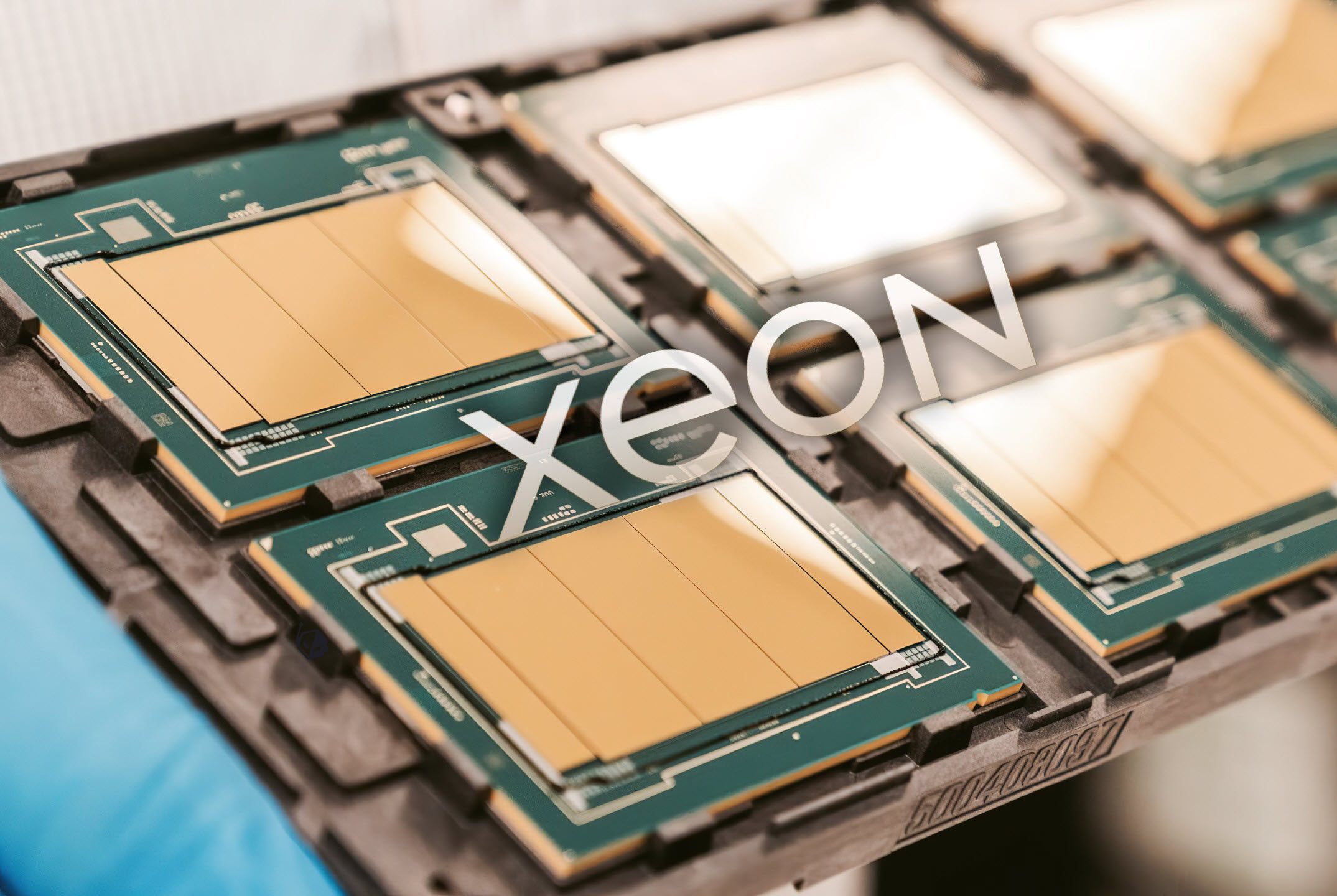
The so-called mainstream lineup is expected to pair the CPUs with 4-channel DDR5 memory and up to 80 PCIe 5.0 lanes, giving creators, engineers, and power users substantially more I/O than a typical consumer platform. Above that sits the expert tier, equipped with 8-channel DDR5 and a hefty 128 PCIe 5.0 lanes, clearly aimed at serious workstation builds that juggle multiple GPUs, high-speed storage arrays, and specialized accelerator cards.
The leaked Xeon 654 lands at the lower end of this expert universe but still looks far from modest on paper. The chip is configured with 18 cores and 36 threads, backed by 72 MB of L3 cache and 36 MB of L2 cache. According to the Geekbench 6 entry, its nominal clock is listed at 4.60 GHz, but real-world boost behavior appears to push the chip closer to 4.80 GHz under load. The sample was tested on a reference Granite Rapids-WS platform with 32 GB of DDR5 memory, suggesting this is still very much an engineering configuration rather than a shipping product.
Performance-wise, the leaked numbers are interesting but clearly provisional. In Geekbench 6, the Xeon 654 scores around 2634 points in single-core and roughly 14,743 points in multi-core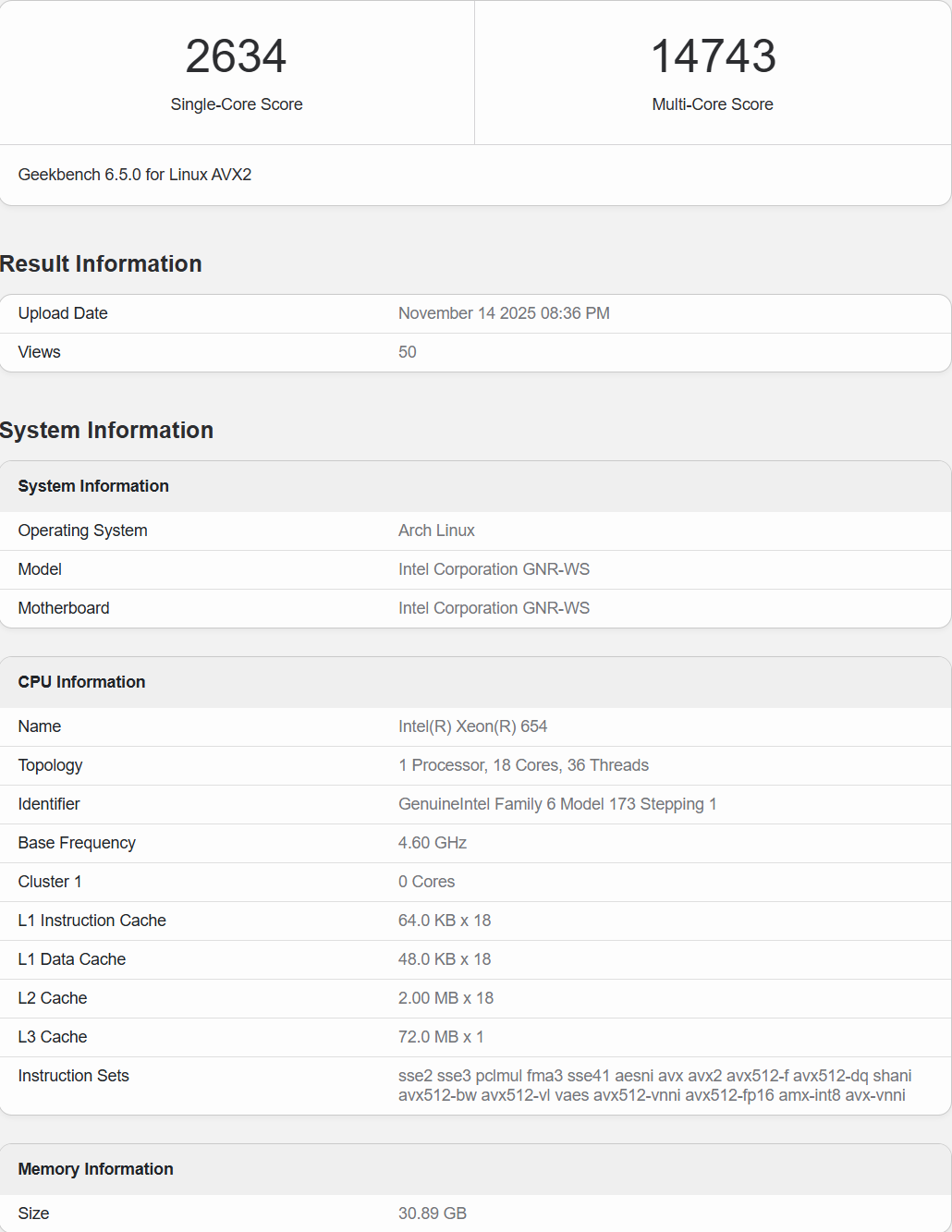
. On their own, those figures are not headline-grabbing, and early comparisons show that even 12-core AMD Threadripper 9000 parts are ahead in this particular run. However, it is crucial to remember that this appears to be an engineering sample running on a pre-release platform, with firmware, power limits, and memory tuning still in flux. History has shown that Intel’s ES results often sit noticeably below final retail silicon once clock speeds, microcode, and platform maturity improve.
The more intriguing part of the leak is the broader Granite Rapids-WS lineup that appears alongside the 654. The stack stretches all the way up to a Xeon 698X, which reportedly tops out at a massive 86 cores and 336 MB of cache, highlighting just how aggressively Intel is scaling this generation. Other models include the 696X, 678X, 676X, 674X, 658X, and non-X parts such as the 656, 654, 638, 636, and 634, with base clocks ranging from 2.00 GHz to 3.50 GHz and cache configurations tuned for different workloads and price points.
To make sense of the naming, it helps to look at a small slice of the leaked data. The 698X sits at the top with 86 cores and 336 MB of cache. Just below, the 696X keeps the same 336 MB cache pool but bumps its base clock to 2.40 GHz. Mid-stack, chips like the 678X and 676X are listed with 192 MB and 144 MB of cache respectively at 2.40 GHz and 2.80 GHz, while parts such as the 674X and 658X offer 3.00 GHz base clocks with 144 MB of cache. On the more modest side, the 656 and 654 share 72 MB of cache at 2.90 GHz and 3.10 GHz, and the 638, 636, and 634 descend to 72 MB or 48 MB cache with base clocks up to 3.50 GHz.
One detail that will catch enthusiasts’ eyes is the number of SKUs carrying the “X” suffix. In Intel’s recent high-end desktop playbook, that letter usually signals unlocked multipliers and some degree of overclocking support. Granite Rapids-WS appears to follow the same philosophy: the X-branded parts should appeal to builders who want server-class core counts but still enjoy tweaking frequencies, memory timings, and power limits. In other words, Intel seems to be aiming for both traditional workstation buyers and the overclocking crowd that historically gravitated toward HEDT platforms.
Platform-wise, Granite Rapids-WS will succeed the Sapphire Rapids and Sapphire Rapids Refresh workstation families, likely on a new W890-class chipset and an updated socket with significantly more I/O. The mainstream tier should already be a big jump for users stuck on aging quad-channel DDR4 systems, while the expert tier, with its 8-channel DDR5 and up to 128 PCIe 5.0 lanes, is clearly carved out for multi-GPU rendering rigs, complex CAD and simulation workloads, and heavy virtualization hosts. Compared with older HEDT platforms like X299, X99, and X79, Granite Rapids-WS looks like a different era entirely in terms of bandwidth, lane count, and memory throughput.
This leak also places Granite Rapids-WS within a long lineage of Intel high-end desktop and workstation offerings that stretches back to Sandy Bridge-E, Ivy Bridge-E, and the famous Gulftown and X58 days. Over time, core counts have climbed from six and eight cores into the double digits, PCIe lane budgets have ballooned, and thermal envelopes have grown accordingly, with recent workstation flagships reaching up to the 350 W range. Granite Rapids-WS is expected to push those boundaries again, offering significantly more cores and cache than Skylake- and Cascade Lake-based predecessors while refreshing the platform with modern DDR5 and PCIe 5.0 support.
Of course, none of this exists in a vacuum. AMD’s Threadripper 7000 and 9000 series currently own much of the workstation mindshare, thanks to brutal multi-core performance and strong platform features. That reality is reflected in community reactions to the Xeon 654 leak: many enthusiasts are already calling the chip “too slow to matter” and joking that even years-old Threadripper parts would make short work of this early 18-core sample. Some are bluntly labelling Granite Rapids-WS as “DOA” if Intel cannot deliver meaningful price-to-performance gains over current and next-generation Zen-based workstations.
Core counts are also a sticking point in the discussion. An 18-core part may sound substantial, but in 2025 it can feel modest when 16-core consumer CPUs sit on mainstream desktop sockets and workstation buyers can step up to 32, 64, or even higher core counts with AMD. Commenters are quick to argue that a modern workstation should start around 32 cores, especially for heavily threaded workloads, and that 18 cores should be considered an entry configuration rather than the star of the show. Others counter that the real value of Granite Rapids-WS lies in its quad- or octa-channel memory, large PCIe 5.0 lane budget, and Xeon-class reliability, not simply in how many cores you can tick on a spec sheet.
Looking further ahead, some in the community are already skipping a generation in their minds and eyeing what AMD may deliver with future Zen 6-based Threadripper models, rumored to bring expanded AVX-512 support and even more aggressive core and cache configurations around 2026–2027. Against that backdrop, Intel will need Granite Rapids-WS to offer more than just incremental gains. Competitive pricing, robust turbo behavior under sustained load, and strong application performance in real workstation software will matter far more than one leaked Geekbench score.
For now, the Xeon 654 leak is best read as an early snapshot of a platform still under construction. We are likely months away from a full reveal, with expectations circling a late Q4 window or a formal debut around CES 2026. Key details such as final boost clocks, SKU positioning, motherboard pricing, and complete TDP figures have yet to be confirmed. Until then, Granite Rapids-WS will remain a mix of promising specifications, cautious optimism, and a fair bit of online trolling, as enthusiasts argue over whether Intel is staging a genuine workstation comeback or simply arriving a generation too late to the fight.
1 comment
yawn another leak, wake me up when we see real benchmarks in blender, unreal and vm workloads, synthetic scores alone mean nothing in 2025