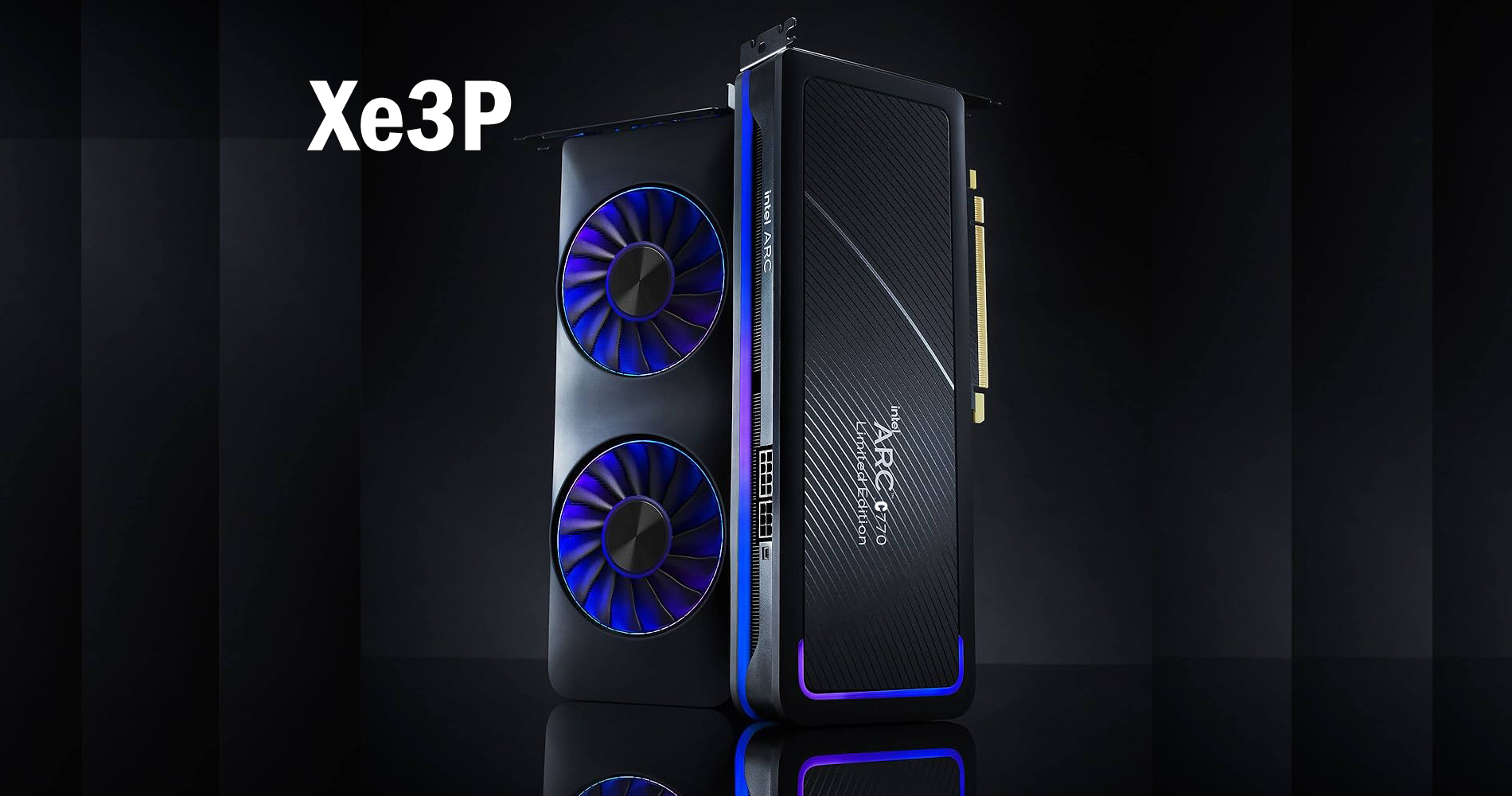
Rumor watch: a fresh hardware/firmware log has stirred the pot around Intel’s Xe3P graphics architecture. While Xe3P has been widely associated with the data-center–oriented Crescent Island parts and future integrated GPUs, a newly spotted entry suggests the story may extend to standalone cards. Two media engine configurations – LPM (Low Power Media) and HPM (High Power Media) – appear alongside Xe3P, hinting at product tiers that could scale from thin-and-light devices up to discrete GPUs built for gaming or workstation media workloads.
Before diving in, here’s our rumor methodology in brief. We grade four axes – source quality, corroboration, technical feasibility, and timeline realism – then roll them into a 0–100 likelihood score. For this report the math lands at 60% (Plausible): source 4/5, corroboration 2/5, technical 3/5, timeline 3/5. In other words, there’s enough smoke to take seriously, though not yet enough independent proof to call it likely.
What the log actually implies
The log, originally flagged by a community sleuth, doesn’t name retail cards or clock charts. It points to Xe3P with two media tiers, LPM and HPM. That’s materially different from prior Intel shorthand such as LPG/HPG that denoted full architecture classes. Here, the split is in the media engine – encode/decode blocks and throughput – rather than the shader front end itself. However, a genuine HPM tier suggests a thermal and power budget that fits better in add-in cards or performance-class laptops than in the smallest iGPUs. That is the kernel of the discrete-GPU speculation.
Where Xe3P sits in Intel’s roadmap
Industry watchers broadly expect Nova Lake client CPUs to ship with Xe3P-based integrated graphics for essential 3D and compute, while next-gen display and media duties at the platform level continue to lean on Xe4 (codename Druid) IP. In parallel, the data-center line known as Crescent Island is already tied to Xe3P. What’s new in this leak is the possibility of discrete deployments: think mainstream Arc gaming boards or Arc Pro workstation SKUs that prize strong transcode and low-latency playback pipelines.
If Intel does greenlight desktop/mobile cards on Xe3P, naming becomes interesting. Internally and in prior chatter, Xe3P has been associated with the Arc “C” (Celestial) generation rather than the earlier “B” family. Intel itself has previously excluded Xe3P from the B-series context, which aligns with a Celestial-era debut. Whether that translates to something like a “C770”-class board – the tier enthusiasts expected but never got in the B-series – remains an open question.
Technical read: why HPM matters
On paper, an HPM configuration suggests higher parallelism in encode/decode blocks, broader codec coverage, and more bandwidth to feed them. That’s useful for creator rigs and pro laptops where multi-stream 4K/8K workloads and hardware AV1/HEVC performance can be decisive. Practically, a discrete Xe3P with HPM could pair media heft with a compute array sized for the midrange gaming segment, sidestepping the most bruising high-end contests while still landing where volume lives. Memory technology is a wildcard: some readers speculate about GDDR7 for Celestial-era cards; it’s possible on a 2025–2026 cadence, but this leak doesn’t confirm memory at all.
Signals to watch next
- Kernel and driver patches: new PCI IDs, Celestial-flavored strings, or device tables mapping Xe3P to dGPU targets.
- OEM breadcrumbs: board partners quietly preparing coolers or mobile design wins referencing elevated media throughput.
- Pro software notes: ISV certification lists citing Xe3P-class Arc Pro parts with HPM capabilities.
- Marketing taxonomy: if Intel formalizes LPM/HPM as visible product suffixes or bundles them into creator-centric SKUs.
Market context: why this would matter
Readers are restless. The GPU market has felt like a two-horse race, and the novelty is wearing thin for some enthusiasts. A credible Intel midrange push – with competent drivers at launch, modern media engines, and stable pricing – would pressure incumbents and improve options for buyers. The conversation tends to go quiet between tape-out and samples, then spikes when real benchmarks arrive; the current lull in forum threads is normal, not necessarily a verdict on the roadmap.
Our verdict – for now
Plausible at 60%. The presence of HPM/LPM alongside Xe3P is a meaningful breadcrumb that fits Intel’s segmentation logic, particularly for creator and workstation-leaning cards that can also carry mainstream gaming. But corroboration is still thin. Until we see matching IDs in public drivers, references from OEMs, or industry documentation tying Xe3P directly to Arc Celestial boards, prudence applies. If and when a “C770”-style SKU surfaces – especially with beefy media specs – you’ll know this log was the first domino.
Bottom line: expect Xe3P in Nova Lake iGPUs and data center parts; keep an eye out for a discrete HPM-tier Arc under the Celestial banner. The pieces fit. We just need the next piece of proof.
1 comment
Threads are dead till hardware lands. same every year. wake me up when drivers drop