Intel’s long-awaited W890 workstation platform has finally stepped into the spotlight, and our first concrete glimpse comes in the form of ADLINK’s ISB-W890 motherboard. Aimed at next-generation AXE servers and serious professional workstations, this board is built around Intel’s 6th Gen Xeon “Granite Rapids-WS” CPUs and shows how the blue team plans to answer an increasingly aggressive AMD, whose Zen roadmap keeps pushing core counts, efficiency and feature sets generation after generation.
At the center of the ISB-W890 sits the LGA 4710-2 socket, the same interface used by upcoming Xeon 6700P and 6700E server parts. 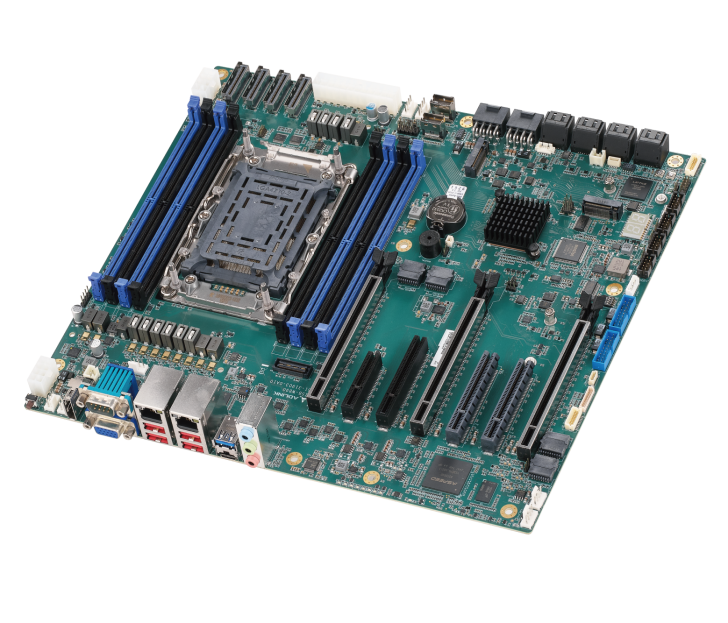
In this W890 configuration, however, the platform is tuned specifically for workstation-class Granite Rapids-WS chips, with core counts reportedly scaling up to 86 cores. That kind of density firmly targets simulation, rendering, AI inference, complex CAD and EDA workloads – exactly the spaces where AMD’s high-end Threadripper and Epyc-derived solutions have been eating into Intel’s share and where buyers want both raw multi-threaded performance and rock-solid reliability.
Physically, the ADLINK ISB-W890 is unapologetically big iron. It uses the CEB form factor and measures 305 x 267 mm, so it is clearly designed for spacious tower workstations or 4U rackmount chassis rather than compact gaming cases. The PCB is packed with power delivery components surrounding the socket, and the board draws juice from a standard 24-pin ATX connector plus multiple 8-pin 12 V connectors, including additional 8-pins dedicated to feeding hungry PCIe devices. Everything about the layout signals expectations of multi-GPU or accelerator-heavy builds with sustained high power draw and plenty of airflow.
Memory support is another major pillar of the W890 story. The ISB-W890 exposes four DDR5 memory channels, wired out to eight RDIMM slots. With current RDIMM densities, up to 1 TB of system memory is already realistic, and higher capacities will become possible as larger modules roll out. ADLINK specifies support for DDR5 speeds up to 6400 MT/s when running a single DIMM per channel (1DPC) and up to 5200 MT/s with two DIMMs per channel (2DPC). For buyers, that means choosing between maximum bandwidth and maximum capacity depending on whether the priority is speeding up compile times and simulations or feeding massive datasets to virtual machines, in-memory databases or complex analytical pipelines.
Where the W890 platform really stretches its legs is PCI Express connectivity. Intel is segmenting Granite Rapids-WS into two classes: “Expert Stream” and “Mainstream Stream.” Expert Stream CPUs expose up to 128 PCIe lanes, while Mainstream chips offer up to 80 lanes. ADLINK maps those lanes into seven physical PCIe slots on the ISB-W890, including three full-length x16 slots. On Expert-tier processors, you can expect multiple PCIe 5.0 x16 slots for high-end GPUs, a mix of PCIe 5.0 and 4.0 x8 slots for accelerators, networking or storage HBAs, and additional x4 links for IO cards and extra NVMe connectivity. Even on the 80-lane Mainstream parts, you still get a pair of PCIe 5.0 x16 slots plus a healthy spread of x8 and x4 slots, which is more than enough for dual-GPU setups, capture cards, fast networking and dedicated storage controllers in a single system.
The storage side of the ISB-W890 is clearly designed for modern workflows where local NVMe storage is as important as CPU horsepower. Instead of relying only on a couple of M.2 sockets, ADLINK equips the board with four MCIO x8 connectors that can fan out to high-density NVMe backplanes. This allows integrators to connect entire banks of PCIe SSDs without sacrificing the primary PCIe slots reserved for GPUs and accelerators. On top of that, there are two M.2 M-Key NVMe slots ideal for ultra-fast OS or scratch drives, two SlimSAS ports coming off the W890 chipset, and eight SATA III ports for bulk hard drives or legacy 2.5-inch SSDs. The end result is a platform that can comfortably host tiered storage with blisteringly fast NVMe at the top and multi-terabyte HDD arrays for archives and backups below.
External and internal IO complete the workstation-grade picture. Networking is covered by a combination of 1 GbE and 2.5 GbE LAN ports, striking a balance between office-class connectivity and faster links to NAS devices or shared project storage. USB support is almost over the top: the ISB-W890 can deliver a mix of USB 3.0 and USB 3.2 ports across Type-A and Type-C, alongside several USB 2.0 ports for low-bandwidth peripherals or management devices. Internally, builders get headers for extra USB 3.2 Gen1 and USB 2.0 ports, multiple COM headers including RS-232/422/485, a TPM header for secure boot environments, VROC connectivity for advanced RAID setups, numerous 4-pin fan headers for complex cooling topologies, chassis intrusion headers, SGPIO for drive backplanes, and IPMC options that tie into IPMI-style remote management for environments where machines live in racks rather than under desks.
One particularly interesting twist is that ADLINK lists overclocking support for select Xeon “X”-series Granite Rapids-WS models. Historically, Intel’s workstation and server products have leaned heavily toward locked-down stability, leaving overclocking to consumer Core-branded chips. Bringing limited OC options to Xeon again opens the door for boutique builders who want to squeeze a bit more frequency out of heavily threaded workstations or lightly threaded EDA and CAD workloads that still scale with clock speed. Nobody expects esports rigs based on a CEB Xeon platform, but the ability to nudge clocks higher without giving up ECC RDIMM support will definitely appeal to a certain slice of the enthusiast-professional crowd.
All of this unfolds against a broader competitive backdrop dominated by AMD’s Zen roadmap. Enthusiasts are already talking about Zen 6 and even Zen 7 as potentially huge jumps, and AMD has earned a reputation for relentlessly pushing the envelope with each generation. That’s exactly why a board like the ISB-W890 matters: it demonstrates that Intel is not quietly exiting the high-end workstation stage. By pairing Granite Rapids-WS silicon with up to 128 PCIe lanes, massive DDR5 RDIMM capacity and dense storage options, Intel is signaling that it still intends to fight for the desks of creators, engineers and data scientists – not just concede the halo market to Threadripper-class platforms.
The operating system angle also deserves attention. Many power users feel that Windows 11 is drifting further away from their needs, with intrusive UI choices, background processes they never asked for and a general sense that the OS is optimized more for telemetry and storefronts than for serious work. For that crowd, a board like the ISB-W890 is likely to sit under Linux distributions, Windows Server or heavily debloated Windows 11 images. ADLINK’s generous management headers, serial connectivity and IPMI-friendly interfaces line up perfectly with that reality, making the platform attractive for studios, research labs and homelab builders who want tight control over their software stack instead of accepting a locked-down, consumer-style experience.
On the timeline front, Granite Rapids-WS has already been spotted in synthetic benchmarks and public databases, and industry watchers widely expect Intel to put the spotlight on the family around CES 2026 if roadmaps remain on track. The appearance of a fully featured board like the ISB-W890 is usually a strong indicator that a platform is graduating from internal engineering samples to real-world deployment. From here we should see more W890-based designs from other vendors, including models focused on classic tower workstations, GPU compute nodes and storage-dense configurations aimed at edge data centers.
For now, ADLINK’s ISB-W890 serves as a detailed preview of what Intel’s W890 workstation ecosystem will look like: oversized, purpose-built boards with serious power delivery, vast PCIe 5.0 connectivity, flexible storage paths and memory configurations that scale from “high-end desktop” all the way to “small data center in a box.” Whether that is enough to outshine AMD’s incoming Zen-based waves remains an open question, but one thing is clear – the combination of Granite Rapids-WS and the W890 chipset is poised to make the workstation space far more interesting than it has been in years.