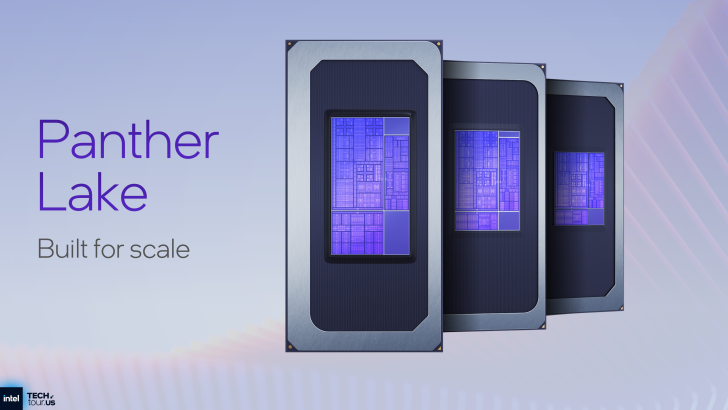
Intel Panther Lake Mobile CPUs Leak: Core Ultra X7 358H & Ultra 5 338H Aim Arrow Lake-H Parity, With Notable Xe3 iGPU Gains
Fresh engineering-sample numbers for Intel’s next mobile platform, Panther Lake, have slipped into the wild – and they paint a picture of early multi-threaded parity with today’s Arrow Lake-H chips while quietly hinting at meaningful integrated-graphics progress. The alleged results, published by LaptopReview and consistent with earlier whispers around Xe3 iGPU behavior, focus on two parts: Core Ultra X7 358H and Core Ultra 5 338H. Because these appear to be ES (engineering sample) units, treat the figures as directional rather than definitive. Still, there’s enough signal here to merit a closer look.
What exactly leaked – and what didn’t
The new run centers on Cinebench R23 Multi-Thread (MT) scores and an updated 3DMark Time Spy graphics result for the Xe3 iGPU. Precise testbeds weren’t disclosed – no cooling profile, memory configuration, or OS build – so keep expectations in check. Clock information is also provisional, tracing back to recent synthetic listings rather than finalized spec sheets. All signs point to ES silicon, which often ships with conservative power tables, immature firmware, and not-yet-tuned schedulers.
Specs at a glance (rumored)
| CPU | P-cores | E-cores | Boost (up to) | Notable iGPU | Indicative TDP |
|---|---|---|---|---|---|
| Core Ultra X7 358H (Panther Lake) | 4 (Cougar Cove) | 12 (Darkmont) | ~4.8 GHz* | Xe3 (12 clusters) | ~45–65 W platform targets |
| Core Ultra 7 255H (Arrow Lake-H, comparator) | 6 | 10 | ~5.1 GHz* | Prior-gen Xe | ~65 W tested |
| Core Ultra 5 338H (Panther Lake) | 4 | 8 | ~4.7 GHz* | Xe3 (12 clusters) | ~45–60 W platform targets |
| Core Ultra 5 225H (Arrow Lake-H, comparator) | 4 | 10 | ~4.9 GHz* | Prior-gen Xe | ~65 W tested |
*Boosts cited in leaks; subject to change on retail silicon. LP-E core counts (Skymont) aren’t the focus here and may vary by SKU.
Early multi-thread numbers: close race today, room to grow tomorrow
On Cinebench R23 MT, the Core Ultra X7 358H allegedly lands around 20,000 points at a 65 W setting, versus roughly 21,826 for the Arrow Lake-H Core Ultra 7 255H at the same nominal power. Stepping down a tier, the Core Ultra 5 338H is pegged near 16,000 at around 60 W, with the outgoing Core Ultra 5 225H scoring about 17,988 at 65 W.
- Core Ultra 7 255H (Arrow Lake-H, 65 W): ~21,826
- Core Ultra X7 358H (Panther Lake, 65 W): ~20,000
- Core Ultra 5 225H (Arrow Lake-H, 65 W): ~17,988
- Core Ultra 5 338H (Panther Lake, 60 W): ~16,000
Read that not as a loss for Panther Lake, but as a snapshot of ES behavior against mature, higher-clock Arrow Lake-H bins with core-count advantages in key places. The 255H wields two extra P-cores and higher peak clocks; the 225H keeps more E-cores and a faster boost than the 338H sample. In other words, the current deltas are exactly where you’d expect them given the raw topology and clock headroom.
Why parity is plausible despite fewer P-cores
Two dynamics are worth highlighting. First, E-core evolution: Intel’s efficiency cores have steadily become more capable per watt, especially when the scheduler keeps them busy on properly chunked MT workloads. Second, platform efficiency: Intel has publicly targeted substantial power-efficiency gains with Panther Lake – claims of up to ~30% lower power at equal MT performance versus Arrow Lake-H have circulated. If that bears out on final silicon, OEMs can either hold performance steady and extend battery life or push sustained clocks harder within the same chassis thermals.
Remember, ES firmware frequently leaves boost behavior, voltage curves, and memory timings on the table. Historically, late-stage microcode, thread director tuning, and OEM-level power tables can add several percent in CB R23 MT before launch day – and sometimes more after day-one BIOS updates.
Integrated graphics: Xe3 inches upward – and outruns Lunar Lake’s iGPU
On the GPU side, the story is cleaner. A refreshed score for the 12-cluster Xe3 iGPU shows about 6,830 points in 3DMark Time Spy, up from roughly 6,300 in an earlier pass – an 8.5% uplift that implies maturing clocks, drivers, or both. Plotted against recent thin-and-light silicon, the Xe3 figure sits well ahead of Lunar Lake’s 8-cluster Xe2 (~4,396) and even distances AMD’s Radeon 890M entry quoted here (~3,489) at a similar 30 W reference.
| iGPU | 3DMark Time Spy Graphics |
|---|---|
| Panther Lake Xe3 (12c), new run | ~6,830 |
| Panther Lake Xe3 (12c), earlier run | ~6,300 |
| Lunar Lake Xe2 (8c @ ~30 W) | ~4,396 |
| Radeon 890M (16 RDNA 3.5 @ ~30 W) | ~3,489 |
Time Spy isn’t a game, but it’s a useful yardstick. If retail drivers preserve this gap, we’re looking at a solid step forward for Intel’s iGPU story in performance-oriented notebooks, with enough headroom to lift 1080p low/medium settings in a wide spread of esports titles and lighter AAA fare – especially when paired with fast LPDDR5X or DDR5 memory and aggressive power sharing.
Context that matters: memory, cooling, and OEM tuning
Mobile performance is a three-legged stool: silicon, power policy, and cooling. Without memory speeds and latencies, it’s impossible to know if these ES runs were bound by sub-optimal RAM. Likewise, a 65 W label can mean different sustained behaviors across chassis. Expect high-end designs to give the X7 358H space to breathe, while thinner machines may cap the 338H closer to its 45–60 W comfort zone. Intel’s Thread Director and Windows scheduler updates will also influence how P- and E-core mixes realize their potential in mixed loads.
SKU landscape (work in progress)
Leaked matrices suggest familiar tiers – X9, X7, X5 H-class alongside U-series parts – with combinations of Cougar Cove P-cores, Darkmont E-cores, and low-power Skymont helpers, plus Xe3 iGPU blocks scaling by cluster count. Frequencies, LP-E usage, and exact TDP windows will likely finalize late, as usual, through OEM negotiations and thermal targets.
Timeline and what to watch next
Timing lines up with a first Panther Lake SKU landing in Q4 2025, followed by a richer stack and full messaging at CES 2026 (January). Between now and then, look for:
- Retail-caliber CB R23 numbers and cross-suite validation (Geekbench, Cinebench 2024, y-Cruncher, Blender).
- Driver drops for Xe3 that either lock in or expand the current Time Spy lead.
- Battery life and sustained-load profiles under identical chassis/power envelopes versus Arrow Lake-H.
- Memory configurations (LPDDR5X speeds, DDR5 timings) that move iGPU and MT needles.
Bottom line for now: early MT parity with Arrow Lake-H despite topology disadvantages is an encouraging sign for Panther Lake’s efficiency trajectory, and the Xe3 iGPU uplift looks tangible. Final silicon, firmware, and OEM tuning will tell the real story.
Disclaimer: All figures referenced are from alleged engineering-sample testing with incomplete platform disclosure. Specifications, clocks, and performance can change before retail availability.
1 comment
Need mem configs and temps before I believe anything. Where’s the fine print?