Intel’s Panther Lake “Core Ultra Series 3” CPUs are officially set to make their grand debut at CES 2026, bringing a major leap in computing power and efficiency to next-generation laptops and compact PCs. As the tech world gears up for this event, Intel has begun to lift the curtain on what could be one of the most important CPU launches in years – a lineup designed not only for AI-driven experiences but also for broader mainstream performance and efficiency improvements across all computing categories.
During the company’s Tech Tour 2025, Intel confirmed that the Panther Lake “Core Ultra Series 3” processors would headline its CES showcase. 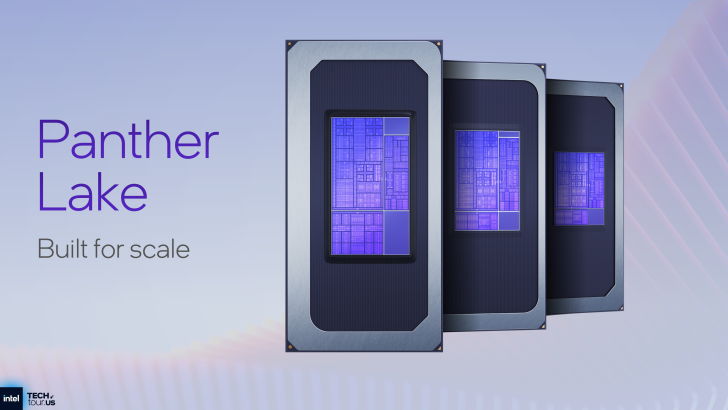
At the event, Intel plans to fully unveil specifications, performance data, and architectural insights, while major laptop brands and OEMs will showcase their latest devices powered by the new chips. The production ramp is already underway, with initial shipments expected before the end of 2025, and broad retail availability slated for January 2026. This marks a significant milestone in Intel’s roadmap, following its earlier Lunar Lake and Arrow Lake families.
Intel’s strategy for Panther Lake focuses on an ambitious goal – combining Lunar Lake-level power efficiency with Arrow Lake-class performance, essentially blending the best of both worlds. According to early performance projections, the new CPUs will feature up to 16 cores (P-cores and E-cores), delivering an impressive 50% boost in CPU performance compared to the previous generation. The integrated Intel Arc GPU is also getting a massive uplift, featuring up to 12 Xe3 cores that promise over 50% faster graphics performance. This means gamers, creators, and AI developers alike can expect smoother rendering, faster workloads, and better real-time processing.
Beyond the raw numbers, Intel’s design philosophy for Panther Lake emphasizes a more balanced “XPU architecture” – a term the company uses for its integration of CPU, GPU, and NPU (Neural Processing Unit) working cohesively on a single platform. The Panther Lake NPUs are expected to deliver up to 180 platform TOPS (trillions of operations per second), positioning these chips as a cornerstone for the coming wave of AI PCs. From generative AI assistants to real-time media editing and adaptive workloads, Intel’s vision clearly extends far beyond traditional laptop performance metrics.
When asked about pairing Panther Lake CPUs with discrete GPUs, Intel’s representatives mentioned that such combinations weren’t expected in most configurations. However, given that Lunar Lake systems were later seen with discrete graphics options, it’s likely that Panther Lake laptops will eventually include them too – especially in high-performance or gaming-focused models. The early wave of devices, however, is likely to rely primarily on the powerful integrated Xe3 GPU.
Looking deeper into the architecture, Panther Lake CPUs are built on Intel’s advanced 18A process node, a significant step in the company’s manufacturing evolution. The GPU tile, meanwhile, uses TSMC’s N3E process, continuing Intel’s pragmatic approach of mixing internal and external foundry technologies. This hybrid production model allows Intel to balance efficiency, scalability, and cost while ensuring top-tier performance across tiles.
To better understand where Panther Lake stands, here’s a snapshot of Intel’s CPU evolution. The Panther Lake lineup succeeds the Lunar Lake (Core Ultra 200V) and Arrow Lake (Core Ultra 200) families, following in the footsteps of Meteor Lake, Raptor Lake, and Alder Lake. Each generation has steadily evolved Intel’s hybrid architecture approach – combining high-performance cores (P-Cores) with power-efficient cores (E-Cores) to maximize both speed and battery life. For Panther Lake, the P-Cores are codenamed Cougar Cove, while the E-Cores are based on the latest Darkmont architecture.
Memory support has also received a considerable upgrade. Panther Lake supports LPDDR5X-9600 memory and configurations of up to 128 GB, ensuring blazing-fast bandwidth and ample headroom for multitasking and heavy workloads. Connectivity-wise, the chips will integrate Thunderbolt 5 and WiFi 7 – both critical technologies for future-proof laptops. The expected TDP range between 17W and 45W also indicates flexibility across thin ultrabooks, standard laptops, and even small form-factor PCs.
What truly sets Panther Lake apart is Intel’s aggressive optimization for AI acceleration. The company’s emphasis on NPUs has grown since Meteor Lake, and now, with NPU5 delivering 50 TOPS, Panther Lake extends Intel’s relevance in the AI PC race – an area increasingly important as Windows, Adobe, and other ecosystems build AI-native software experiences. In simple terms, Intel wants your next laptop to understand you better, adapt faster, and perform smarter.
As Intel prepares for CES 2026, anticipation is high. Analysts expect that Panther Lake could serve as the inflection point where Intel fully regains its competitive momentum against rivals like AMD and Apple Silicon. If early indications hold true, Panther Lake’s combination of performance, efficiency, and AI capabilities could redefine what consumers expect from a laptop processor in 2026 and beyond.
4 comments
this will make AI PCs actually useful ngl
hope they fix the power draw tho, last gen was kinda hot lol
bro 128GB RAM support on laptops? overkill but i love it 😂
intel finally catching up with apple silicon maybe?