Intel’s next wave of integrated graphics is starting to take shape, and the latest leak around the Panther Lake Arc B390 iGPU suggests that Intel is finally ready to play hardball in the iGPU arena. A fresh PassMark entry points to a big step forward not only versus AMD’s current RDNA 3.5 iGPUs like the Radeon 890M, but also versus Intel’s own Xe2-based solutions in Lunar Lake. 
On paper, this is the kind of uplift that could turn future ultra-portable laptops and gaming handhelds into genuinely capable gaming machines without a discrete GPU.
The Arc B390 is the flagship integrated GPU configuration expected inside Intel’s upcoming Core Ultra Series 3 “Panther Lake” CPUs. The graphics side is based on the Xe3 architecture and tops out at 12 Xe3 cores. Below it, Intel is reportedly lining up Arc B380, B370, and B360 variants with fewer cores – 10, 4, and 2 Xe3 units respectively – to cover everything from thin productivity notebooks to higher-end ultraportables and handheld devices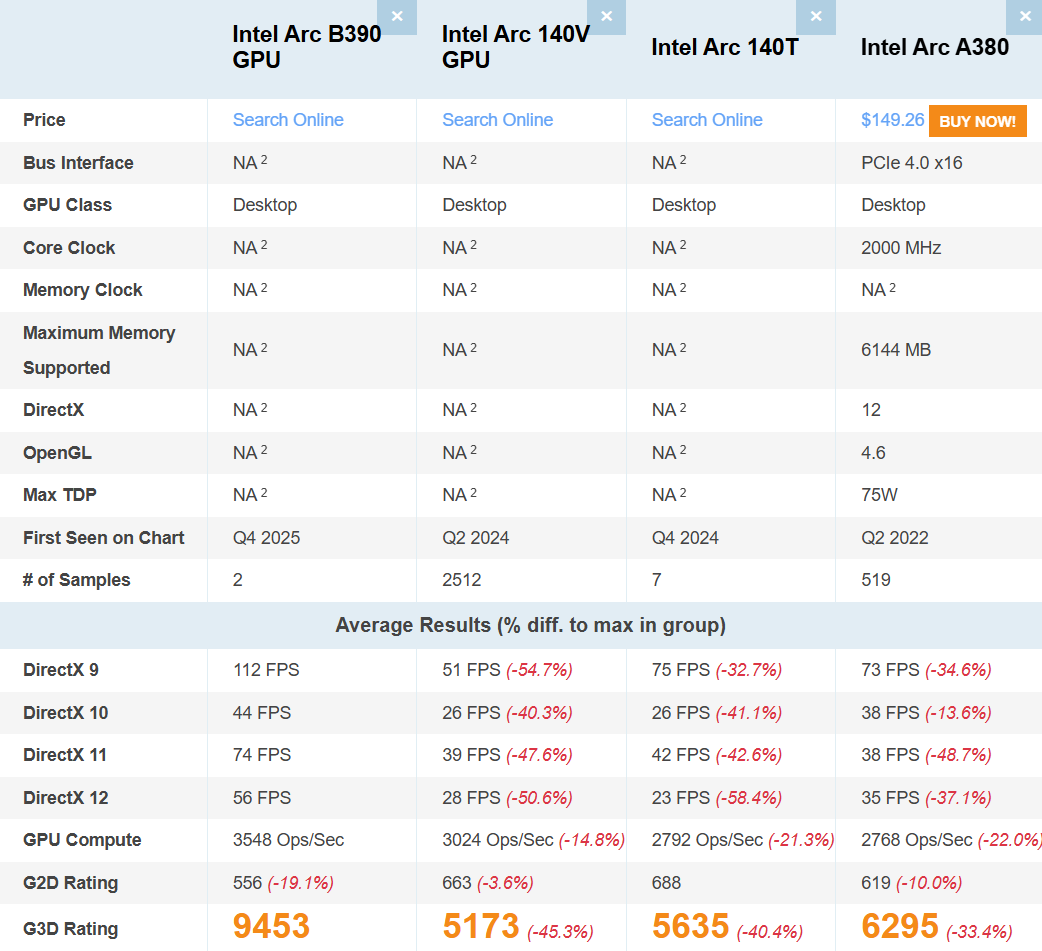
. Where previous Intel iGPUs often felt like an afterthought, Xe3 looks like an attempt to turn the integrated GPU into a headline feature.
PassMark leak: big uplift over Intel’s own lineup
The headline number from the leak is a score of 9453 points in PassMark’s graphics test for the Arc B390. For an integrated solution, that immediately raises eyebrows. For context, Intel’s Arc 140V iGPU inside Lunar Lake – an 8 Xe2 core design – is logged at around 5173 points. That makes the B390 a massive 83% improvement over the 140V in this specific benchmark. Even the Arc 140T with 8 Xe+ cores, at 5635 points, lags far behind, with the B390 coming out roughly 67% faster.
Things get more interesting when you compare B390 to Intel’s own discrete Alchemist GPUs. The Arc A380 (8 Xe cores) scores around 6295 points here, putting the new integrated B390 roughly 50% ahead. Against the Arc A530M – a mobile dGPU that also has 12 Xe cores but uses the older Alchemist architecture – the B390 still wins by about 18%. In other words, Intel’s best integrated graphics are now starting to edge past its previous generation of low-end discrete cards in synthetic tests, which is a significant milestone.
Radeon 890M and the AMD angle
Of course, the real story for most enthusiasts is how Intel’s new iGPU stacks up against AMD’s latest APUs. According to the same PassMark listing, the Radeon 890M – a 16 CU RDNA 3.5 iGPU found in Strix Point Ryzen chips – scores about 8166 points. On that basis, the Arc B390 comes out roughly 16% faster. Considering that the 890M is widely regarded as the fastest “normal” iGPU currently available in mainstream APUs, that’s a big claim.
AMD is not standing still either. A higher-clocked Radeon 890M variant is expected for the upcoming Ryzen AI 400 “Gorgon” series, with GPU clocks reportedly pushing up to around 3.1 GHz. That should close the gap somewhat, but based on these early numbers, Intel still looks positioned to keep a small lead – at least in PassMark.
At the same time, seasoned hardware watchers are right to be cautious. Some commenters have already pointed out that other solutions, such as APUs in the 8060S class, can reach 22,500–24,000 points in PassMark’s graphics tests depending on configuration, which is more than double what the B390 manages. In other words, the B390 looks strong among typical laptop iGPUs, but it is hardly the absolute ceiling of integrated graphics performance in every niche segment.
Synthetic benchmarks vs real-world gaming
One important nuance buried in the leak is how weirdly PassMark treats Intel’s older Arc implementations. The Arc 140V (Xe2) looks significantly slower than the Radeon 890M in these charts, yet in real gaming workloads the 140V often lands close to or even ahead of AMD’s top iGPU, especially when drivers and settings are dialed in. That strongly suggests that PassMark simply isn’t well optimized for Intel’s current Xe2 GPUs.
The fact that Xe3 performs so well in the same test suite may mean two things: Intel has improved the architecture in ways that align better with these workloads, and the software stack behind Xe3 is already getting special attention. Still, anyone who remembers the early days of Arc on desktop knows the other big variable: drivers. Intel has come a long way there, but it’s no surprise that many enthusiasts still see driver quality as the big “if” between a promising chart and a genuinely smooth experience.
Power, memory, and the handheld question
There’s another huge missing piece: power draw. These leaked numbers don’t specify the wattage at which the Panther Lake chip was running. Comparing a desktop-class Intel SoC to a mobile AMD APU at completely different power limits is a recipe for confusion. For any serious handheld or ultra-thin laptop analysis, we need numbers in the 7–16 W range, not just “up to 20-something watts and beyond.” Without clear power envelopes, performance-per-watt and performance-per-dollar remain giant question marks.
Memory configuration adds yet another twist. AMD’s RDNA 3.5 iGPUs can behave very differently depending on whether they are paired with standard SO-DIMM memory or fast LPDDR5X. The same will be true for Arc B390. Like other modern integrated GPUs, it uses system RAM as graphics memory, so bandwidth and latency will have a big impact on real game performance. Any head-to-head comparison that doesn’t disclose the memory type and speed is at best incomplete.
Even with those caveats, B390’s positioning is obvious: Intel wants Panther Lake-based devices to be legitimate gaming handheld candidates. The Xe3 architecture supports the latest feature set, including XeSS 3 MFG upscaling and frame generation, which can be a huge multiplier for perceived performance at handheld-friendly resolutions like 1080p or below. If Intel can deliver stable drivers out of the box, this could seriously pressure lower-end discrete GPUs and force AMD to respond more aggressively in the handheld and thin-and-light segments.
Where enthusiasts want Intel to go next
The leak has also reignited wishful thinking in the community. If 12 Xe3 cores in an iGPU can nip at the heels of GPUs like the Radeon 7600M and sit not far behind an RTX 3050 laptop in synthetic charts, people can’t help but imagine what 32 or 48 Xe3 cores could do in a dedicated desktop GPU with a wide GDDR7 bus and a 384-bit interface. Intel’s current Arc lineup has already proven that the company can build competent gaming hardware; the dream is a fully realized Battlemage or even Xe3P/Celestial design that scales this efficiency to higher tiers.
Looking ahead, Intel’s roadmap doesn’t stop at Panther Lake. Future generations like Celestial on Nova Lake are already being teased, and if Xe3 is effectively a refined evolution of Xe2, the hope is that each step will bring more consistent performance, better drivers, and stronger competition. For now, Arc B390 is shaping up as a key test: if it delivers in real games at sensible power levels, AMD’s near-monopoly on high-end iGPUs could be coming to an end.
In short, the Panther Lake Arc B390 looks like a serious threat to both older Intel solutions and AMD’s current RDNA 3.5 offerings in synthetic tests. But synthetic scores are just the opening move. Until we see gaming benchmarks, power measurements, and pricing for actual laptops and handhelds, the B390 is best viewed as a very promising sign that the integrated graphics war is finally heating up again – and that’s great news for anyone who wants more performance without paying for a discrete GPU.
2 comments
B390 beating old Arc dGPUs is nice, now give us 32 or 48 Xe3 cores with real desktop GDDR7 and let it cook already
Thank you for your sharing. I am worried that I lack creative ideas. It is your article that makes me full of hope. Thank you. But, I have a question, can you help me?