Intel is finding an unexpected path forward for its AI chip ambitions – not by competing directly against NVIDIA, but by joining its ecosystem. In a surprising and strategic move, Intel has integrated its Gaudi 3 rack-scale AI architecture with NVIDIA’s powerful Blackwell platform, creating a hybrid solution that leverages both companies’ strengths. This partnership signals a rare moment in the AI hardware race: a truce of necessity, where collaboration might be the only way forward for Intel to stay relevant in the booming AI data center market.
The new rack-scale configuration reportedly blends Intel’s Gaudi 3 accelerators with NVIDIA’s Blackwell B200 GPUs, forming what SemiAnalysis describes as a hybrid platform that optimizes inferencing efficiency and throughput. 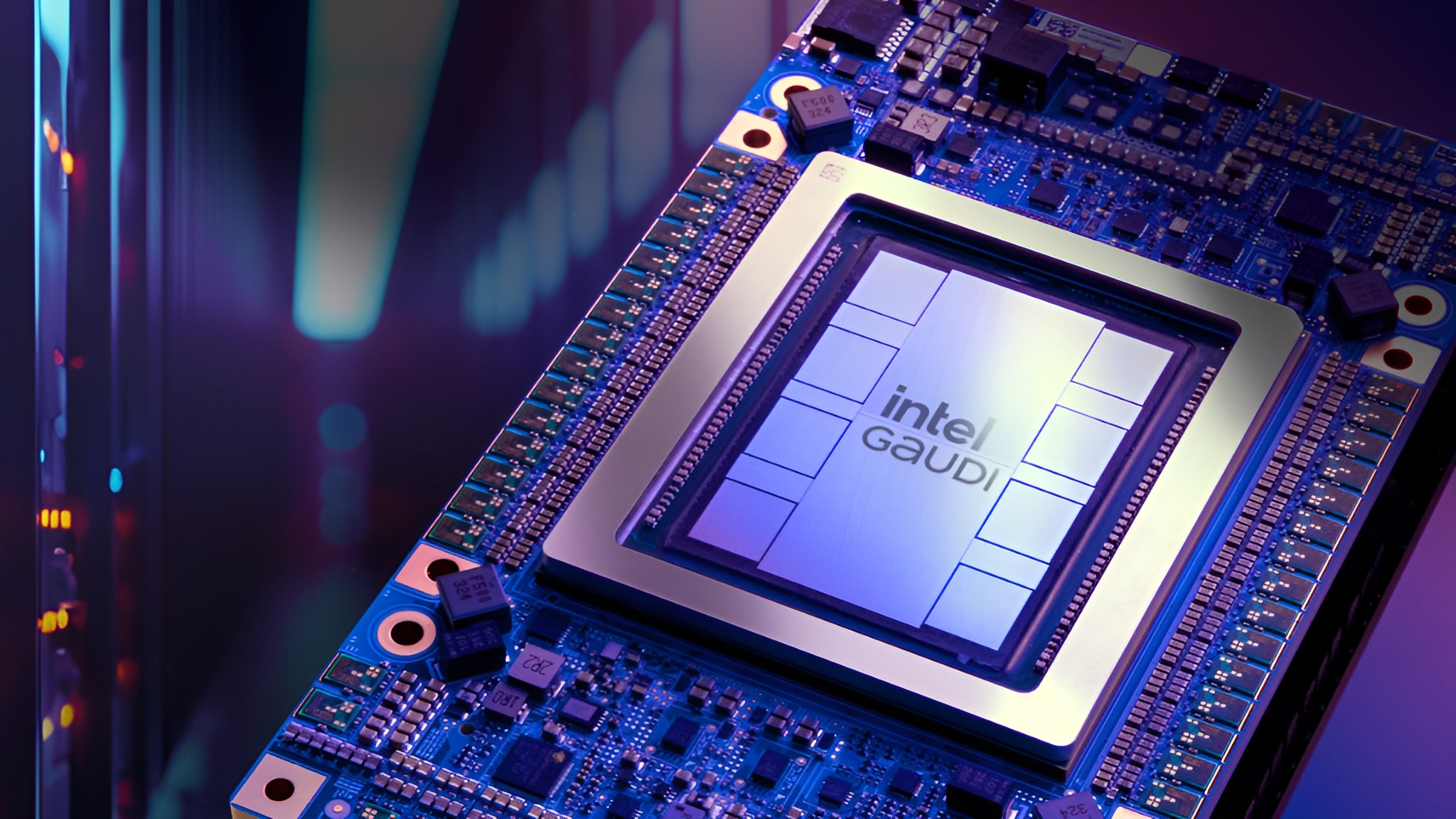
Intel’s Gaudi 3 focuses on the decode phase of inference – a stage that relies heavily on bandwidth and network scalability – while the Blackwell B200 GPUs handle the prefill phase, which demands massive computational bursts for large-scale matrix operations. The result is a system designed for balance: computation-heavy tasks go to Blackwell, while Gaudi 3 handles the distributed, memory-bound workloads more efficiently.
At the OCP Global Summit, Intel showcased this innovative setup as part of its attempt to reassert itself in the AI data center race. The rack combines NVIDIA’s ConnectX-7 400 GbE NICs with Broadcom’s Tomahawk 5 51.2 Tb/s switches, enabling low-latency, all-to-all communication across the compute trays. Each tray houses two Xeon CPUs, four Gaudi 3 accelerators, four NICs, and one NVIDIA BlueField-3 DPU, with a total of sixteen trays per rack. This integration blurs the lines between competitors and shows Intel adopting a pragmatic approach: when you can’t beat the industry leader, you integrate with them.
According to internal performance metrics shared by SemiAnalysis, the system reportedly delivers up to 1.7x faster prefill performance compared to a standalone B200 setup on smaller, denser AI models. However, this claim remains unverified by independent benchmarks. Still, it’s a noteworthy attempt by Intel to position Gaudi 3 not as a rival to NVIDIA’s dominance but as a complementary solution – one that offers cost efficiency and scalability for enterprises seeking balance between price and performance.
From a business perspective, the strategy is both bold and practical. Intel has struggled to gain traction against NVIDIA and AMD in the AI market, with Gaudi chips often sidelined due to software immaturity and limited ecosystem support. By embedding Gaudi within a rack-scale system that already embraces NVIDIA’s stack, Intel gains a new monetization path. NVIDIA, meanwhile, benefits by showcasing the breadth of its networking technologies and reaffirming the superiority of its interconnect ecosystem.
However, challenges remain. The Gaudi software ecosystem is still underdeveloped, limiting the platform’s full potential. And with reports suggesting that Gaudi’s lifecycle may end soon, this hybrid rack could serve more as a proof-of-concept than a long-term market solution. Yet, it also underscores a broader industry trend: the era of isolated, vendor-locked AI systems may be giving way to collaborative, interoperable designs that prioritize efficiency over exclusivity.
In essence, Intel’s partnership with NVIDIA’s Blackwell ecosystem isn’t just about keeping Gaudi relevant – it’s about survival through adaptation. The hybrid model presents an intriguing glimpse into a future where major chipmakers cooperate as much as they compete, each leveraging their strengths to serve the insatiable global demand for AI compute power.
2 comments
finally some smart move by intel tbh, gaudi was dying alone
hope the software stack actually works this time..