Intel has officially unveiled its long-awaited Crescent Island GPU, a next-generation data center solution designed to accelerate AI inference workloads with unprecedented efficiency. This new entry marks a strategic shift for Intel after its earlier struggles to compete head-to-head with NVIDIA and AMD in the high-end AI accelerator space. 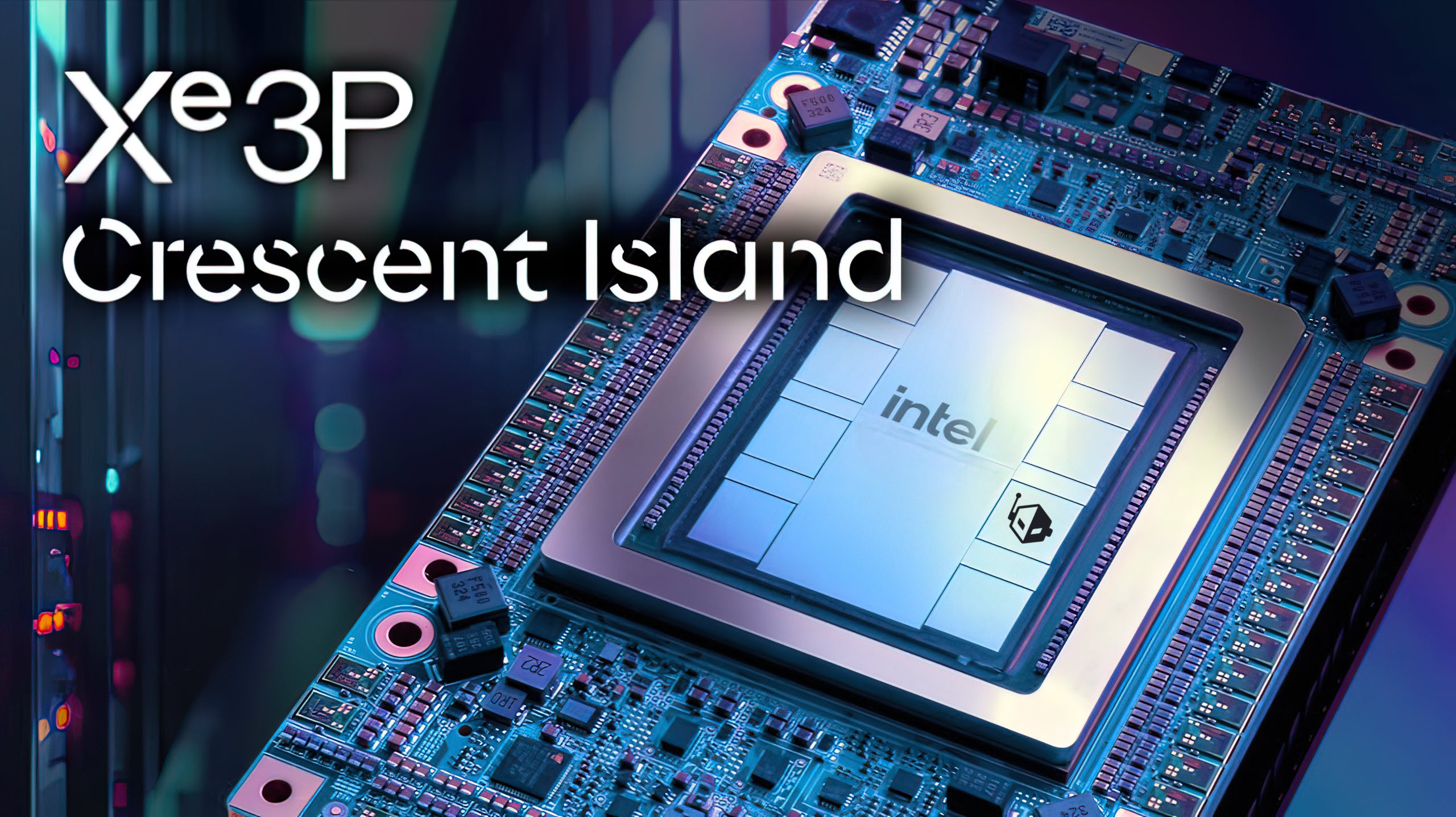
Instead of chasing sheer power, Intel’s focus now lies on optimizing performance per watt and balancing cost, cooling, and scalability – an approach that could redefine how AI inference hardware evolves in enterprise environments.
The Crescent Island GPU is built on the brand-new Xe3P graphics architecture, which represents the latest leap in Intel’s Xe series. Introduced during the company’s Tech Tour 2025, the Xe3P design is a direct successor to the Xe3 family used in consumer and professional GPUs like the Arc series. However, this new architecture is not just an incremental upgrade – it’s designed to scale seamlessly from integrated GPUs in laptops all the way up to full-scale AI data center accelerators. This cross-platform consistency gives developers a unified foundation for AI workloads, whether they’re running on client devices or massive inference clusters.
Where Crescent Island really stands out is its memory configuration. Intel has equipped the GPU with a colossal 160 GB of LPDDR5X memory, delivering a significant combination of capacity, bandwidth, and efficiency. This choice is both bold and pragmatic. While rivals like NVIDIA’s H100 and AMD’s MI300 rely on ultra-high-bandwidth HBM3E memory, those modules are notoriously expensive and currently in short supply. By contrast, LPDDR5X provides an excellent cost-to-performance balance – lowering expenses while still offering impressive data throughput for large-scale inference workloads. Intel’s decision to go with LPDDR5X could make Crescent Island a much more accessible option for organizations seeking scalable AI infrastructure without breaking the bank.
Intel has clearly designed Crescent Island with practical deployment in mind. The GPU is optimized for air-cooled enterprise servers, making it easier to integrate into existing data center configurations. This eliminates the need for complex liquid-cooling setups that many high-performance accelerators demand, reducing total cost of ownership. At the same time, the chip leverages Xe3P’s efficiency improvements to maintain high performance-per-watt, making it ideal for inference-heavy applications such as real-time analytics, large language model querying, and token-based AI services.
Another key highlight is its support for a broad range of data types, a crucial feature for inference flexibility. This makes Crescent Island particularly appealing to emerging service models like “tokens-as-a-service,” which rely on dynamically processed AI outputs at massive scales. By supporting multiple data representations natively, Intel is ensuring that the GPU can handle both legacy AI frameworks and next-generation architectures with minimal software overhead.
On the software side, Intel is continuing to refine its open and unified AI software stack, aimed at simplifying heterogeneous AI development. This same software framework is currently being tested and optimized on the Arc Pro B-Series GPUs, providing a development environment that will later transfer seamlessly to the Crescent Island ecosystem. This continuity ensures early adopters can build and test inference workloads today and deploy them effortlessly once Crescent Island becomes commercially available.
Intel expects customer sampling to begin in the second half of 2026, signaling that the GPU’s design is nearing finalization. With this launch, Intel appears determined to carve out a niche between premium high-cost AI accelerators and the more affordable – but often less capable – alternatives. The combination of energy efficiency, large LPDDR5X memory, and flexible data support positions Crescent Island as an innovative contender for enterprises prioritizing value and scalability.
While NVIDIA and AMD continue to dominate headlines with their extreme-performance chips using advanced HBM4 technology, Intel’s move represents a strategic recalibration – one that could pay off in environments where energy costs and operational simplicity matter as much as raw compute power. As the AI landscape matures, Crescent Island may well emerge as Intel’s most balanced and commercially viable answer to the growing global appetite for inference-oriented hardware.
1 comment
air cooled sounds nice but i bet it’ll still run hot 😂