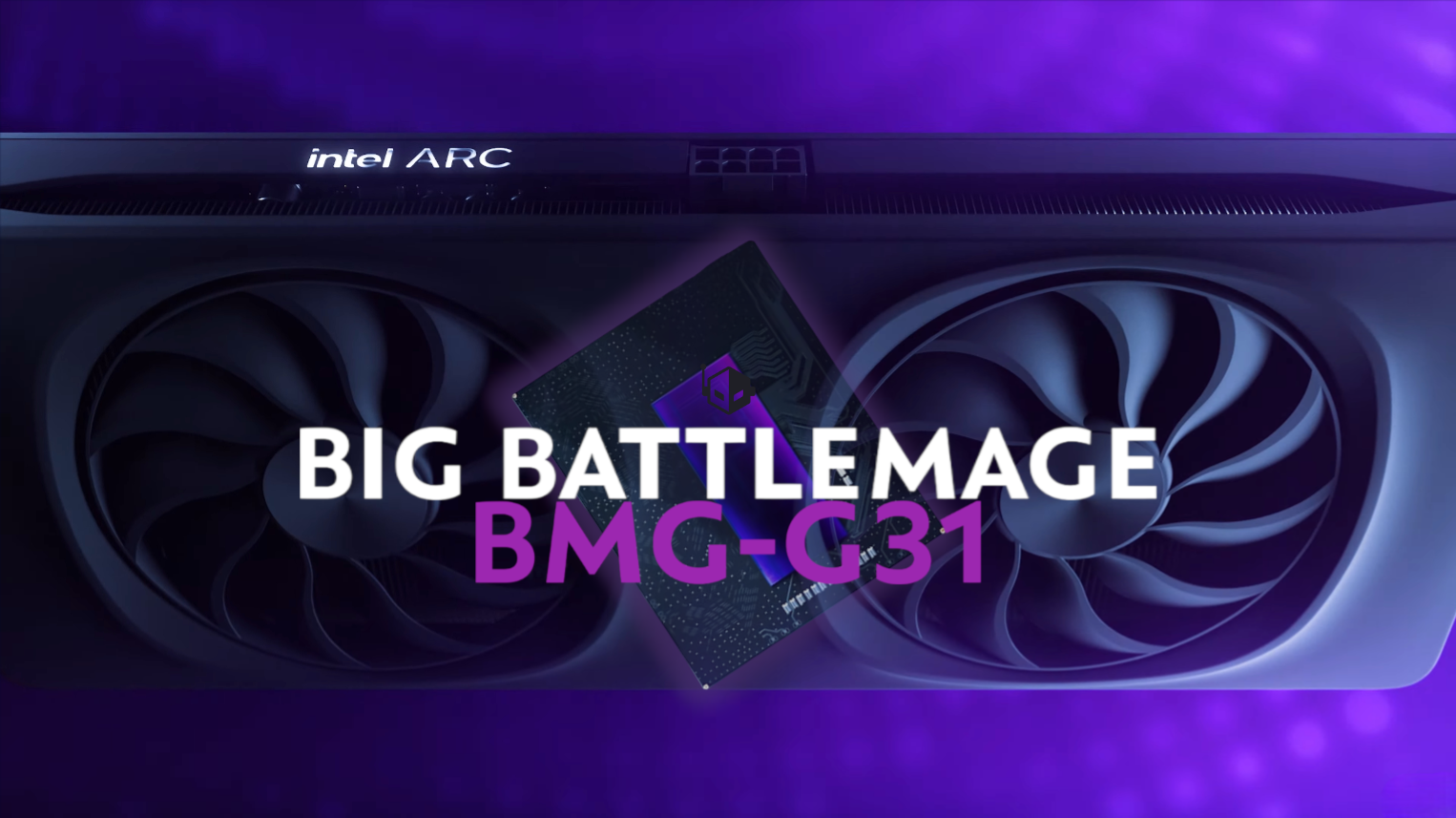
Intel Arc Battlemage BMG-G31 Nears Launch As VTune Adds Support
Intel has spent the last few years trying to convince gamers that Arc graphics are more than a one generation experiment. Alchemist was the warm up, Battlemage is supposed to be the real test, and at the center of that story sits the long rumored big die, Arc Battlemage BMG-G31. After months of leaks, half cancelled plans, and endless speculation about a desktop card often referred to as Arc B770, we finally have a fresh and very concrete sign that the silicon is alive and well: Intel has quietly added explicit BMG-G31 support to its own VTune Profiler tool.
That might sound like a small footnote, but it matters. Developer tools are usually the first place new hardware IDs show up, long before glossy launch trailers or influencer benchmarks. Intel needs its profiling stack to understand every new GPU it plans to ship, so engineers can tune drivers, runtimes, and game engines against the real device. When you see BMG-G31 baked into VTune, it strongly suggests that the chip is far enough along that performance work on production style hardware is happening behind the scenes.
The new 2025 dot 7 release of VTune Profiler brings several workload features that are nice in their own right. Code annotations get a richer formatted metadata API so developers can tag tasks with detailed, human readable context instead of cryptic labels. Finalization of large traces is advertised as up to twice as fast for compute heavy, multi GPU workloads, which is exactly the sort of environment Battlemage is supposed to thrive in. But the headline for gamers is simple: official support for Intel Arc Battlemage BMG-G31 and Core Ultra 3 processors based on the Panther Lake platform arrives in the same changelog.
Panther Lake is widely expected to be Intel’s big consumer CPU story at CES 2026, which raises an obvious question. If the CPU and the new Battlemage GPU now appear together in the software stack, is Intel lining them up for a joint splash on stage. The company has not promised anything publicly, and plans can slip, but the timing fits the pattern we have seen with earlier launches. First the drivers and tools quietly learn about the new hardware, then retail boards and gaming laptops follow a few months later.
What Big Battlemage BMG-G31 Is Rumored To Deliver
Under the hood, BMG-G31 is described as the larger Battlemage die that sits above the already shipping BMG-G21 used in Arc B580 and Arc B570 cards. While Intel has not published final specifications, consistent leaks point to a configuration with up to thirty two Xe2 cores, adding up to four thousand and ninety six shading units. Paired with sixteen gigabytes of GDDR6 on a two hundred and fifty six bit bus running at nineteen gigabits per second, that would give the flagship Battlemage desktop card memory bandwidth in the six hundred gigabytes per second range.
On paper, that makes BMG-G31 a clean step above the midrange B580, which uses twenty Xe2 cores, a one hundred and ninety two bit bus and twelve gigabytes of VRAM. It also reads like the spiritual successor to the older Arc A770, which already offered sixteen gigabytes on a two hundred and fifty six bit interface but with first generation Xe cores and slightly slower memory. If Intel can keep total board power under control and still push clocks high enough, Big Battlemage should leapfrog the A770 by a healthy margin and offer a meaningful upgrade path for anyone who bought into the first wave of Arc.
Price, however, is where this story will be won or lost. The sweet spot that keeps being floated is somewhere in the three hundred to four hundred US dollar range. Land too high, and BMG-G31 will be compared mercilessly to faster cards from years past. Nail a sharp price to performance ratio, and suddenly the conversation shifts from raw frames per second to value, particularly if the card ends up competing with future midrange offerings such as a hypothetical GeForce RTX 5060 or Radeon RX 9060 family rather than halo boards that cost as much as a full system.
Community Expectations: From Doom Scenarios To Quiet Optimism
Enthusiasts have not exactly been shy about their mixed feelings. One camp looks at the timeline and worries. In their eyes, launching a brand new GPU in twenty twenty six that only trades blows with graphics cards from twenty twenty would be a recipe for a memeworthy flop. They look at the pace of progress at the high end and say that anything less than a giant leap will be dead on arrival, especially if ray tracing and frame generation still lag behind the best from Nvidia and AMD.
Another part of the community is far more pragmatic. They point out that the majority of players do not need a monster board just to have fun. Many modern games still run just fine at 1080p or even 1440p on midrange hardware, and when titles demand extreme horsepower, it is often because the engine is poorly optimized rather than because the visuals are truly ground breaking. From that perspective, a card that can hang with the popular class of sixty class GeForce and entry level Radeon cards at a lower price could be far more impactful than yet another thousand dollar flagship.
There is also a group that sees Arc B580 as a positive sign. Early independent testing has already shown B580 outpacing the older A770 sixteen gigabyte model at 1440p by a healthy double digit margin in many scenarios, even with drivers that are still maturing. If that uplift is what the smaller G21 die can do, the logic goes, then a full fat G31 with more cores and more bandwidth has the headroom to land in a very competitive spot, assuming Intel does not kneecap it with conservative clocks or thermal limits.
A Roadmap Marked By Reset Plans And Cancellations
The backdrop to all of this is Intel’s constantly evolving discrete GPU roadmap. At one point, insiders and leakers alike were talking about a Battlemage family that would stretch all the way up into genuine high end enthusiast territory. Over time, many of those more ambitious parts were reportedly shelved or folded into different product segments, leaving BMG-G31 as the de facto top dog for consumer Battlemage. The decision lines up with a more cautious strategy that prioritizes reliable midrange volume over chasing absolute performance crowns.
By the time BMG-G31 reaches store shelves, Intel will already have moved its integrated graphics stack over to a newer Xe3 architecture in upcoming processors, even though the company still refers to that integrated generation under the broader Arc Battlemage branding. That means the discrete B7 series will actually arrive into a world where the bleeding edge iGPU technology is technically a step ahead architecturally. It is a slightly unusual situation, but not unprecedented in a market where desktop and mobile roadmaps rarely stay perfectly aligned.
Will Big Battlemage Matter In A Tight Memory Market
Adding another layer of uncertainty is the ongoing squeeze in DRAM supply. There have already been reports of vendors rethinking or delaying some graphics launches because high speed memory is both expensive and hard to secure at scale. For Intel, this cuts both ways. On one hand, every sixteen gigabyte card it ships will be fighting for the same pool of components. On the other hand, a smartly priced midrange GPU with a relatively generous VRAM configuration could look very attractive if rivals are forced to cut capacity or push prices up to protect margins.
What seems clear is that Intel cannot afford a repeat of the rough edges that hurt the first wave of Arc. Frame pacing issues, quirky game compatibility and immature drivers overshadowed decent raw performance in the early days. Since then, the software team has made visible progress, and the inclusion of BMG-G31 in core tools like VTune suggests that optimization for the new architecture is being treated seriously well ahead of any public launch. For players, that groundwork matters as much as any headline teraflop figure.
In the end, Big Battlemage does not have to dethrone the absolute top end to be a success. If BMG-G31 can deliver a noticeable jump over A770 and B580, stay in the three to four hundred dollar window, and ship with polished drivers on day one, it would give price conscious gamers a genuine third option in a market that has felt like a two company duopoly for far too long. Combined with stronger developer tools and a more conservative, realistic roadmap, that might finally be the moment where Intel Arc stops feeling experimental and starts looking like a permanent pillar of the GPU landscape.
1 comment
Honestly if they drop a stable card with good drivers at 350 bucks im in, i dont care if the badge says Intel or not