Infinix GT 30 Hands-On Review: A Deep Dive into the Gamer’s Smartphone with GT Shoulder Triggers
Over the past few years, Infinix has steadily positioned itself as a brand that understands the needs of budget and mid-range smartphone buyers, especially in emerging markets. But with the launch of the GT series, the company is signaling that it has bigger ambitions – it wants to take a shot at the rapidly growing mobile gaming market. Following the Infinix GT 30 Pro introduced in May, the GT 30 made its debut in India in August and is now reaching international shelves. We spent a significant amount of time with the Infinix GT 30 (also called Infinix GT 30 5G+) and put it through its paces to see if it truly delivers on the promise of being a gamer-centric device. Here’s a detailed breakdown of everything we experienced.
Unboxing Experience
Inside the retail box, you’ll find a SIM ejector tool, protective case, charging cable, documentation, and a 45W power adapter. It’s nice to see that Infinix includes a fast charger in the box at a time when many manufacturers are removing them, and the inclusion of a case is always appreciated by buyers who want instant protection without an additional purchase.
Display: A Bright and Fluid Canvas
The Infinix GT 30 is built around a large 6.78-inch LTPS AMOLED display with a sharp 2,720 x 1,224-pixel resolution and an eye-popping 4,500 nits peak brightness. That’s a number that jumps off the spec sheet – few smartphones in this price range can boast that level of brightness, making it an ideal device for gaming or streaming even under bright sunlight. The panel supports a 144Hz refresh rate and up to 240Hz touch sampling, making fast-paced games feel more responsive. Its 10-bit color depth ensures rich, vibrant visuals across media and games alike.
The display is shielded by Gorilla Glass 7i and includes Always On Display functionality, although Infinix’s implementation leaves room for improvement. Instead of truly being “always on,” the screen only shows information when tapped – a quirk that may frustrate users accustomed to the conventional AOD experience. Hopefully, this is something Infinix can refine with a software update.
The phone supports HDR10, HDR10+, and HLG codecs, with Widevine L1 certification enabling full-HD playback on streaming services. Refresh rate options range from 60Hz to 144Hz, and users can toggle between Auto-Switch (adaptive), Standard (60Hz), and High (144Hz) modes. There’s also an option to manually assign refresh rates to individual apps, but not every app respects the higher refresh settings, which is slightly disappointing for power users.
Front Camera and Biometrics
The centered punch-hole cutout houses a 13MP selfie camera with an f/2.2 aperture and 82° field of view. It supports 4K video recording at 30fps – a rare offering at this price tier. For security, an optical in-display fingerprint scanner sits beneath the screen. It works reliably and quickly, though its placement is a tad low, requiring a bit of thumb stretching compared to ideal positioning.
Cyber Mecha 2.0 Design Language
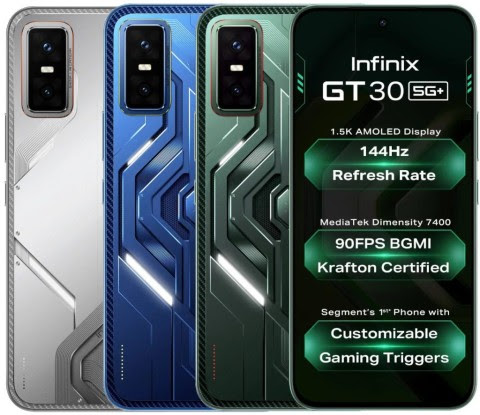
Flipping the phone over reveals Infinix’s “Cyber Mecha 2.0” design. It’s a bold aesthetic, full of sharp geometric lines and a futuristic flair clearly intended to appeal to gamers. The glossy back resists smudges fairly well but may feel less comfortable to hold due to its flat design lacking curved edges. While the style will divide opinion, one cannot deny that it sets the phone apart from generic mid-range competitors.
The dual-camera system sits on the back: a 64MP Sony IMX682 primary sensor with f/1.75 aperture and 86.2° FOV, and an 8MP ultrawide with f/2.2 aperture and 111.4° FOV. Both support autofocus, with the primary sensor capable of 4K recording at 30fps and 1080p at 60fps. The ultrawide is a nice inclusion, though serious photography enthusiasts may find it limited in low light.
Color Variants and Mechanical Light Waves
The GT 30 comes in Cyber Blue, Pulse Green, Blade White, and Shadow Ash (not sold in India). The color options reflect Infinix’s attempt to add individuality, with some finishes featuring bold geometric accents. Our Pulse Green unit looked less green than expected, shifting in appearance depending on angle and lighting. It adds a unique twist for those who enjoy standout designs.
Perhaps the most attention-grabbing element is the customizable white LED strips on the back – Infinix calls them Mecha Lights or Mechanical Light Waves. These glow or blink during notifications, calls, charging, gaming, and music playback. They also sync with timers, startup, or even video recording. Party Mode adds fun with dynamic patterns like Breathe, Meteor, and Rhythm. While visually striking, their practicality is limited since they’re only visible when the phone is face down. Still, as a stylistic flourish, they’re a playful touch that matches the gaming aesthetic.
Ports, Controls, and Build
The phone includes a USB-C port at the bottom, alongside a microphone, speaker, and SIM slot. Up top sits another mic, an additional speaker, and even an IR blaster – something rarely seen in this price bracket. The right edge houses volume controls and a power button with a red accent for added flair. The overall construction feels sturdy enough for daily use, though the plastic build reminds you that this is not a premium flagship.
The Star Feature: GT Shoulder Triggers
Now to the centerpiece of this device: the GT Shoulder Triggers. These capacitive buttons, located along the right edge, deliver a 520Hz touch sampling rate with only 7ms latency, ensuring snappy performance. They even register wet or greasy touches, which is impressive given the sweaty-finger realities of long gaming sessions.
More than just hardware gimmicks, the triggers are deeply customizable. Each can be mapped to single press, double press, or long press actions – everything from launching apps and recording the screen to camera shutter shortcuts. For example, double-tapping one trigger could launch the flashlight, while holding another could burst-shoot photos in the camera app. When gaming, they can be assigned as L and R buttons via the XBOOST panel, dramatically enhancing gameplay in shooters or MOBAs. The haptic feedback adds immersion, and in real-world use, the triggers genuinely improved the experience, making it one of the most practical innovations Infinix has ever implemented.
Gaming and Performance
The Indian model is marketed with BGMI support up to 90fps, while the global version promises high frame rates for ten popular titles including PUBG Mobile, MLBB, COD Mobile, FreeFire, and more, with some supporting 120fps gameplay. Interestingly, despite those claims, our Indian test unit could only push COD Mobile at 60fps. That said, in actual gameplay across multiple titles, performance was smooth and enjoyable, with no noticeable frame drops.
Under the hood is MediaTek’s Dimensity 7400 chipset paired with 8GB of LPDDR5X RAM and up to 256GB UFS 2.2 storage. The phone runs Android 15-based XOS 15 and comes with a guarantee of two major OS updates and three years of security patches. Commendably, our review unit was nearly free of bloatware, a refreshing change compared to rivals that preload countless unnecessary apps.
Benchmark results paint a clear picture. In GeekBench 6, the GT 30 scored 3,186 in multi-core and 1,065 in single-core tests. On AnTuTu, it achieved 711,539 – comfortably beating some rivals in the same price bracket. In 3DMark Wild Life Extreme, it scored 1,058, which is modest compared to high-end gaming phones but decent for this segment. More importantly, real-world gaming for extended sessions remained stable, with the device maintaining cool temperatures without aggressive throttling.
Battery and Charging
A 5,500mAh battery powers the GT 30, supported by 45W wired charging and 10W reverse wired charging. Infinix also includes bypass charging for gamers who want to play without heating the battery during long plugged-in sessions. Charging tests showed respectable speeds: 25% in 15 minutes, 50% in 30 minutes, and a full charge in about 65 minutes. While not the fastest in the market, it strikes a good balance between speed and battery longevity. Three charging modes – Low-Temp, Smart, and Hyper – allow users to optimize based on needs. Most will stick with Smart Mode, but enthusiasts may prefer Hyper Mode for peak charging speeds.
Additional Features
Other highlights include dual stereo speakers with Hi-Res certification, NFC (except on the Indian variant), and an IP64 rating for splash resistance. Together, these extras round out the GT 30’s appeal, ensuring it doesn’t feel one-dimensional as just a “gaming phone.”
Pricing and Availability
In India, the Infinix GT 30 is offered in Cyber Blue, Pulse Green, and Blade White with two memory options: 8GB/128GB at INR 19,499 (about $220) and 8GB/256GB at INR 20,999 (about $240). Globally, it also comes in Shadow Ash, starting at around $200/€170. For the price, the GT 30 delivers an impressive array of gaming-centric features rarely seen in this bracket.
Final Impressions
Infinix has made a bold statement with the GT 30. By combining a fluid high-refresh display, customizable GT Shoulder Triggers, striking design, and reliable performance, the phone stands as a compelling option for gamers on a budget. While it isn’t perfect – the limited Always On Display, plastic build, and occasional refresh rate quirks hold it back slightly – its value proposition is undeniable. If you are looking for an affordable gaming phone that actually enhances gameplay through thoughtful hardware, the Infinix GT 30 deserves a serious look.
Ultimately, Infinix has taken a confident step forward in carving out a niche within the gaming smartphone market. The GT 30 is not only a fun device to use but also proof that gaming-centric features don’t always have to come at flagship-level prices.
2 comments
why only 60fps in codm?? kinda sus ngl
bro those lights on the back r 🔥🔥