Huawei has once again shaken up the smartphone world by unveiling the Mate XTs, its second-generation trifold smartphone. What makes this release remarkable is not only the cutting-edge form factor but also the fact that Huawei is already on its second iteration while most competitors are still struggling to bring their first trifold to market. 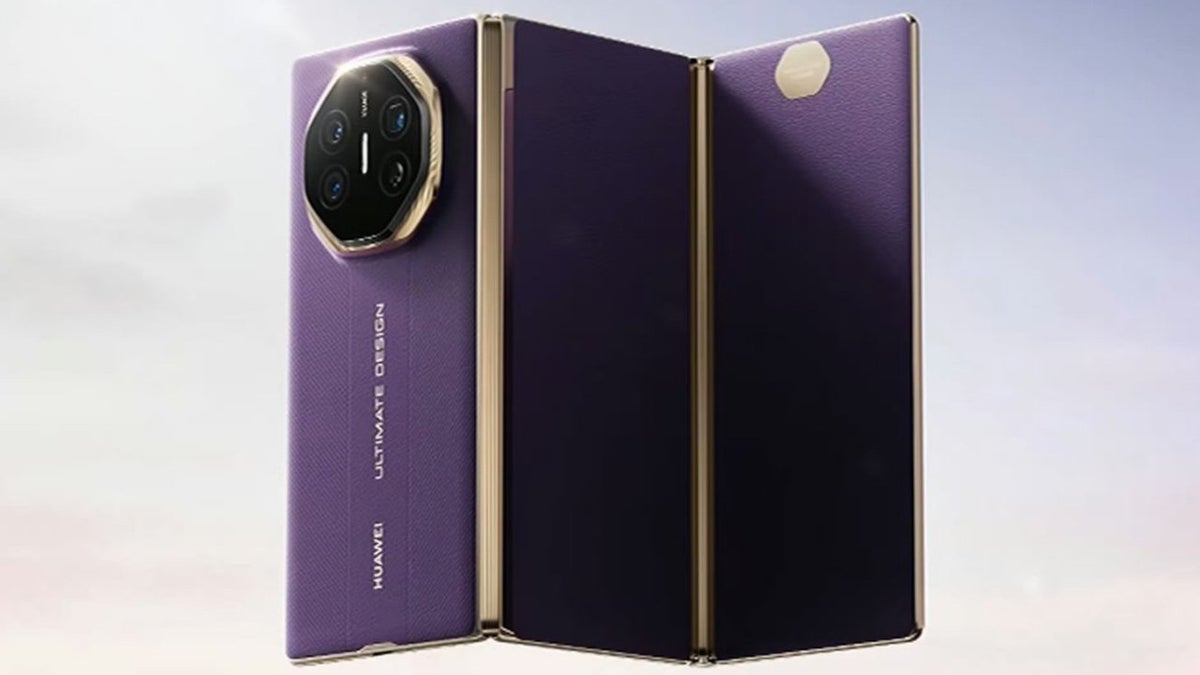
The device, which is already available for order in China, signals Huawei’s determination to remain at the forefront of foldable innovation despite ongoing challenges with global market reach.
The Mate XTs is less about reinvention and more about refinement. The overall folding concept remains intact, allowing the screen to expand from a compact 6.4-inch setup to 7.9 inches and ultimately to an expansive 10.2-inch display. The most significant new feature is stylus support, a logical addition for a device that essentially transforms into a tablet-sized workspace. This feature is aimed squarely at professionals, students, and creatives who see large foldables as productivity tools, not just futuristic showpieces.
Inside, Huawei has upgraded the phone with its new Kirin 9020 chipset, delivering improved performance and efficiency. The camera system also gets a notable upgrade, with a sharper 40-megapixel ultrawide sensor designed to capture more detail across wide shots. Color options have been refreshed too, with striking white and purple joining the previously available red and black finishes, giving users more personalization choices. While these are not revolutionary changes, they represent meaningful polish for a product category that is still in its infancy.
Price-wise, the Mate XTs continues to be positioned as a premium luxury gadget. Launching at 17,999 yuan (around $2,520), it is undeniably expensive. However, it is also about $300 cheaper than the original Mate XT, which debuted at 19,999 yuan. In the ultra-premium segment, even a slight price drop signals Huawei’s awareness that accessibility could play a role in expanding this niche product’s reach, though affordability is still far from reality for average consumers.
In terms of market context, Huawei is moving faster than its rivals. Samsung, the current leader in foldables, has long been rumored to be developing its own trifold. Yet while Samsung has the advantage of stronger global distribution and its polished One UI software ecosystem, Huawei is now two generations ahead in hardware. This raises an intriguing question: will Huawei’s early lead force Samsung to accelerate, or will Samsung’s inevitable release with refined software support steal the spotlight?
Despite its technical brilliance, the Mate XTs highlights the central dilemma of trifolds: they are solutions in search of a problem. While tech enthusiasts and collectors will marvel at the engineering, mainstream buyers still face practical hurdles. The steep price tag puts it out of reach for most, and Huawei’s limited app ecosystem outside of China, due to the absence of Google services, remains a serious handicap for international adoption. As a result, the Mate XTs feels more like a glimpse into a possible future than a device ready for widespread acceptance.
Nevertheless, its existence demonstrates how rapidly mobile hardware can evolve when a company commits to bold experimentation. Whether or not trifolds eventually become a staple of the smartphone landscape, Huawei’s Mate XTs represents an important milestone. It underscores both the ambition and the risk of pushing boundaries in a market that often rewards caution.
Interestingly, this conversation about daring design comes as nostalgia for past mobile icons also grows. A new illustrated book titled “Iconic Phones: Revolution at Your Fingertips” is scheduled for release this fall. Covering more than 20 of the most memorable devices of the past two decades, it promises to take readers on a journey through the mobile industry’s biggest milestones, from quirky experiments to culture-defining handsets. Just as the Mate XTs hints at the next chapter, this book offers a reminder of how far phones have already come – and how they continue to shape our everyday lives.
4 comments
samsung better step up or huawei gonna run this game
stylus on 10 inch screen makes sense tbh
bro this is basically a tablet that folds into a phone 😂
lol who even needs a 3 fold phone, just flexing at this point