Huawei is doubling down on premium foldables with the new Mate X7, a device that tries to prove a book-style foldable can be both elegant and genuinely tough. Instead of chasing spec sheet gimmicks alone, the Mate X7 leans on a distinctive design, serious durability upgrades and a heavy dose of in-house silicon with the Kirin 9030 Pro. 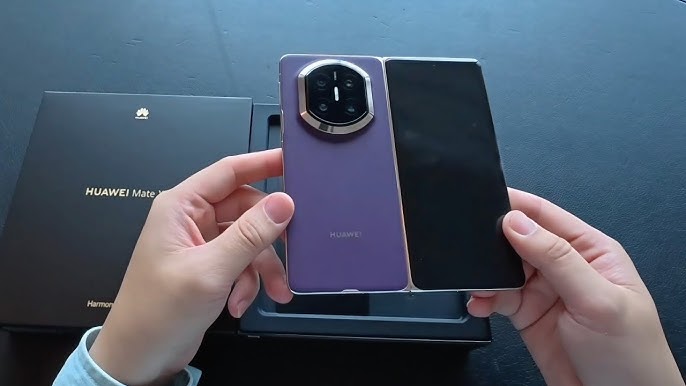
It is also unapologetically expensive, positioning itself as a status symbol as much as a piece of cutting-edge tech.
On the outside, the Mate X7 keeps the slim and light philosophy of the Mate X6, but refines it even further. Folded, the phone measures just 9.5 mm, and when opened flat it shrinks to about 4.5 mm, making it feel more like an ultra-thin tablet than a phone. At 235 grams, it is a few grams lighter than its predecessor while still using a rigid aluminum frame, so you do not feel like you are holding a fragile prototype. Visually, the design stands out: the lines, camera island and color choices make it easy to recognize from across the room, something many users miss in today’s look-alike slab market.
Durability is one of the headline talking points. Huawei gives the Mate X7 a rare combination of IP58 and IP59 protection, meaning the device is shielded against dust and can withstand both splashes and close-range high-pressure water jets. In normal life that translates to surviving rain, kitchen accidents and the occasional sink splash far better than most foldables, which often come with lower ingress ratings or compromises around the hinge area.
The displays are also slightly larger and smarter than before. On the front, you get a 6.49-inch cover screen with a tall 20.4:9 aspect ratio that behaves like a familiar candy bar smartphone. Open the hinge and an 8-inch main panel with an 8:7.3 ratio appears, giving you a near-square canvas that works brilliantly for multitasking, reading and split-screen use. Both panels are LTPO OLED, offering a variable refresh rate between 1 Hz and 120 Hz to balance silky smooth animations with power efficiency. High-frequency 1,440 Hz PWM dimming is used to reduce eye strain, which will be appreciated by those who spend hours scrolling or reading on their phones.
Camera hardware is another area where Huawei tries to justify the premium price. The primary camera is a 50 MP sensor with an RYYB color filter and a physical variable aperture ranging from f/1.4 to f/4.0, plus optical image stabilization. This setup allows the phone to adapt to very different lighting conditions, opening wide at night and stopping down for sharper daylight shots. The telephoto unit gets a meaningful upgrade: it is now a 50 MP sensor with a brighter f/2.2 lens and 3.5x optical zoom, promising more detail and better low-light performance when you zoom in. Completing the trio is a 40 MP ultrawide camera for landscapes and cramped interiors. Huawei even doubles down on selfies, with 8 MP front cameras on both the cover and inner screens so you can choose the framing that fits the moment.
Under the hood, the Mate X7 shares Huawei’s latest flagship heart with the Mate 80 Pro line: the Kirin 9030 Pro. While the company has not published every detail, the chip reportedly uses a nine-core ARMv8 layout with one performance-focused prime core clocked at 2.75 GHz, four high-performance cores running at 2.27 GHz and four efficiency cores at 1.72 GHz. Paired with 12 GB or 16 GB of RAM in most versions, this should deliver strong multitasking, smooth gaming at moderate settings and plenty of headroom for heavy camera processing. The top configuration even pushes RAM up to 20 GB alongside 1 TB of storage, an unusual figure that will definitely catch enthusiasts’ eyes and spark debates about how much memory a phone truly needs.
Power is supplied by a dual-cell silicon-carbon battery rated at 5,600 mAh in total, which is impressive considering the thin body and complex hinge. The phone supports 66 W wired charging and 50 W wireless charging, so topping up quickly should not be a problem whether you plug in or drop it on a compatible charger. With the adaptive refresh rate screens and Huawei’s aggressive power management, the Mate X7 aims to be a foldable that can genuinely last through a demanding day instead of living next to a charger.
On the software side, the device boots HarmonyOS 6 in China, bringing Huawei’s ecosystem integrations, refined multitasking and foldable-aware interface tweaks. Split-screen and floating windows take advantage of the 8-inch panel, making it easier to treat the device like a mini-laptop for work and content consumption. The phone also supports satellite connectivity, a niche but increasingly talked-about feature that can offer basic communication in areas with no traditional signal, adding peace of mind for frequent travelers or people living far away from cities.
The Mate X7 launches in a palette of Black, White, Purple and Red, with finishes that underline its luxury positioning. Pricing, however, is where reactions will be sharply divided. The base model with 12 GB of RAM and 256 GB of storage starts at CNY 12,999 (around USD 1,830), the 12/512 GB option costs CNY 13,999 (roughly USD 1,970), the 16/512 GB Collector’s Edition goes for CNY 14,999 (about USD 2,111), and the fully loaded 20 GB/1 TB variant is set at CNY 17,999 (approximately USD 2,534). These numbers put the Mate X7 toe-to-toe with the most expensive global foldables from Korean and American brands, and in some cases even higher.
That pricing strategy will inevitably make the Mate X7 feel like a device aimed at enthusiasts and wealthy early adopters rather than the average buyer. Many will admire the gorgeous design, robust build and ambitious spec sheet, yet still feel the brand is demanding a "rich people only" surcharge. The odd-looking 20 GB RAM configuration, while technically impressive, also raises eyebrows and jokes online about whether it is just 12 GB plus 8 GB combined branding. Huawei’s latest foldable is therefore a paradox: one of the most distinctive and durable foldables available, but also one that deliberately lives in a rarefied price bracket. For those who can afford it, the Mate X7 looks like a stunning statement piece; for everyone else, it may be the aspirational foldable you admire from afar.