Huawei’s Mate 70 Air doesn’t just join the ultra-thin phone trend – it challenges the idea that slim must mean small battery, timid performance, or forgettable cameras. After a steady drip of leaks, the device is official in China, and the headline sounds almost contradictory: a 6.6 mm body that still houses a 6,500 mAh silicon-carbon battery, a sprawling 7-inch 120 Hz AMOLED, and a 5G Kirin chipset. 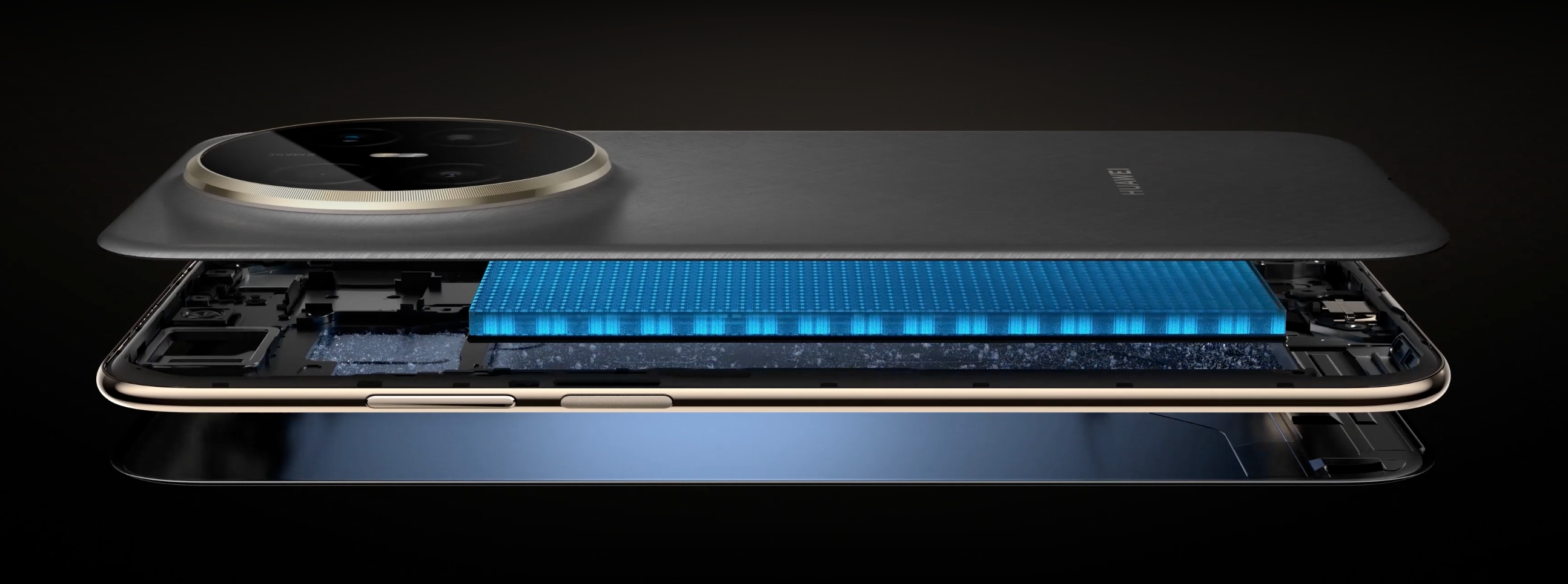
The market has seen plenty of wafer-thin experiments; this one feels like a thesis on how to make thin genuinely useful.
Design: thin lines, big ambitions
At 6.6 mm, the Mate 70 Air isn’t the thinnest slab this year, but it’s firmly in that rarefied “how is there anything inside?” class. The weight tells you the story Huawei is trying to write: 208 g. That’s heavier than rival featherweights – but it’s the price of carrying real endurance and a giant display. The silhouette reads minimalist and premium, with Huawei’s signature circular camera island, polished edges, and three finishes that actually look like finishes, not just names: gold and silver brocade, white feather robe, and obsidian black. The build is IP68-rated, so it meets the durability bar flagship buyers now expect.
Display: a tablet’s swagger in a phone frame
The front is essentially screen – a 7-inch AMOLED running 2760 × 1320 with a 120 Hz refresh and a claimed up to 4,000 nits peak brightness. Whether you binge videos, review spreadsheets, or sketch on the go, the canvas is enormous. The kicker: stylus support. In a category where “thin” often equals “basic,” Huawei adds a niche-but-powerful tool for note-takers, students, and creators who want pen precision without jumping to a foldable or a tablet.
Power: thin shell, thick battery
The headline spec is the 6,500 mAh silicon-carbon battery paired with 66 W wired charging. That capacity simply outclasses most thin competitors by a wide margin. Community comparisons already point out that Huawei’s cell is roughly 1,500–1,700 mAh larger than what some rival “Air” and “Edge” models ship with – and even edges out Motorola’s skinny entrant by about 1,700 mAh. Add Huawei’s famously aggressive power management (which some love and some find overly protective of background tasks), and you’re looking at a device that aims to be the thin phone you don’t need to baby.
Performance: two Kirins, one goal
Under the hood, Huawei offers two flavors depending on memory: the 12 GB RAM trim pairs with the Kirin 9020B; the 16 GB RAM model switches to the Kirin 9020A. Storage choices are 256 GB or 512 GB. Crucially, both chips deliver 5G. That matters because skeptics insisted a Huawei “Air” would be stuck on LTE. It isn’t. If your market supports the right bands, you’ll get modern radios to match the modern silhouette.
Cameras: a confident triple that respects physics
Camera islands on thin phones often exist for balance more than bravado. Here, the triple system looks purposeful: a 50 MP main, 12 MP telephoto, and 8 MP ultra-wide, with a 10.7 MP selfie camera up front. Huawei has long leaned on computational photography to maximize smaller sensors, and the expectation here is the same: dependable, versatile results rather than physics-defying miracles. The telephoto in particular gives the Mate 70 Air an edge; many thin rivals skip it to shave fractions of a millimeter.
Prices (China) and configurations
- 12 GB + 256 GB – CNY 4,199 (~$590)
- 12 GB + 512 GB – CNY 4,699 (~$660)
- 16 GB + 256 GB – CNY 4,699 (~$660)
- 16 GB + 512 GB – CNY 5,199 (~$730)
Early chatter framed ultra-thin flagships as automatic wallet-busters. The Mate 70 Air undercuts that narrative in China. Even the top-end 16/512 trim lands below the base storage versions of some rival “super-slim” phones. That pricing calculus, paired with the larger battery, may be the phone’s most persuasive argument.
Rivals: the Airs and Edges it’s meant to face
Huawei clearly aims at the likes of the iPhone Air and Galaxy S25 Edge. Those devices lean hard into thinness and featherweight feel; Huawei answers with longevity, a bigger panel, and stylus support. The trade-off is obvious: 208 g in the hand and a frame so large that one-handed use is a negotiation. In calls, the 7-inch footprint can look borderline comical. In movies, games, or multitasking, it looks genius.
Software reality check
As with most modern Huawei hardware, the China-first launch comes with asterisks. Expect no Google Mobile Services out of the box and a distinct software ecosystem. Enthusiasts who import will live with app workarounds and regional quirks. That won’t be news to Huawei’s core audience, but it’s the single biggest reason the phone – at least for now – makes the most sense in its home market.
Community verdict so far: thin done right
Early buyer energy around the Mate 70 Air coalesces around three points. First, this is how you do a thin phone: it sacrifices grams, not stamina. Second, pricing is saner than expected – especially stacked against similarly slim rivals. And third, 5G is here, contrary to predictions that Huawei’s “Air” would settle for 4G. There’s even a dose of humble-pie humor from skeptics now conceding that the battery and radios are stronger than anticipated.
Who should buy it?
If you’ve been craving a device that merges slim with substantial, the Mate 70 Air makes a compelling pitch. Mobile gamers and binge-watchers will love the screen and cell size; note-takers will appreciate stylus support; travelers get IP68 peace of mind. If you require Google services or prioritize the absolute lightest possible phone, look elsewhere. For everyone else, Huawei just turned the thin-phone trope into something practical.
Bottom line
The Mate 70 Air reads like a rebuttal to a year of ultra-thin compromises. It’s slim, yes, but also big-screened, big-battery, and big-on-features. In a trend that risked becoming a fashion show, Huawei brought function back to the runway.
3 comments
To the doubters: serving hot crow and humble pie today 😉
People said it’d be $$$ – top spec here is still cheaper than the base models of the other skinny phones lol
I said battery would be the trump card and yep… it’s like 1500–1700mAh more than the others. Chinese ROMs sip power too