On a recent episode of the Joe Rogan Experience, NVIDIA CEO Jensen Huang dropped one of those tech origin stories that sounds almost too cinematic to be true: the company spent billions building its first dedicated AI supercomputer, the DGX-1, launched it with fanfare – and, according to Huang, absolutely nobody wanted to buy it. No purchase orders. No eager cloud providers. 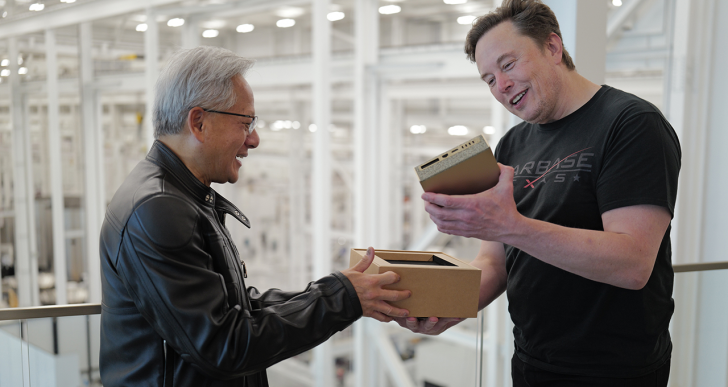
Just one buyer raising his hand: Elon Musk.
Seeing Huang, in his iconic leather jacket, telling that story on a mainstream podcast is a reminder of how far both he and NVIDIA have come. For most of its history, the company was known as the GPU brand behind PC gaming and professional graphics. Today, NVIDIA sits at the center of the AI boom, shaping everything from data centers and self-driving research to the tools used by generative models. Yet the DGX-1 anecdote shows that even era-defining products can start out looking like a bad business decision.
The DGX-1, revealed around 2016, was essentially an AI lab in a box: a dense server packed with high-end GPUs, CPUs, fast interconnects and a tuned software stack for deep learning. It was radically ahead of the buying habits of most enterprises, which still thought in terms of CPU clusters and traditional workloads. To many IT managers, GPU supercomputers for neural networks sounded expensive, niche, and hard to justify to a CFO. Inside NVIDIA, however, it was a strategic bet that AI training would move from academic experiments to industrial-scale computing.
Huang told Rogan that when DGX-1 hit the market, interest was effectively zero. The world was still focused on cloud VMs and x86 servers, and many decision-makers saw GPUs merely as accelerators for gamers or niche scientific codes. In that context, NVIDIA’s AI supercomputer looked like a solution in search of a problem. That’s the moment, Huang says, when Elon Musk called and said he had a nonprofit AI company that could really use exactly this kind of machine.
According to Huang, he literally boxed up one of the first DGX-1 units himself, drove it up to San Francisco and delivered it to Musk in 2016 for OpenAI. From a narrative perspective, it’s a perfect scene: the visionary chip maker hand-delivering a next-gen supercomputer to the visionary entrepreneur who would help ignite the modern AI wave. It also conveniently positions Musk as NVIDIA’s first true AI customer and OpenAI as the early adopter that “got it” before everyone else.
Online, not everyone buys the story at face value. Viewers quickly noticed how often Huang repeated the word “nobody,” turning it into a meme in its own right, with some joking that “nobody” might become the new “everything just works.” Others point out that by 2015 Google was already designing and deploying its own TPU accelerators, so it’s not like the entire world was asleep at the wheel while NVIDIA and Musk alone saw the future. To those critics, the anecdote is less a lie and more an aggressively polished piece of founder mythology – the kind of “cool story, bro” tale that tech leaders refine over years of retelling.
Still, even the skeptics acknowledge a kernel of truth: early AI hardware was a brutally small market. NVIDIA really was pushing a product far ahead of corporate comfort zones. Having a marquee buyer like Musk and OpenAI gave DGX-1 something every new platform desperately needs – a flagship reference customer. Once a recognizable name proves the box can train cutting-edge models, it becomes dramatically easier for NVIDIA’s sales teams to walk into other boardrooms and justify the price tag. Whether Musk was literally the first customer or just the most famous one, his adoption helped legitimize GPU-centric AI computing.
Fast-forward to today and the contrast is staggering. NVIDIA’s data-center portfolio has expanded from that lone DGX-1 to entire generations of systems built on Ampere, Hopper and soon Blackwell architectures, with the Vera Rubin platform already on the roadmap. Instead of begging customers to take a chance on GPUs for AI, NVIDIA is now struggling to keep up with demand from hyperscalers, startups and national labs desperate to train ever-larger models. Rival chipmakers feel the pressure: Intel is scrambling to stay relevant in AI accelerators while AMD’s designs, such as the upcoming Strix Halo family, are increasingly mentioned in the same breath as NVIDIA’s DGX and Spark-class systems.
The scramble for compute doesn’t stop at GPUs. Sam Altman, Jensen Huang’s sometime collaborator and sometime rival in shaping the AI landscape, has reportedly worked on massive long-term deals to lock in DRAM supply from giants like SK Hynix and Samsung. These aren’t just memory modules; we’re talking about wafer-level commitments that effectively pre-buy a huge slice of the world’s future memory output. At the same time, tighter export controls from recent U.S. administrations have made it harder for Korean and other manufacturers to offload older equipment to China, contributing to a market where high-performance memory and advanced GPUs are both scarce and strategic.
All of that makes the lonely DGX-1 look very different in hindsight. What started as a box nobody wanted has evolved into a blueprint for the AI data center, and the dynamic around it has flipped completely: now it’s cloud providers and AI labs who are begging NVIDIA for more capacity, not the other way around. In that light, Huang’s podcast anecdote isn’t just about Musk being early; it’s about how fragile and contingent technological revolutions can be. A single risky bet on a “nonexistent” market – and a single high-profile customer willing to play along – helped set the stage for the AI arms race we’re watching today.
Whether you see the story as perfectly accurate or slightly mythologized, it captures a real shift. Once, AI hardware looked like a vanity project; now it is the backbone of trillion-dollar companies and national strategies. And somewhere between those two realities is a leather-jacketed CEO, a trunk full of GPUs, and one of the strangest first-customer stories in modern computing.
1 comment
Altman locking up half the DRAM supply while US politicians crank up export bans is the real plot twist here. AI needs more chips, not more paperwork