Honor has never been shy about experimenting with unusual smartphone ideas, but its so-called Robot Phone might be the most playful and eccentric concept the company has shown so far. Instead of a standard camera bump, this prototype hides a mechanical pop-out gimbal module on the back that looks like a tiny robot eye emerging from the phone. It is not just a render or a vague promise: Honor has built a working prototype, even if there is a strong chance that most people outside of China will never get the opportunity to buy one.
The first glimpse of the Robot Phone came during the launch of the Honor Magic8 series, where the company briefly teased a device with a moving camera and promised a more detailed reveal next year, originally targeting the Mobile World Congress in Barcelona. 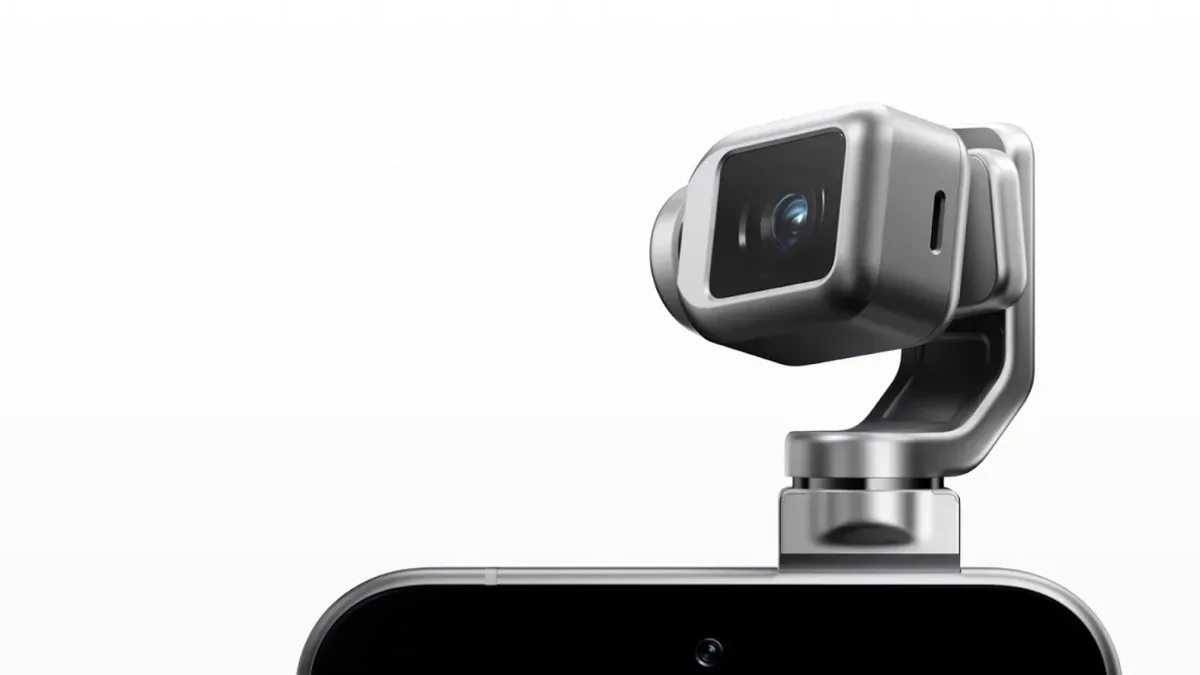
At the time, it felt like just another distant concept in a market full of flashy ideas. Yet only a month later, Honor surprised fans at its User Carnival event in China by putting an early version of the Robot Phone on display in a glass case. Attendees could not touch it, but they could see the unusual hardware in person, and photos of the device quickly spread across Chinese social networks like Weibo.
Even in prototype form, the Robot Phone looks more polished than many experimental devices. The pop-out gimbal camera dominates the rear design, sitting inside an oversized island that instantly draws the eye. When extended, the module is designed to tilt and pivot like a miniature stabilised rig, theoretically allowing it to track a subject and smooth out motion in a way that fixed smartphone cameras struggle to match. You can easily imagine vloggers or mobile filmmakers using it as a tiny robotic cameraman that can follow their face, reframe a shot, or give their clips a bit of personality that goes beyond standard optical stabilisation.
Honor’s material choices and color options suggest that it is treating this less like a throwaway experiment and more like a near-production concept. The company appears to be preparing at least three finishes – black, white, and gold – and renders and photographs show a design that combines a metal-looking frame with a glass panel beneath the camera island. The silhouette echoes the sharp, flat-edged language popularised by Apple, and the oversized camera block in particular feels very close to the rumored iPhone 17 Pro layout, only stretched and exaggerated to make room for the gimbal hardware. It is familiar enough to look premium, but odd enough to feel like a sci-fi gadget.
Where things get even stranger is Honor’s pitch around artificial intelligence. The original teaser was generated with AI and framed the Robot Phone almost like a Pixar-style character, complete with big-eyed wonder as it gazed at the world. Honor described the device as an emotional companion that senses, adapts, and evolves autonomously, suggesting that the phone would not only respond to taps and swipes but also read context, understand mood, and interact in a more human-like way. In theory, the moving camera would give that AI a physical presence, letting the phone quite literally turn to face the scene it is reacting to.
In practice, delivering that vision is a massive technical challenge. Packing a durable mechanical gimbal into a slim smartphone is difficult by itself, and adding a sophisticated AI layer on top – one that truly understands behaviour, emotions, and environment – pushes the project to the edge of what is realistic today. That is why Honor is still calling the Robot Phone a prototype and has avoided promising concrete launch details. Earlier hints pointed to a more complete demonstration around Mobile World Congress in Barcelona and a fuller showcase at MWC 2026, but none of that guarantees that the device will ever move from demo unit to something you can actually order.
Even if the engineering hurdles are solved, there are serious questions about availability. Historically, phones with complex moving parts have either been released only in small numbers or kept within a single region, and Honor has made it clear that China is its main focus. It is entirely possible that the Robot Phone ends up as a limited-run domestic curiosity, used to demonstrate the company’s design and AI ambitions rather than as a global hero product. For users in Europe or the US, the closest they may ever get could be watching videos of the robot-like camera blinking out from its housing at trade shows.
Looked at that way, the Robot Phone becomes less a specific product and more a preview of where smartphone design could go next. After years of increasingly similar slabs of glass and metal, manufacturers are searching for bold ways to stand out, and turning phones into objects with more character – devices that move, react, and feel almost like companions rather than passive tools – is one possible direction. A pop-out gimbal eye, animated AI persona, and emotionally aware software might seem niche today, but they hint at a future where personal devices are designed to feel more alive.
Personally, there is still a lot I am skeptical about. Marketing promises around AI emotional companions tend to overshoot reality, and the first generation of any experimental hardware usually falls short of the dream shown in trailers. I doubt Honor’s AI-powered gimbal buddy will fully match that whimsical teaser video, at least not right away. Yet the fact that there is already a physical prototype, with working mechanics and a refined exterior, makes the Robot Phone feel far more real than a simple concept render. If Honor ever does decide to sell it, even in limited numbers, it would be fascinating to test how much of that sci-fi vision survives in day-to-day use and how quickly people get used to the idea of a phone that literally looks back at them.
1 comment
ngl this looks like a tiny Wall E glued to a phone lol