Honor has officially lifted the curtain on the Honor 500 and Honor 500 Pro in China, and this duo is clearly meant to shake up the upper midrange and affordable flagship space. The new series keeps the core philosophy of the Honor 400 line but turns almost every dial up: bigger batteries, brighter screens, more powerful Snapdragon chips and a bold design that instantly sparks the Apple and Pixel comparisons people love to argue about in the comments.
Visually, the Honor 500 pair is impossible to ignore. 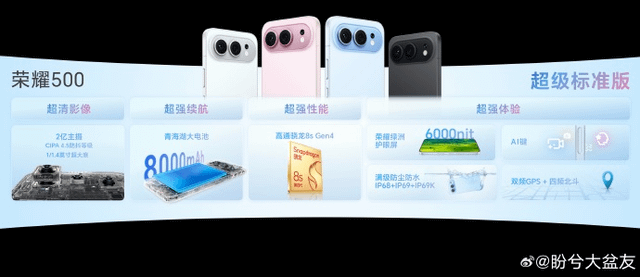
Both models embrace a flat aluminum frame with a glass back and a prominent raised camera plateau that immediately recalls the latest iPhone Air aesthetic, only stretched into a wider visor shape. At 7.8 mm thick and 198 g for the Honor 500 and 201 g for the Pro, these are not the featherweight champions of the smartphone world, yet they still feel relatively slim for devices packing gigantic 8000 mAh batteries. The color palette is classic Honor: Aquamarine, Starlight Powder pink, Moonlight Silver and Obsidian Black, all finished to look premium rather than budget.
Beyond looks, durability has clearly been prioritized. Both the Honor 500 and 500 Pro carry IP68 and IP69K ingress protection, a level of sealing you usually expect on rugged devices rather than stylish everyday phones. That means they are built to handle dust, immersion in water and even high pressure water jets, which should reassure users who tend to treat their phones more like tools than jewelry. For people tired of babying glass slabs, this combination of premium design with serious protection is a strong selling point.
The displays are another highlight. Each phone features a 6.55 inch LTPO OLED panel with a resolution of 1264 x 2736 pixels, a smooth 120 Hz adaptive refresh rate and a claimed peak local brightness of 6000 nits. On paper, that puts the Honor 500 screens in the same conversation as the brightest flagships on the market, a big deal if you spend a lot of time outdoors or watching HDR content. In display fingerprint scanners keep the front clean, while a 50 MP selfie camera sits in a punch hole, aimed at social media users and mobile vloggers who care about front facing image quality as much as the rear cameras.
Under the hood, the two phones split in different directions. The Honor 500 Pro is the performance hero, built around the Snapdragon 8 Elite platform and available with up to 16 GB of RAM and a huge 1 TB of internal storage. That combo is clearly aimed at power users who juggle heavy multitasking, high frame rate gaming and big local media libraries. The standard Honor 500 uses the Snapdragon 8s Gen 4, which is still a serious upper tier chip focused on efficiency and stable performance for everyday tasks, social apps and long gaming sessions without cooking your palms.
Honor is leaning heavily on camera hardware too. Both models share a 200 MP main rear camera with a large roughly 1 over 1.4 inch sensor, designed to capture plenty of detail and light, along with a 12 MP ultrawide lens for landscapes, group shots and tight interiors. The Honor 500 Pro adds a dedicated 50 MP telephoto camera with 3x optical zoom for tighter portraits and distant subjects, giving it an extra edge for photography enthusiasts. The idea is clear: even without pushing into ultra premium price territory, the 500 series wants to feel like a serious camera phone lineup rather than an afterthought.
The headline feature for many people, however, will be the battery. Both the Honor 500 and 500 Pro house enormous 8000 mAh silicon carbon batteries, and that single spec is already fueling a lot of online discussion. In a world where many mainstream flagships still hover around 4500 to 5000 mAh, Honor is basically saying: forget battery anxiety, just go. The phones support 80 W wired fast charging, while the Honor 500 Pro also includes 50 W wireless charging for people who prefer dropping their phone on a pad. Both handsets support up to 27 W reverse wired charging too, so they can double as power banks for your accessories or a friend’s dying phone.
Software wise, the pair boots MagicOS 10 based on Android 16 out of the box. That means you are looking at a current Android foundation with Honor’s usual interface tweaks, connectivity options and smart features layered on top. The exact update roadmap will matter in the long run, but out of the gate these devices feel more future ready than phones launching on older Android builds. For users who keep their phones for several years, starting on Android 16 is a meaningful advantage.
Pricing is aggressive, especially in the Chinese market. The Honor 500 starts at CNY 2,699 for the 12 GB RAM and 256 GB storage variant, moves to CNY 2,999 for 12 GB and 512 GB, and tops out at CNY 3,299 for 16 GB and 512 GB. The Honor 500 Pro begins at CNY 3,599 for 12 GB and 256 GB, climbs to CNY 3,899 for 12 GB and 512 GB, then CNY 4,199 for 16 GB and 512 GB, and finally CNY 4,799 for the fully loaded 16 GB and 1 TB configuration. Both phones are already up for pre order in China, with first shipments scheduled for November 27, positioning them perfectly for end of year buyers.
Of course, the design has already sparked heated debates. Some early watchers joke that manufacturers are stuck in a loop: Pixel inspired camera bars, Apple inspired plates and now Android brands echoing Apple’s softened Pixel interpretation. Yet many of those same voices admit that seeing an 8000 mAh battery in a phone this polished feels like something Apple or Pixel fans can only dream about right now. If Honor can deliver strong real world battery life, polished software and reliable cameras to match the impressive numbers, the Honor 500 series could easily become the go to recommendation for users who want enduring endurance and modern flagship style without paying ultra premium prices.