In a genre crowded with grim, mud-splattered survival sims and crafting checklists, Hello Sunshine immediately stands out with one striking image: you, a lone worker in a corporate-ravaged desert, walking in the shadow of a skyscraper-sized robot that is at once your life support system, your mobile home, and – slowly, unexpectedly – your best friend. Red Thread Games, the studio behind narrative-driven titles like Dreamfall Chapters and Dustborn, is stepping far outside its usual comfort zone with a full-blown survival RPG, yet it’s bringing all of its storytelling experience to bear on this scorching, sand-choked world.
A Desert Built by Corporations, Not Nature
Hello Sunshine is set in a future where the planet hasn’t simply suffered climate collapse – it has been actively reshaped by corporations like Sunshine Industries, the company that once employed you and may have doomed the world in the process. 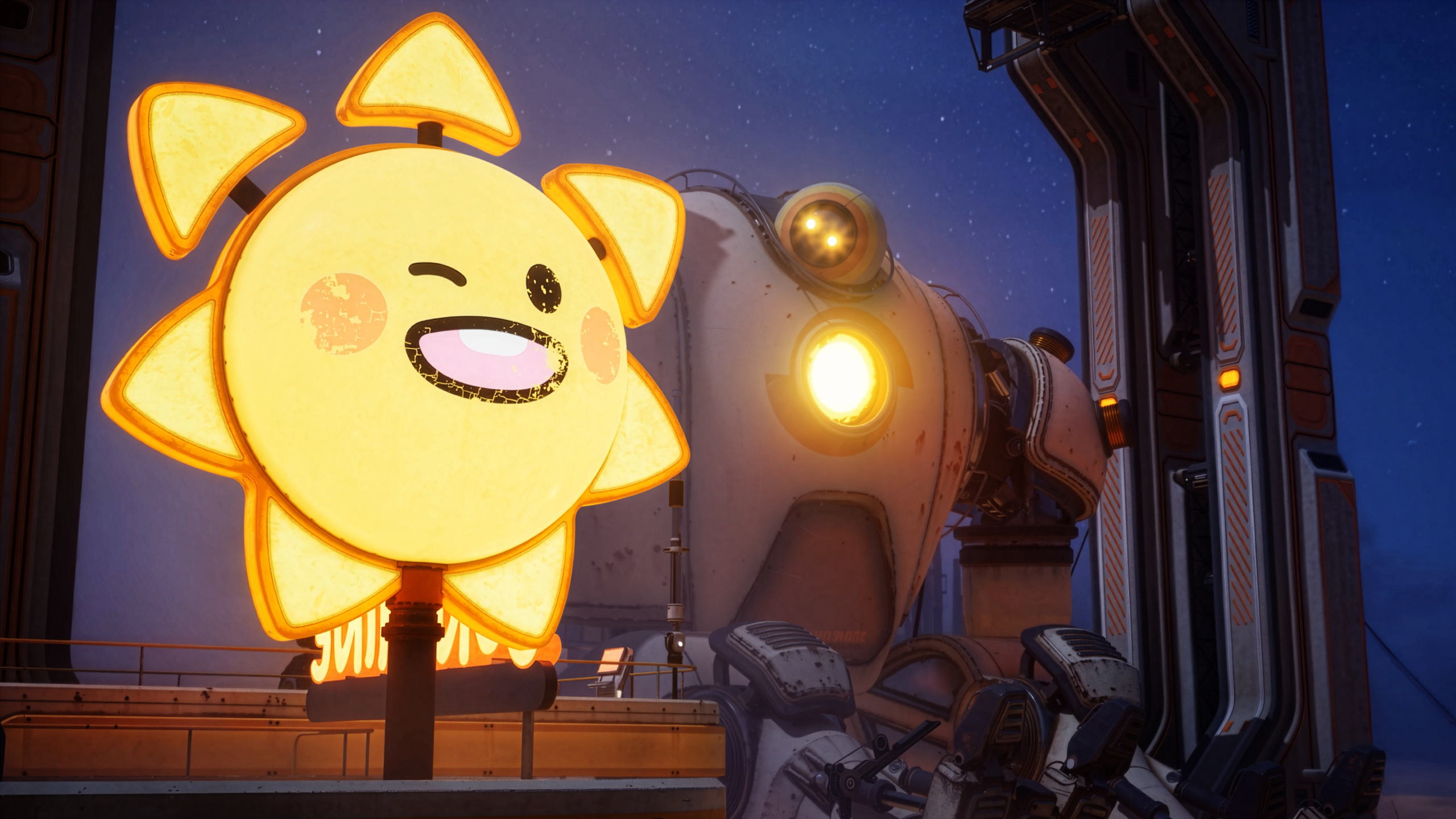
The landscape you traverse resembles a man-made Arrakis: an endless, industrial desert where cities and ecosystems have been buried under dunes. Sand stretches in every direction, the sky is a burning white, and the sun is not just a pretty shader effect but a constant, lethal presence that defines every decision you make. You’re the last remaining employee of Sunshine Industries in this region, wandering through the ruins of your own corporate past, living among rusting machinery, derelict infrastructure, and the scattered remnants of a civilization that thought it could out-engineer nature.
There are no titanic sandworms lurking beneath the dunes here, but the world is far from empty. The desert is patrolled by robots of various shapes and sizes, some small and skittish, others towering, predatory constructs of stray metal and corporate hubris. They’re not mere cannon fodder, either. Red Thread positions combat as something you approach carefully, with a bow and an arsenal of craftable arrow types that reward ingenuity over brute force. The game doesn’t want you to feel like an action hero; it wants you to feel like a scrappy survivor who sometimes has no choice but to fight the machines their old employers left behind.
Survival First, Combat Second
Despite the presence of clanking enemies and flashy projectiles, combat in Hello Sunshine is not the center of gravity. The true antagonist is the environment – the heat, the thirst, the endless exposure to a sun that does not care how good your aim is. Your primary loop is not about clearing out camps or grinding mobs; it’s about staying alive long enough to see the next sunset. You’re constantly scavenging for water, scrap, and raw materials, juggling inventory space and risk, and planning short, dangerous detours away from safety in order to secure what you’ll need tomorrow.
This emphasis on environmental survival taps into the same appetite that games like Dune: Awakening are beginning to cultivate, where understanding the rhythm of a hostile climate matters more than mastering combo attacks. But where other survival titles sometimes let you hunker down, build a fortress, and wait out the worst of it, Hello Sunshine has a brutal twist: the world never really stops moving, because your giant robot never really stops moving.
Living in the Shadow of a Colossal Companion
The heart of Hello Sunshine – mechanically, thematically, emotionally – is the towering robot that trundles across the desert with you in tow. Imagine a walking skyscraper, a moving city block of steel and solar panels, taking slow, patient footsteps toward an uncertain horizon. That is your tether. Its vast shadow is your primary shelter from the sun, and your survival is literally tied to staying within that protective slice of darkness as it crawls across the dunes.
Because the robot keeps marching forward, you can never get too comfortable. Every time you spot an interesting wreck, a broken highway, or a cluster of resources glinting in the sand, you have to weigh that tempting detour against the relentless progress of your mechanical guardian. Stray too far to loot a crashed drone or investigate a strange signal, and you’ll watch the robot’s shadow slide away from you, the sun lancing down with full force. The game constantly forces you into a tense balancing act: how far can you push your curiosity, your greed, your need for materials, before the desert punishes your ambition?
Day, Night, and the Rhythm of the March
Hello Sunshine runs on a continuous day-night cycle that does more than swap lighting presets. Daytime is a race against heatstroke and dehydration, marked by that anxious dance around your robot’s moving shade. Nighttime, though, brings its own dangers and opportunities. Each evening, your colossal friend finally kneels and powers down to recharge, effectively parking itself in the sand and giving you a temporary reprieve from its inexorable march. This is your window to breathe, craft, reflect – and to interact with what remains of Sunshine Industries’ infrastructure.
Yet night is not a cozy safe zone. As the sun dips, the desert’s temperature plummets, the sand turning from scorching to lethal cold. The very heat your robot stored throughout the day becomes your lifeline; staying near it at night is the only way to avoid freezing to death. The design elegantly flips the script: the same machine that shields you from burning during the day now keeps you from becoming an icicle after dark. Venturing away into the darkness is tempting when you see points of interest far beyond the glow of your metallic campfire, but every step away from your mechanical heater comes with sharply increasing risk.
Weather, Risk, and Freedom from the Tether
To complicate things further, dynamic elements like sandstorms occasionally disrupt the sun’s oppressive rule. When thick walls of dust sweep across the desert, visibility plummets, navigation becomes precarious, and sound is muted to a hollow howl – but the sun’s intensity is also blocked. These storms are temporary tickets to freedom, letting you roam a little farther from your robot’s shadow without being instantly cooked. They’re moments of opportunity wrapped in danger: lose sight of your giant friend in the swirling sand and you might struggle to find your way back before the storm clears and the sun returns.
As you progress, you’ll earn upgrades that gradually weaken your total dependence on hugging the robot’s ankles. Better gear might extend the time you can spend in direct sunlight, enhanced suits could insulate you more effectively at night, and improved tools might make scavenging more efficient. Still, Red Thread is careful not to break the fundamental bond; leaving your robot behind never becomes trivial. There’s always a lingering sense that you’re tethered, that your life is literally lived in someone else’s shadow, and that the freedom you’re fighting for will always demand sacrifice.
Corporate Ruins as Lifeline: Crafting and Rest Stations
Ironically, the same corporations that transformed the planet into a corporate wasteland also left behind the means for your survival. Scattered across the desert are Sunshine Industries rest stations – makeshift sanctuaries where the robot can sit and recharge while you regroup. These hubs are stuffed with relics of corporate optimization: modular shelters, half-functional screens, and, most importantly, a 3D printer that turns scrap metal and junk into vital tools, weapons, and upgrades.
Here is where the traditional survival loop clicks into place. Everything you scavenged during the day, every risky detour you took, feeds into the crafting system. You convert broken parts into specialized arrowheads, patch up your equipment, reinforce your suit, or tinker with enhancements that will make the next day’s march a little less terrifying. The stations are also narrative anchors, reminders that you were once part of this machine-like company, an anonymous cog in the system that ultimately devoured the planet. Now, those same systems are all that stand between you and oblivion, which gives every new crafting recipe a bittersweet edge.
From Indifferent Machine to Emotional Anchor
What really sets Hello Sunshine apart is how Red Thread Games treats your giant robot companion as more than a convenient mobile base. At first, the relationship is almost comically one-sided. The robot barely acknowledges your presence, treating you the way people treat ants on the sidewalk – not with cruelty, just with utter indifference. It walks, it charges, it radiates heat at night, and it tolerates you tugging at its heels. You are just one more tiny creature making use of a large structure it doesn’t particularly notice.
Over time, though, that dynamic evolves. Using the rest stations, you can gradually upgrade the robot’s capabilities: improving its sensors, tweaking its behavior, and effectively nudging it into a state of awareness. The more you invest in your metal colossus, the more it begins to respond – not just as a gameplay system, but as a character. Red Thread’s creative director has compared this to a parent-child relationship in reverse: instead of a child growing up in a parent’s shadow, it’s you who grows up in the shadow of this mechanical “parent,” slowly discovering who you are outside of its protection and learning what it means to step into the light on your own terms.
A Story Told Through Systems, Not Just Cutscenes
True to the studio’s roots, Hello Sunshine is not content to leave its narrative in lore dumps or optional logs. Red Thread describes the mechanics as the muscles of the game, with the story as its heart – meaning the real emotional beats are meant to emerge from how you play rather than what you’re simply told. The pressure to keep moving forward, the constant chase for shade, the risk of venturing away from your protector, the gradual awakening of the robot itself: all of these are as much story moments as they are survival systems.
Details about the overarching plot are being kept deliberately vague, but the core themes are clear. This is a game about progress and momentum – the idea that in life, as in the desert, standing still for too long is its own kind of death. It’s also about complicity: you’re not just any survivor, you’re a former employee of the company that helped burn the world. Every rest station, every logo on every rusted panel, is a reminder that you’re surviving thanks to the same machinery that caused the disaster in the first place.
Co-op as a Second Lens on the Same Journey
Intriguingly, Hello Sunshine also features cooperative play, and Red Thread hints that this isn’t just a bolt-on mode but a different way of experiencing the narrative. Playing together apparently “reframes the story,” to the point that you won’t get the complete picture by sticking to solo mode alone. The studio remains tight-lipped on specifics, but the implication is that co-op introduces new perspectives and interactions around the robot, the world, and the act of surviving together under the same looming shadow.
It’s easy to imagine scenarios where communication, trust, and shared decision-making become just as important as resource management. Who runs off after that distant cache of supplies? Who stays in the robot’s shadow to keep things stable? Do you both risk separating, banking on your upgrades to carry you through the burning heat or the freezing dark? If solo play is about the personal, internal journey of stepping out of your protector’s shadow, co-op may explore what it means to build bonds and negotiate survival with others in a world built to grind individuals down.
Stepping Out of the Studio’s Own Comfort Zone
For Red Thread Games, Hello Sunshine is more than just another title on its release slate; it’s a major leap away from the purely narrative adventure space into a systems-heavy survival RPG. That’s a risky move for any studio known primarily for its storytelling chops, but there’s a clear through-line here: rather than bolting a story onto a survival game, Red Thread is trying to make survival itself the storytelling medium. The act of staying alive, of following the robot, of venturing away from it and then scrambling back, is meant to communicate something about fear, growth, dependence, and independence.
The game doesn’t yet have a release date, and there are still plenty of unanswered questions about the scope of its world, the complexity of its crafting systems, and the long-term pacing of its narrative. But even in this early look, the concept is striking. A survival RPG where your greatest asset is a massive, indifferent robot whose shadow you literally grow up inside? A world where corporate ruin is both your enemy and your lifeline? That’s a premise worth watching as Hello Sunshine marches steadily toward launch, one giant mechanical footstep at a time.